


























Views
Downloads

Letter G Beginning Sound Worksheet | Printable Phonics
Paste this activity's link or code into your existing LMS (Google Classroom, Canvas, Teams, Schoology, Moodle, etc.).
Students can open and work on the activity right away, with no student login required.
You'll still be able to track student progress and results from your teacher account.
This comprehensive Letter G phonics worksheet provides early learners with a structured path to mastering alphabet fundamentals. By combining fine motor tracing with auditory discrimination and visual recognition, students develop a multi-sensory understanding of the letter G. This resource ensures students can identify, write, and hear the hard 'g' sound in common vocabulary words like garden and grape.
At a Glance
- Grade: Kindergarten · Subject: ELA Phonics
- Standard:
CCSS.ELA-LITERACY.RF.K.1.D— Recognize and name all upper- and lowercase letters of the alphabet- Skill Focus: Letter G formation and identification
- Format: 2 pages · 18 tasks · Answer key included · PDF
- Best For: Morning work or literacy centers
- Time: 15–20 minutes
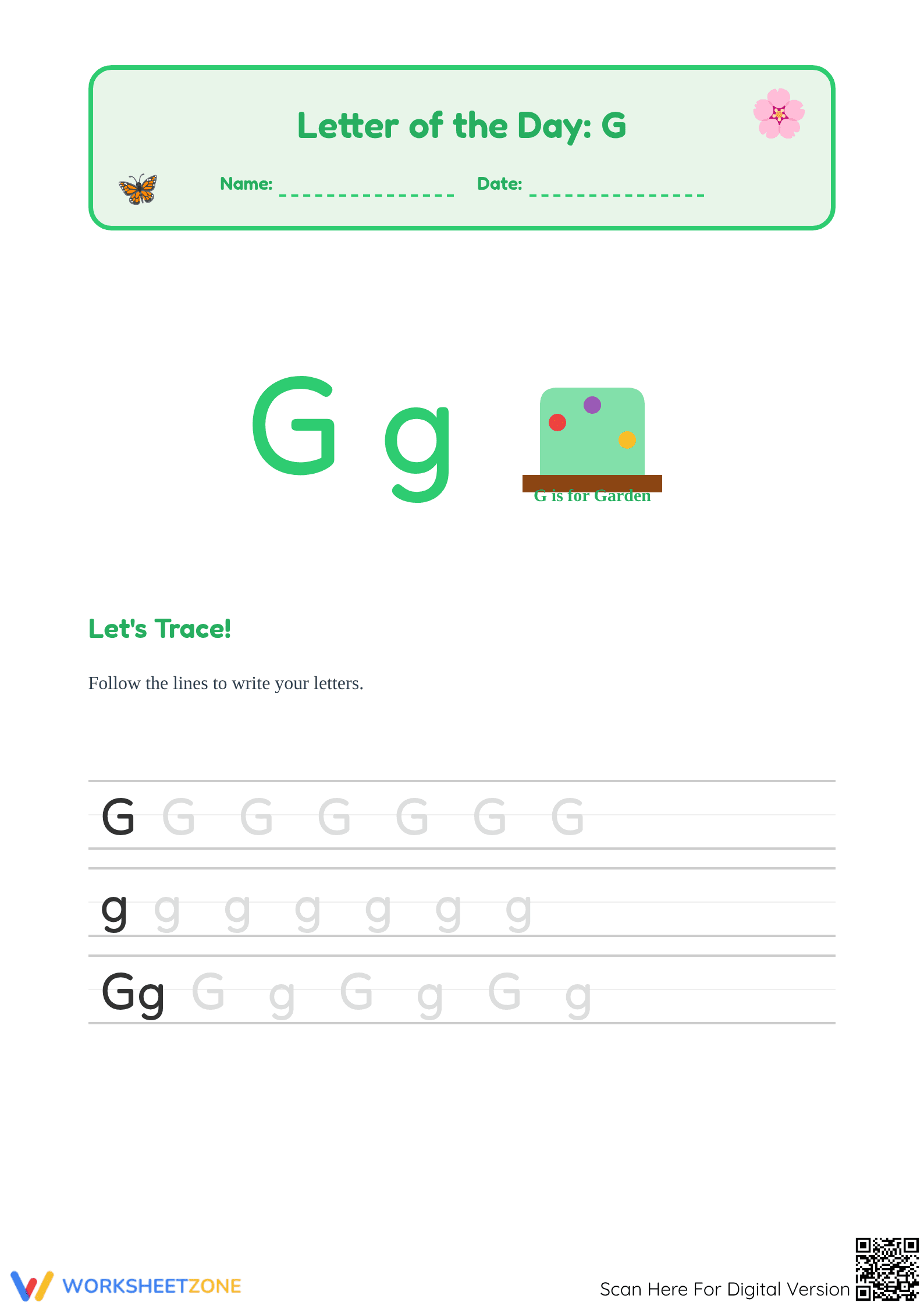
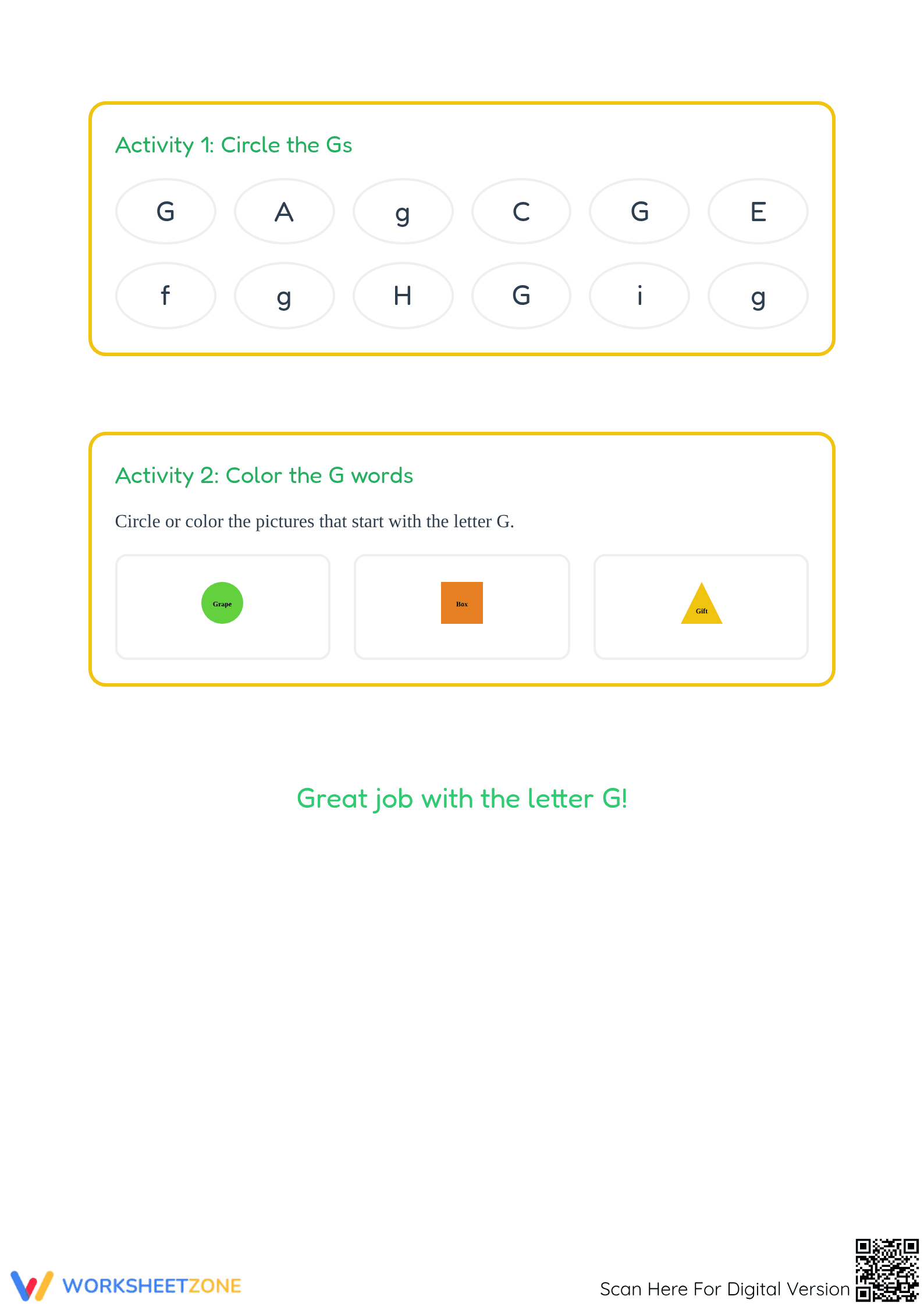
Inside this 2-page PDF, you will find a logical progression of activities designed for independent or guided practice. The first page features large-format tracing lines for both uppercase 'G' and lowercase 'g', utilizing dotted guides to support proper stroke order. The second page transitions to cognitive skills, featuring a letter-search grid and a beginning-sound identification task with clear, high-contrast illustrations to help students connect phonemes to graphemes.
The zero-prep workflow for this resource is designed to save teachers valuable planning time. First, print the 2-page document (30 seconds). Second, distribute the sheets to students during your phonics block (1 minute). Third, review the beginning sound pictures as a whole group to ensure vocabulary clarity (1 minute). This entire sequence requires less than 3 minutes of total teacher preparation, making it an ideal choice for emergency sub plans or daily bell-ringers.
This worksheet is strictly aligned to CCSS.ELA-LITERACY.RF.K.1.D, which requires students to recognize and name all upper- and lowercase letters. It also supports RF.K.3.A by introducing the primary sound associated with the letter. Both standard codes can be copied directly into lesson plans, IEP goals, or district curriculum mapping tools to ensure instructional compliance and tracking.
To maximize the impact of this worksheet, use it during the "You Do" phase of a gradual release lesson. After modeling the letter sound and formation on the board, assign the tracing page to build muscle memory. Use the second page as a formative assessment; as students circle the letters, walk around the room to identify students who may be confusing 'G' with 'C' or 'Q'. This provides immediate data for small-group intervention.
This resource is specifically tailored for Kindergarten students, though it serves as an excellent review for Grade 1 students or English Language Learners (ELLs) who need additional support with phonemic awareness. It pairs naturally with a "Letter of the Day" anchor chart or a classroom read-aloud focused on garden-themed vocabulary to reinforce the beginning sound in a broader context.
Research from Fisher & Frey (2014) emphasizes that the gradual release of responsibility is most effective when students have access to high-quality, scaffolded independent practice materials. This worksheet fulfills that requirement by providing clear visual cues and repetitive tracing tasks that build student confidence. By focusing on CCSS.ELA-LITERACY.RF.K.1.D, the resource targets the foundational skill of alphabet recognition, which is a primary predictor of later reading fluency. The inclusion of 18 distinct tasks across two pages ensures that students remain engaged while receiving enough repetition to move the letter G into long-term memory. Educational analysis suggests that consistent exposure to both uppercase and lowercase forms in the same session, as seen here, reduces letter-reversal errors in early writing. This printable serves as a reliable tool for establishing the phoneme-grapheme correspondence necessary for decoding more complex texts in later primary grades.


