


























Views
Downloads
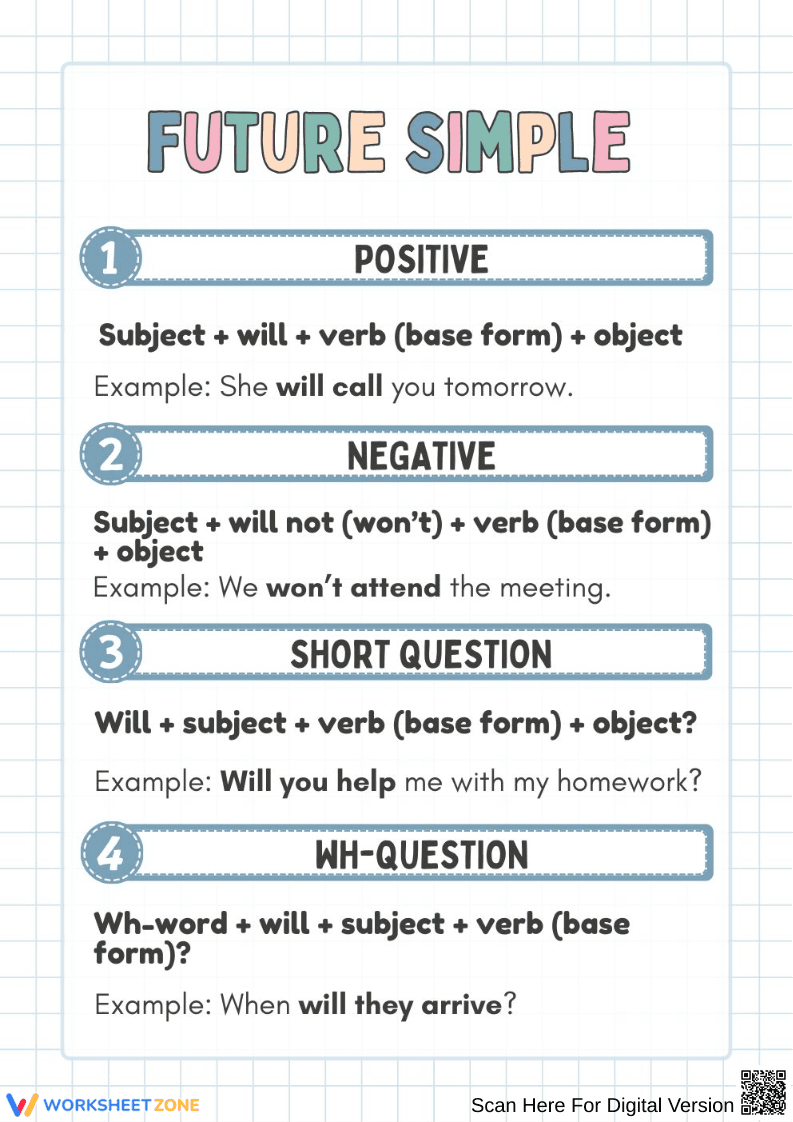

Future Simple Tense Printable Reference | Grade 3 Grammar
Paste this activity's link or code into your existing LMS (Google Classroom, Canvas, Teams, Schoology, Moodle, etc.).
Students can open and work on the activity right away, with no student login required.
You'll still be able to track student progress and results from your teacher account.
This future simple tense reference guide equips students to correctly form and use verbs indicating future actions. By providing clear formulas and concrete examples for positive, negative, and question structures, this resource eliminates guesswork and builds foundational grammar skills essential for effective writing and speaking.
At a Glance
- Grade: 3 · Subject: ELA
- Standard:
CCSS.ELA-LITERACY.L.3.1.E— Form and use simple verb tenses- Skill Focus: Future Simple Tense
- Format: 1 page · 4 sections · No answer key needed · PDF
- Best For: Anchor chart or student notebook
- Time: 5–10 minutes
This single-page reference sheet breaks down the future simple tense into four sections: positive statements, negative statements, short questions, and WH-questions. Each section provides the exact grammatical formula alongside a clear example sentence. The structured layout serves as a visual anchor chart, making it an ideal insert for student grammar notebooks or a quick reference guide.
This resource requires zero teacher preparation. Follow these three steps:
- Print (30 seconds): Generate enough copies for your class or print one large version for a classroom anchor chart.
- Distribute (1 minute): Hand out the reference sheets for students to glue into their interactive grammar notebooks.
- Review (3 minutes): Read through the four formulas together, highlighting the base verb form.
Total teacher prep time is under two minutes. Because it is completely self-explanatory, this guide is an excellent addition to any emergency sub plan.
This resource aligns directly to CCSS.ELA-LITERACY.L.3.1.E: Form and use the simple (e.g., I walked; I walk; I will walk) verb tenses. It specifically targets the future tense component, ensuring students understand how to construct sentences about upcoming events. A supporting standard includes CCSS.ELA-LITERACY.L.3.3, applying knowledge of language to understand how language functions in different contexts. Both standard codes can be copied directly into lesson plans, IEP goals, or district curriculum mapping tools.
Introduce this reference sheet before direct instruction on future tense verbs to give students a visual roadmap of the lesson. Alternatively, use it during independent writing time as a self-correction tool when students draft narratives about future events. For a quick formative assessment, observe whether students independently check the chart when unsure about forming a negative future statement or a WH-question. Expected review time is 5 to 10 minutes.
This guide is designed for third-grade students mastering basic verb tenses, but it serves as an excellent review tool for upper elementary learners. English Language Learners (ELLs) will particularly benefit from the explicit formulas and clear examples that demystify English sentence structure. Pair this reference sheet with a targeted verb practice worksheet or a short writing prompt about weekend plans to immediately apply the concepts.
Mastering verb tenses is a critical component of early language acquisition and writing proficiency. According to a comprehensive EdReports 2024 analysis of foundational literacy curricula, explicit grammar instruction that utilizes clear visual models significantly improves student retention of syntactic structures. This reference guide directly supports CCSS.ELA-LITERACY.L.3.1.E by helping students form and use simple verb tenses accurately. When learners can visualize the formula for future simple tense—including positive, negative, and interrogative forms—they reduce cognitive load during the drafting phase of writing. Providing a dedicated anchor chart allows students to independently verify their grammar, fostering self-regulation and confidence. By isolating the specific mechanics of future actions, educators can ensure that foundational language skills are firmly established, paving the way for more complex narrative and expository writing tasks in subsequent grade levels.


