


























Views
Downloads

Printable Addition Word Problems | Grade 1 Math
Paste this activity's link or code into your existing LMS (Google Classroom, Canvas, Teams, Schoology, Moodle, etc.).
Students can open and work on the activity right away, with no student login required.
You'll still be able to track student progress and results from your teacher account.
This engaging Grade 1 math worksheet helps students master addition word problems by providing clear, structured scenarios. By reading short, summer-themed stories, learners will practice extracting key numbers and writing addition equations to find the total, building essential foundational math and reading comprehension skills simultaneously.
At a Glance
- Grade: 1 · Subject: Math
- Standard:
CCSS.MATH.CONTENT.1.OA.A.2— Solve word problems adding three whole numbers- Skill Focus: Addition Word Problems
- Format: 2 pages · 4 problems · Answer key included · PDF
- Best For: Independent practice
- Time: 10–15 minutes
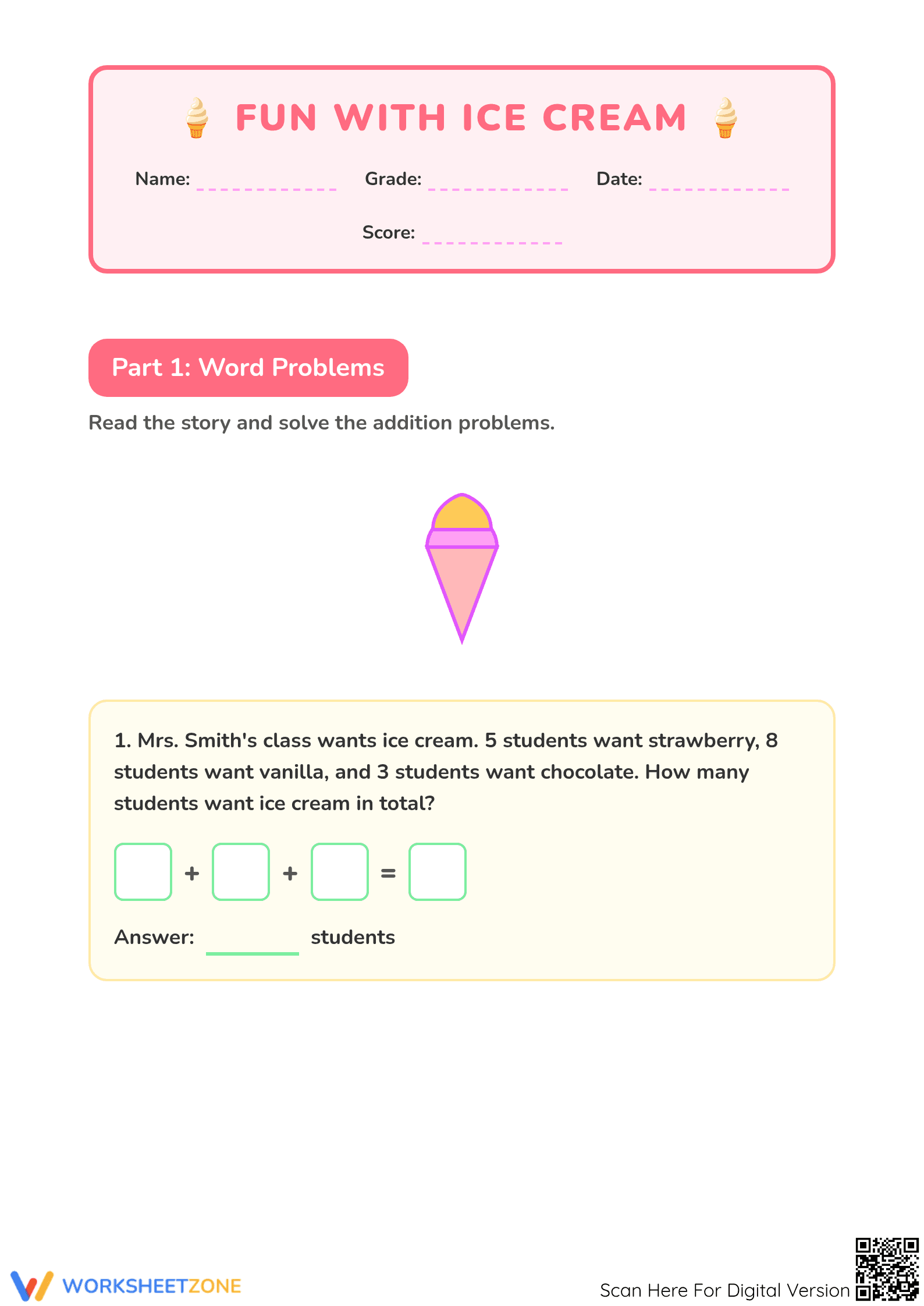
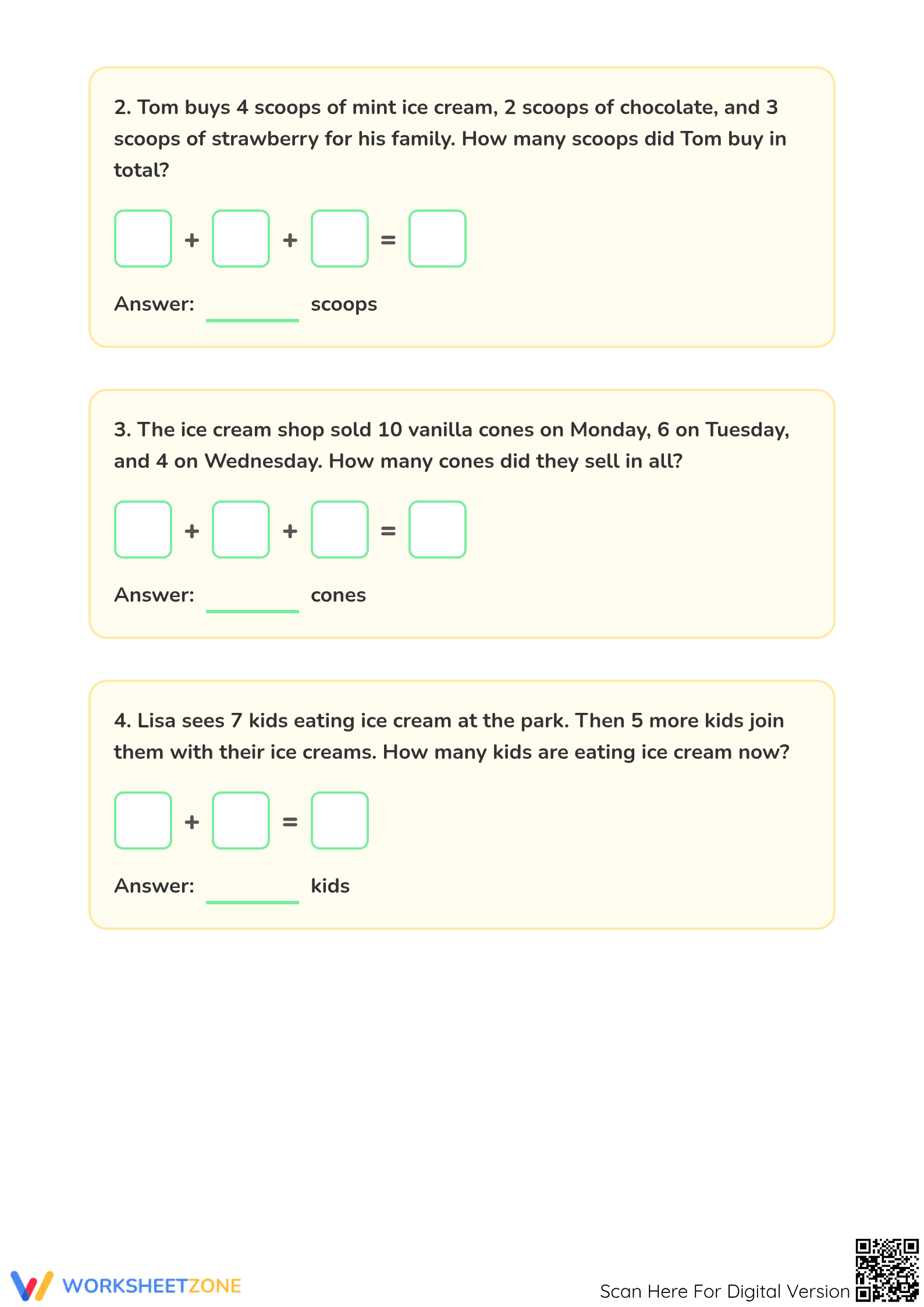
Inside this printable resource, educators will find two pages featuring four distinct word problems centered around a fun ice cream theme. Each problem includes a short reading prompt, designated boxes to write out the addition equation (accommodating both two-addend and three-addend problems), and a final answer line with the appropriate unit label. A complete answer key is also provided to make grading quick and accurate.
- Guided practice: The first problem introduces adding three numbers with a highly relatable scenario, allowing teachers to model how to place each number into the provided equation boxes.
- Supported practice: Subsequent problems continue the visual scaffolding, ensuring students remember to include all addends before calculating the sum.
- Independent practice: The final problem shifts to a two-addend scenario, challenging students to adapt their equation structure independently.
This layout perfectly supports a gradual-release, I Do, We Do, You Do instructional model.
This worksheet is aligned to CCSS.MATH.CONTENT.1.OA.A.2, which requires students to solve word problems that call for addition of three whole numbers whose sum is less than or equal to 20. It also supports basic addition within 20. Both standard codes can be copied directly into lesson plans, IEP goals, or district curriculum mapping tools.
Teachers can deploy this worksheet during core math instruction after a mini-lesson on identifying key information in word problems. It works beautifully as a quiet, independent center activity or as a targeted homework assignment. As a formative assessment tip, observe whether students are correctly mapping the numbers from the text into the equation boxes, which indicates their reading comprehension is successfully translating into mathematical setup. Expect students to complete the 4 tasks in about 10 to 15 minutes.
This resource is ideal for first-grade students who are transitioning from basic equations to reading-based math tasks. The visual equation boxes provide excellent scaffolding for learners who struggle with organizing their work or remembering to include all three addends. It pairs wonderfully with physical manipulatives, like counting blocks or counters, allowing students to physically build the ice cream scoops before writing the numbers.
Developing proficiency in solving word problems is a critical milestone in early mathematics. According to the RAND AIRS 2024 report, integrating reading comprehension with mathematical reasoning significantly improves long-term problem-solving capabilities and overall test scores in elementary students. This worksheet directly targets CCSS.MATH.CONTENT.1.OA.A.2, helping students solve word problems adding three whole numbers by providing structured equation boxes that reduce cognitive load. By visually separating the extraction of data from the calculation process, young learners can focus on understanding the mathematical relationships within the text. Consistent practice with these scaffolded formats ensures students build the necessary confidence to tackle more complex, multi-step word problems as they advance through primary grades, bridging the gap between literacy and numeracy. Providing targeted practice on these specific skills is essential for foundational math mastery and long-term academic success in STEM subjects.


