




























Views
Downloads

Printable Dot Tracing Worksheet | Kindergarten Ready

Paste this activity's link or code into your existing LMS (Google Classroom, Canvas, Teams, Schoology, Moodle, etc.).
Students can open and work on the activity right away, with no student login required.
You'll still be able to track student progress and results from your teacher account.
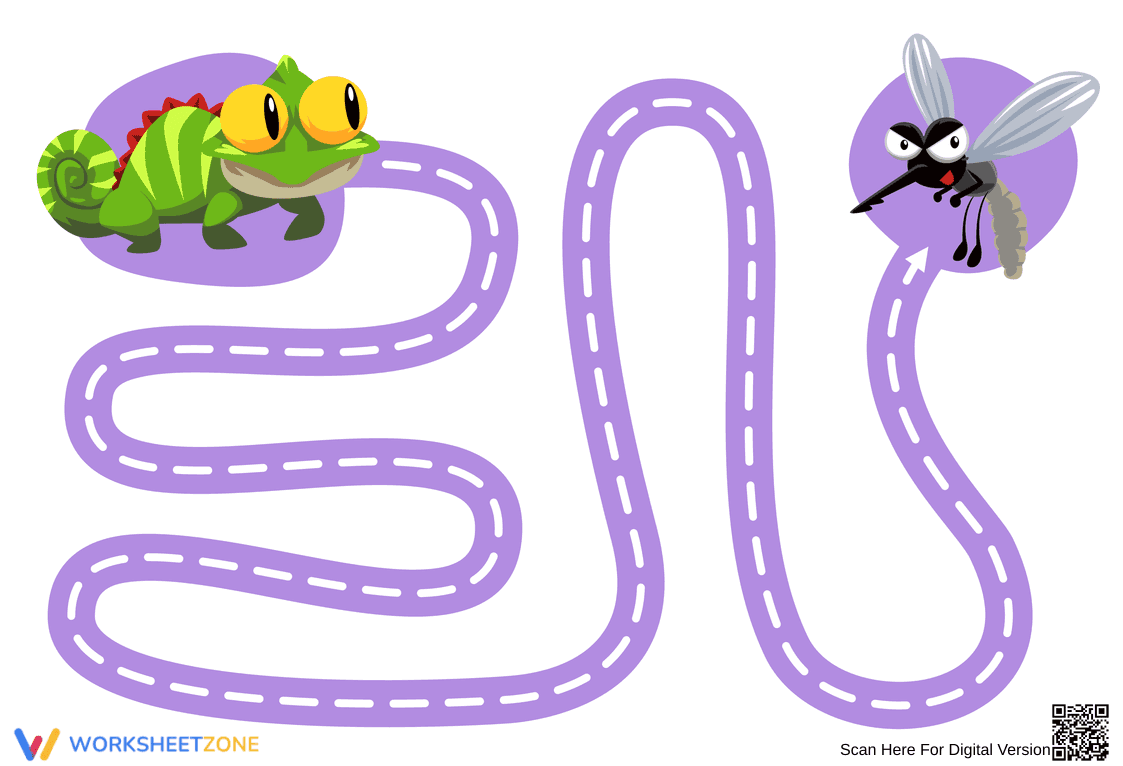
This Kindergarten pre-writing worksheet helps early learners develop the fine motor control necessary for successful handwriting. By tracing a complex path from an iguana to a mosquito, students practice steady hand movements and spatial awareness. This activity provides a playful foundation for letter formation and pencil grip mastery.
At a Glance
- Grade: Kindergarten · Subject: Handwriting
- Standard:
CCSS.ELA-LITERACY.L.K.1.A— Print many upper- and lowercase letters through fine motor control- Skill Focus: Pre-writing path tracing
- Format: 1 page · 1 task · Answer key included · PDF
- Best For: Morning work or fine motor centers
- Time: 5–10 minutes
Inside this resource, you will find a single-page, high-contrast tracing activity. The worksheet features a winding, dashed-line path that connects two vibrant animal illustrations. The wide path is designed specifically for small hands, allowing for varying levels of precision as students move their writing tools from start to finish.
The zero-prep workflow is designed for busy educators. First, print the single-page PDF in under 30 seconds. Second, distribute the sheets to students during center rotations or as a quiet transition activity. Finally, review the completed paths in seconds to check for grip and control. Total teacher preparation time is less than 1 minute.
This activity aligns with `CCSS.ELA-LITERACY.L.K.1.A`, which focuses on the physical mechanics of writing. While it does not feature letters, the curved and straight line segments mirror the strokes required for alphabet formation. Both standard codes can be copied directly into lesson plans, IEP goals, or district curriculum mapping tools.
Use this worksheet during the first 10 minutes of the school day as a warmup to settle the class. It also serves as an excellent formative assessment tool; observe if students are using a tripod grip or if they struggle with the sharp turns in the path. Completion typically takes 5 to 8 minutes.
This resource is ideal for Preschool and Kindergarten students, as well as older students requiring occupational therapy support. It pairs naturally with a Letter I or Letter M phonics lesson or a science unit on animals. It is a perfect addition to any fine motor task box.
Research from Fisher & Frey (2014) emphasizes the importance of scaffolded fine motor practice in the early years to prevent future writing fatigue. This worksheet addresses CCSS.ELA-LITERACY.L.K.1.A by providing a low-stakes environment for students to refine their pencil control. Developing these muscles is a prerequisite for the cognitive demands of composition. According to NAEP data, students who master basic penmanship early are more likely to succeed in complex writing tasks in later grades. This 1-page resource offers a targeted way to build that essential muscle memory through engaging, visual stimuli. By focusing on the Iguana to Mosquito path, learners engage in 1 continuous movement task that mimics the fluid motions needed for cursive and print. It is a practical, evidence-based tool for any early childhood classroom. This specific activity ensures that students are prepared for the rigors of formal handwriting instruction in subsequent units.


