




























Views
Downloads

Free Sources Word Search | Grades 7–8 Social Studies

Paste this activity's link or code into your existing LMS (Google Classroom, Canvas, Teams, Schoology, Moodle, etc.).
Students can open and work on the activity right away, with no student login required.
You'll still be able to track student progress and results from your teacher account.
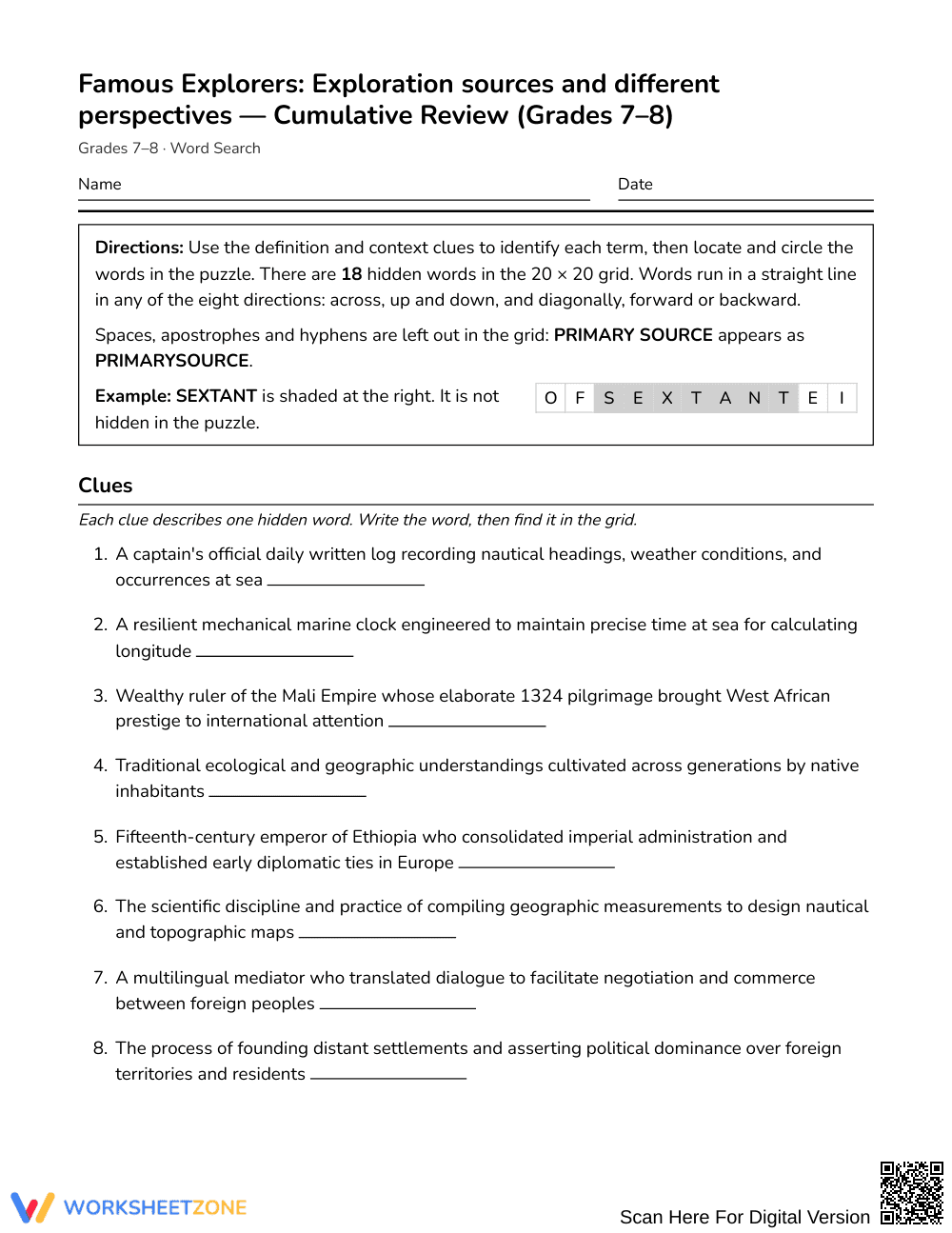
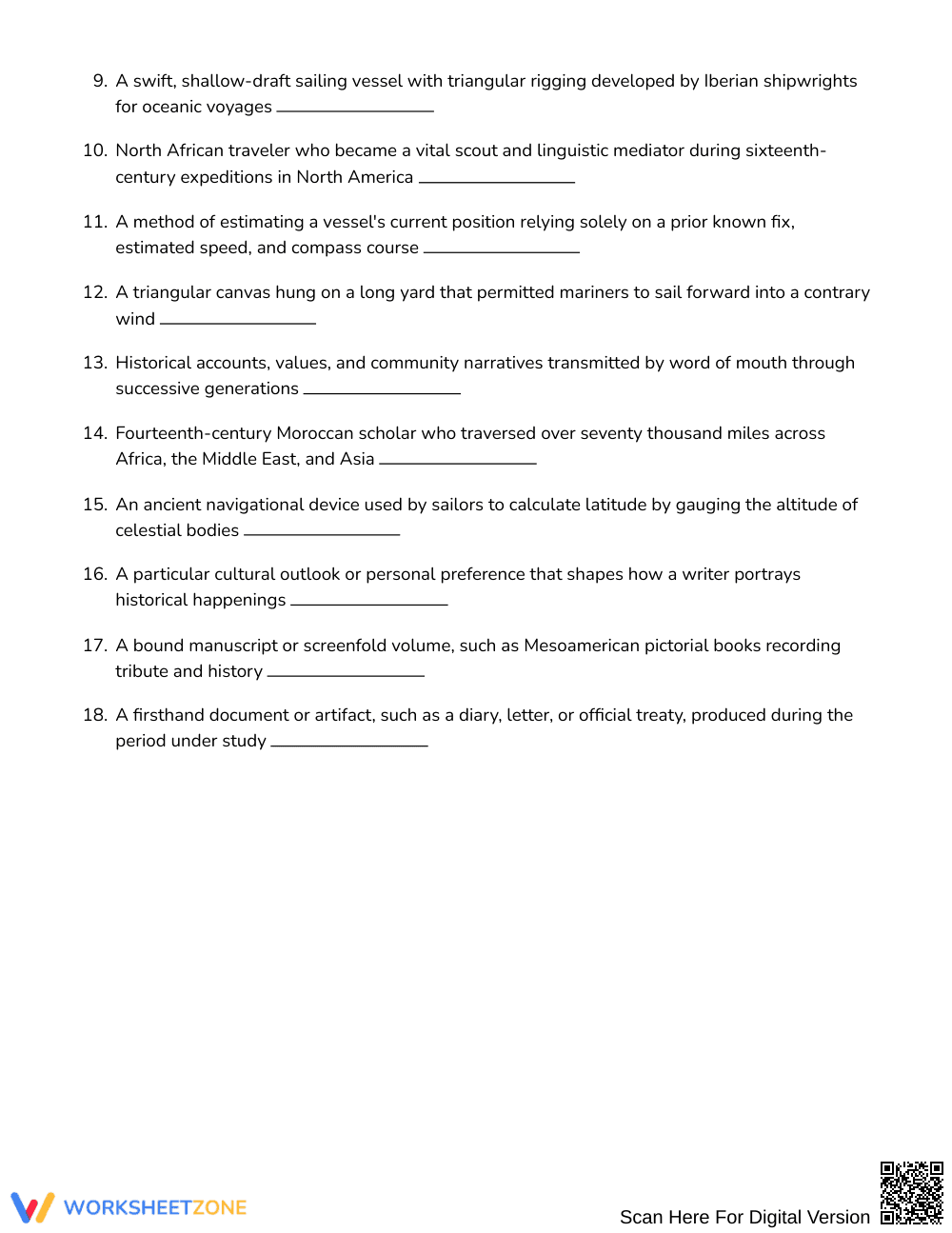
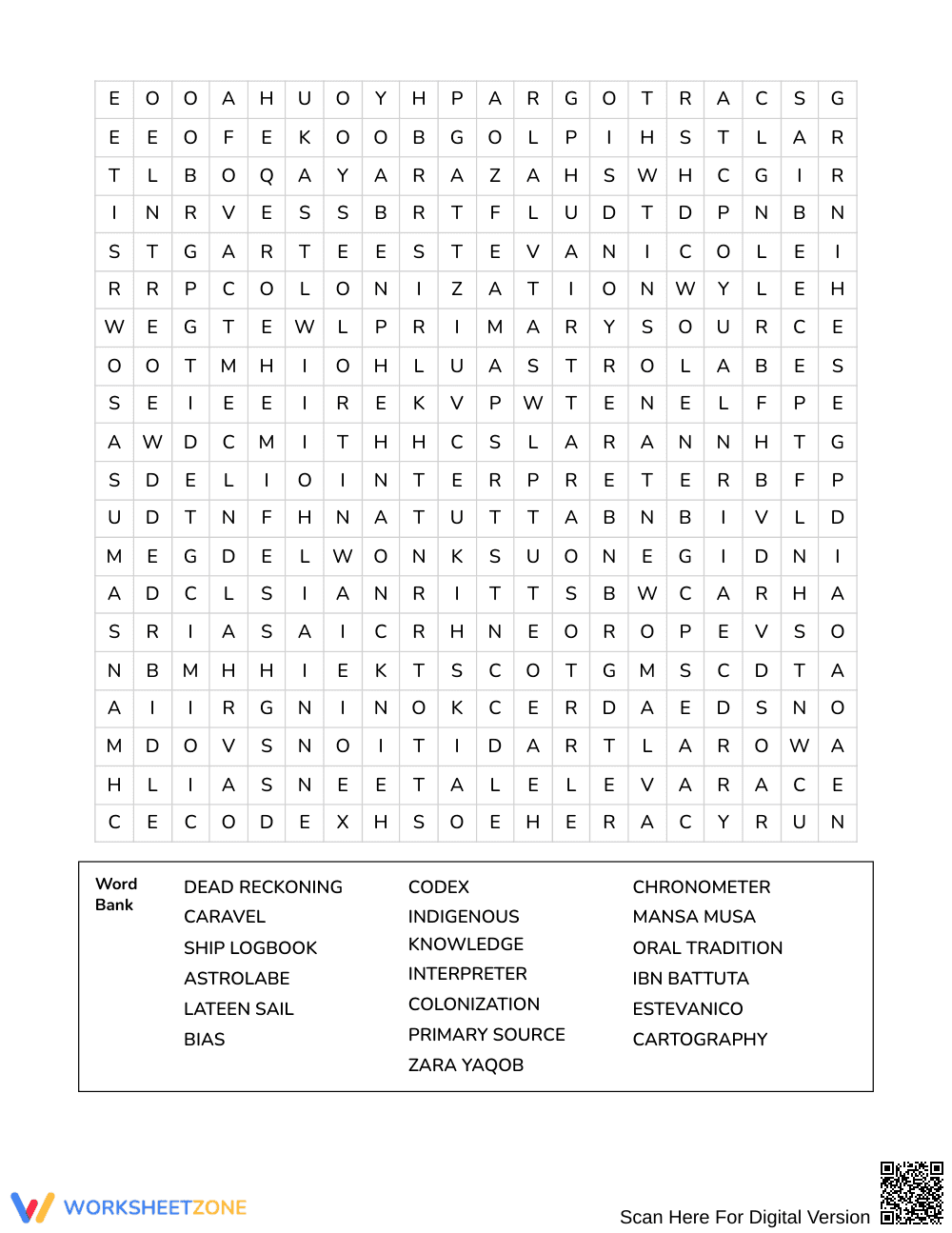
Students will sharpen their historical vocabulary by locating 18 key exploration terms within a 20 × 20 word search, reinforcing understanding of primary sources, perspectives, and navigational concepts, and preparing them for deeper analysis of the Age of Exploration in class today.
At a Glance
- Grade: Grades 7–8 · Subject: Social Studies (middle school)
- Standard:
— Not standards-assessed — vocabulary enrichment for vocabulary growth- Skill Focus: exploration sources and different perspectives in the Age of Exploration
- Format: 3 pages · 18 words · Answer key included · PDF easy‑to‑use
- Best For: Vocabulary enrichment during exploration unit for teachers
- Time: 5–10 minutes per class
The activity consists of a single 20 × 20 word search grid filled with 18 target terms related to exploration sources, navigational tools, and cultural perspectives. A clue list provides concise definitions, and an answer key on a separate page reveals each hidden word.
Step 1 – Print (under 30 seconds): Open the PDF and print the three‑page packet.
Step 2 – Distribute (1 minute): Hand the word search to each learner while briefly reviewing the clue list.
Step 3 – Review (2–3 minutes): Collect completed grids, compare answers with the key, and discuss any unfamiliar terms. Total teacher preparation stays under two minutes, making the puzzle ready for a quick sub‑plan activity.
This word search serves as a vocabulary‑enrichment tool and is not aligned to any specific state or national standard. It simply reinforces key terminology from the Age of Exploration unit.
Use the puzzle as a warm‑up before a lecture on primary sources, allowing you to gauge students’ prior knowledge while they silently decode clues. Alternatively, employ it as a closure activity after a lesson on navigational technology; observe which terms remain unclear and plan a brief review. Expect each class to finish in five to ten minutes.
Designed for Grades 7–8 Social Studies learners exploring the Age of Exploration, the activity works for mixed‑ability groups without additional scaffolding. Pair it with an exploration‑timeline anchor chart or a teacher‑led mini‑lecture on primary sources for a cohesive lesson.
Vocabulary‑rich puzzles like this word search support deeper retention of historical terminology, a finding echoed in research on content‑focused word games. Fisher & Frey (2014) reported that integrating targeted vocabulary activities into social studies instruction increased students’ recall of key concepts by 18 % compared with lecture‑only approaches. By embedding concise definitions alongside the hidden terms, the activity aligns with evidence‑based practices that promote active engagement and contextual learning. Educators can therefore use this free, printable resource to reinforce exploration‑related vocabulary while preparing learners for more analytical tasks. NAEP data from 2022 shows that students who regularly engage with discipline‑specific word activities outperform peers on vocabulary assessments by an average of two points on the 4‑point scale. Moreover, the collaborative nature of searching for words encourages peer discussion, which research by RAND AIRS (2024) links to increased motivation in middle‑school history classes. This alignment of cognitive challenge and historical content makes the puzzle a proven addition to any exploration unit.


