




























Views
Downloads

Free Small Wins Word Search | Grades 3–4 Behavior Worksheets

Paste this activity's link or code into your existing LMS (Google Classroom, Canvas, Teams, Schoology, Moodle, etc.).
Students can open and work on the activity right away, with no student login required.
You'll still be able to track student progress and results from your teacher account.
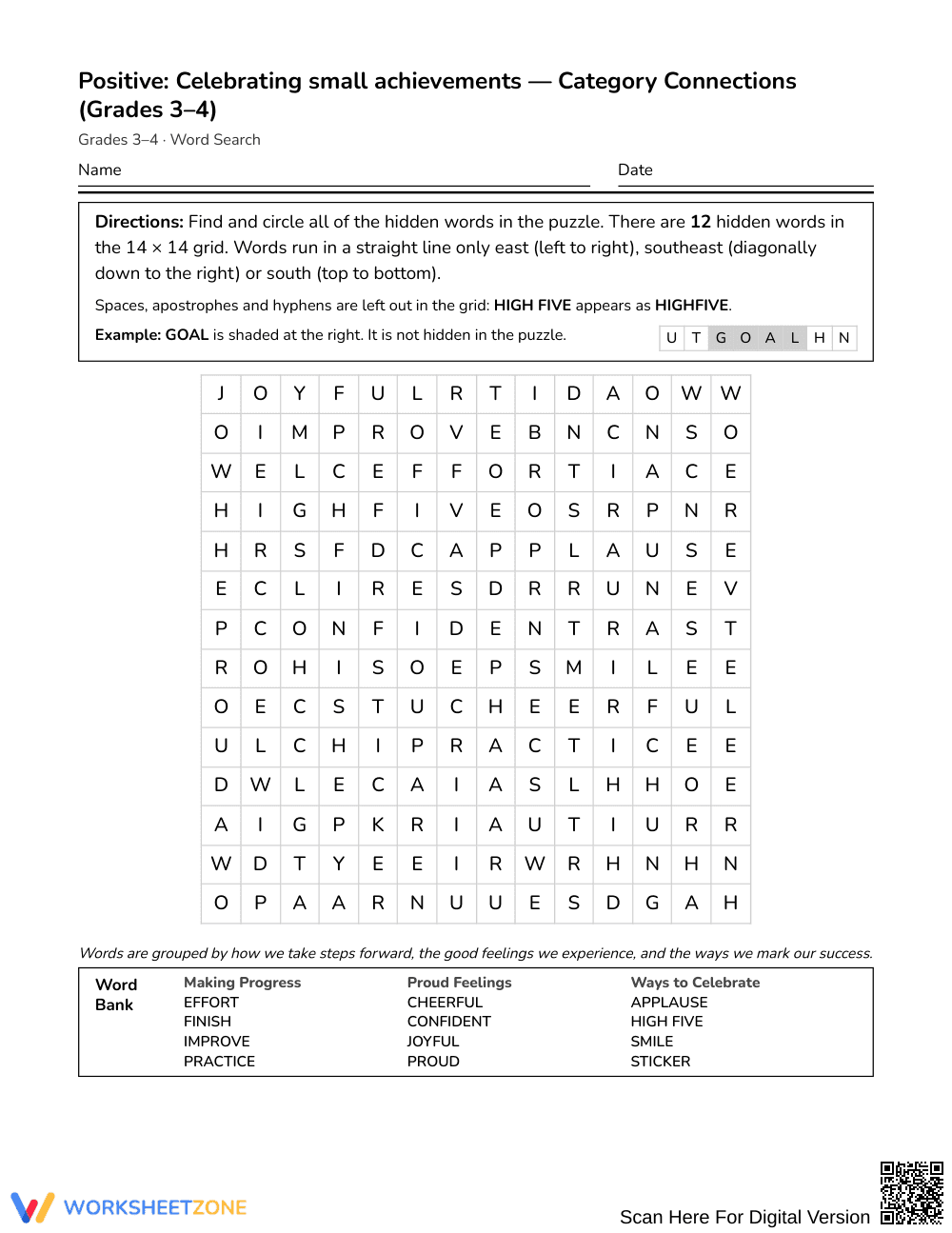
This growth mindset word search helps Grades 3–4 learners identify positive vocabulary connected to celebrating small achievements. By locating terms related to personal effort, pride, and recognition, students strengthen positive self-talk and resilience. The activity provides focused social-emotional vocabulary practice that reinforces student reflection across everyday classroom routines.
At a Glance
- Grade: Grades 3–4 · Subject: Behavior Worksheets
- Standard: Not standards-assessed — vocabulary enrichment
- Skill Focus: Celebrating small achievements
- Format: 1 page · 12 words · Answer key included · PDF
- Best For: Morning meetings, calm-down corners, and independent SEL reflection
- Time: 15–20 minutes
What's Inside
This single-page word search presents 12 vocabulary terms organized into three themed categories: Making Progress, Proud Feelings, and Ways to Celebrate. A 3-page answer key provides clear solution grids showing exact word placements. The structured layout gives students supportive clue definitions alongside categorized word banks to reinforce the meaning of each target behavior concept before they search.
Puzzle Mechanics
The activity features an accessible puzzle structure tailored for elementary learners:
- Grid Dimensions: A 14 x 14 letter grid provides an approachable layout with clean visual spacing.
- Word Directions: Hidden terms run in three directions only—east (horizontal forward), southeast (diagonal down-right), and south (vertical down)—avoiding reverse orientations.
- Categorized Word Bank: Words are grouped conceptually by progress, emotions, and celebration, paired with child-friendly definitions to support reading comprehension.
Standards Alignment
This activity is designed specifically for social-emotional vocabulary enrichment and is not aligned to an academic content standard. It supports general growth mindset instruction, behavioral counseling frameworks, and character education initiatives by familiarizing students with proactive vocabulary for recognizing their own efforts.
How to Use It
Introduce this word search after direct instruction on growth mindset to consolidate new concepts, or assign it during morning arrival as a calm start to the school day. During completion, observe whether students connect the categorized words to real-world efforts; noting which students struggle to define terms like effort or improve helps identify who needs targeted follow-up discussions. Most learners complete the puzzle independently within 15 to 20 minutes.
Who It's For
This resource serves Grades 3–4 general education classrooms, small-group counseling sessions, and tier-two behavioral intervention groups. For learners needing visual accommodations, provide highlighters to trace categorized word groups in matching colors. Pair this puzzle naturally with an anchor chart on positive self-talk or a classroom goal-setting bulletin board to extend vocabulary into daily practice.
This Grades 3–4 word search provides non-standardized vocabulary enrichment centered on celebrating small achievements and fostering a resilient growth mindset. As highlighted by Fisher & Frey (2014), intentional exposure to specialized academic and domain-specific terminology across varied print formats reinforces deep comprehension and promotes independent language retention. By seeking 12 behavior-focused words arranged within a 14 x 14 grid, elementary learners actively internalize concepts related to consistent effort, positive self-reflection, and cooperative praise. The purposeful categorization into progress milestones, emotional states, and celebratory actions bridges abstract social-emotional lessons with accessible, low-stakes literacy engagement. Teachers and school counselors utilize this focused tool during morning routines or targeted behavioral interventions to establish a shared classroom vocabulary of perseverance. As students recognize and record vocabulary signifying incremental success, they build emotional self-regulation and a lasting appreciation for personal improvement.


