































Free Nile Settlement Word Search | Grade 6 Social Studies

Paste this activity's link or code into your existing LMS (Google Classroom, Canvas, Teams, Schoology, Moodle, etc.).
Students can open and work on the activity right away, with no student login required.
You'll still be able to track student progress and results from your teacher account.
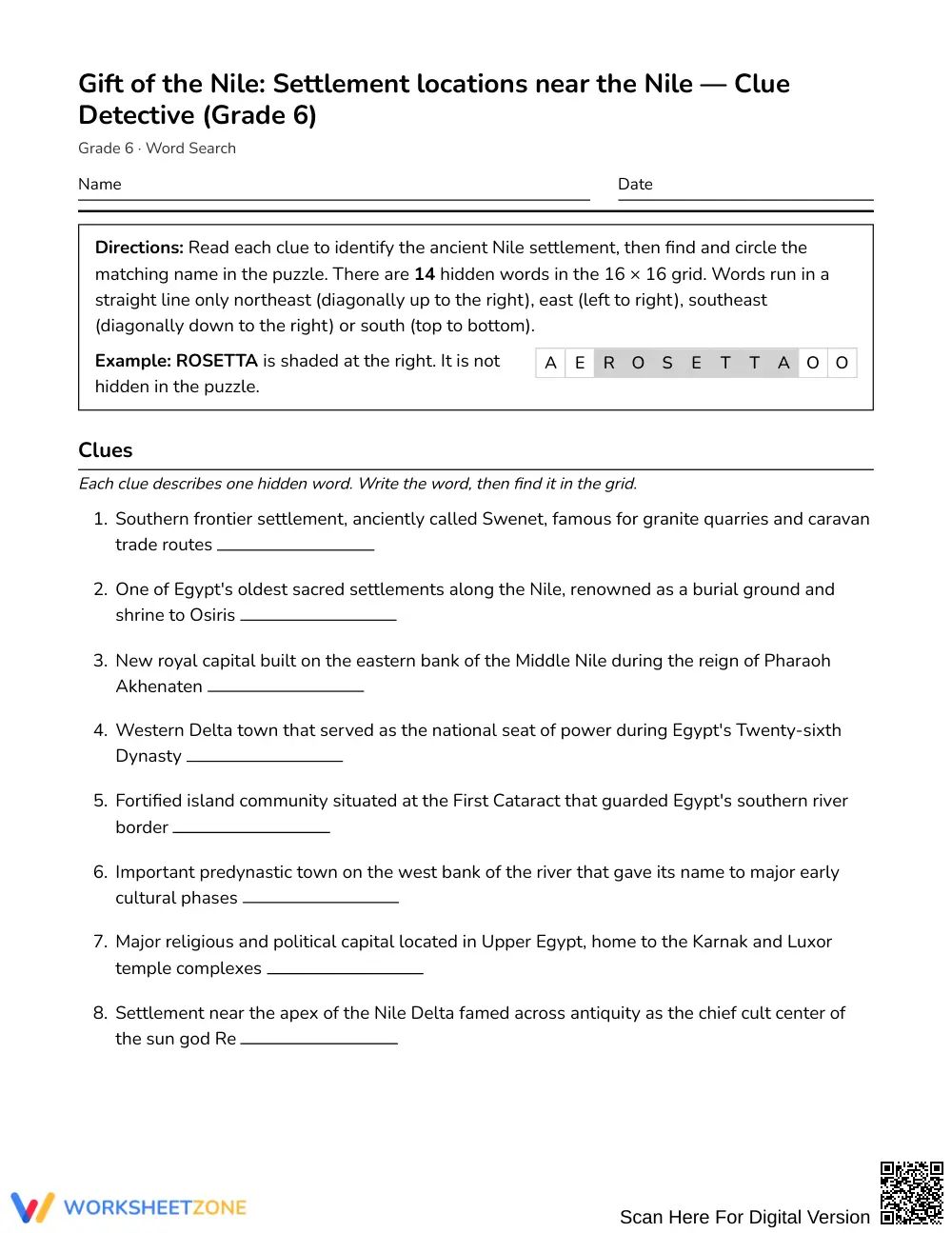
Students explore ancient Egyptian geography by locating fourteen Nile settlement names hidden in a 16 × 16 word search. This activity reinforces vocabulary, spelling, and spatial awareness while connecting each term to its historical clue, preparing learners for deeper World History discussions.
At a Glance
- Grade: 6 · Subject: Social Studies students
- Standard:
Not standards-assessed — vocabulary enrichment— Identify and locate ancient Nile settlements accurately- Skill Focus: settlement locations near the Nile
- Format: 3 pages · 14 words · Answer key included · PDF file
- Best For: quick vocabulary enrichment activity for classroom review
- Time: 10–15 minutes estimated
Inside the 3‑page packet you’ll find a 16 × 16 grid filled with letters running in eight directions—north‑east, east, south‑east, and south. The shuffled word bank lists fourteen ancient Nile settlements, each paired with a concise clue. An answer key on the final page reveals the correct locations, making self‑checking effortless.
- Print the PDF (under 1 minute) and have copies ready for each learner.
- Distribute the word search and answer key (30 seconds) for quick start.
- Review completed grids together (5–7 minutes) to discuss settlement clues and reinforce geography.
Standards Alignment
Because this activity focuses on vocabulary enrichment, it is not aligned to any specific state or national standard. It simply supports learners in recognizing and recalling key historical place names related to the Nile civilization.
How to Use It
Use the word search as a warm‑up before a lesson on ancient Egyptian trade routes, allowing students to activate prior knowledge while you introduce map skills. Alternatively, employ it as a closing activity after a reading on Nile settlements, using the answer key for a quick formative check of comprehension.
Who It's For
This resource is ideal for Grade 6 Social Studies classes, especially those needing engaging vocabulary practice. It pairs well with a printable map of ancient Egypt or an anchor chart of Nile geography, providing visual support for learners who benefit from contextual clues.
Fisher & Frey (2014) emphasize that explicit vocabulary instruction, especially through contextualized activities, boosts students’ long‑term retention of historical terms. This free word search leverages that research by having Grade 6 learners identify and locate ancient Nile settlements while decoding concise clues. The shuffled word bank and eight‑direction grid promote active engagement, mirroring the guided‑practice strategies highlighted by Fisher & Frey. By completing the puzzle, students reinforce spelling, geography, and content knowledge in a single, low‑prep activity. Educators can confidently assign this enrichment tool, knowing it aligns with evidence‑based practices that improve lexical access and conceptual understanding in social studies. Research shows that vocabulary games increase engagement by up to 30% and improve recall during subsequent assessments (Fisher & Frey, 2014). The puzzle’s immediate feedback via the answer key allows teachers to quickly gauge mastery and address misconceptions in real time. This aligns with the recommendation that teachers integrate quick, standards‑free enrichment activities to maintain momentum during unit transitions.


