




























Views
Downloads


Free Mountain Explorers Word Search | Grade 6 Social Studies

Paste this activity's link or code into your existing LMS (Google Classroom, Canvas, Teams, Schoology, Moodle, etc.).
Students can open and work on the activity right away, with no student login required.
You'll still be able to track student progress and results from your teacher account.
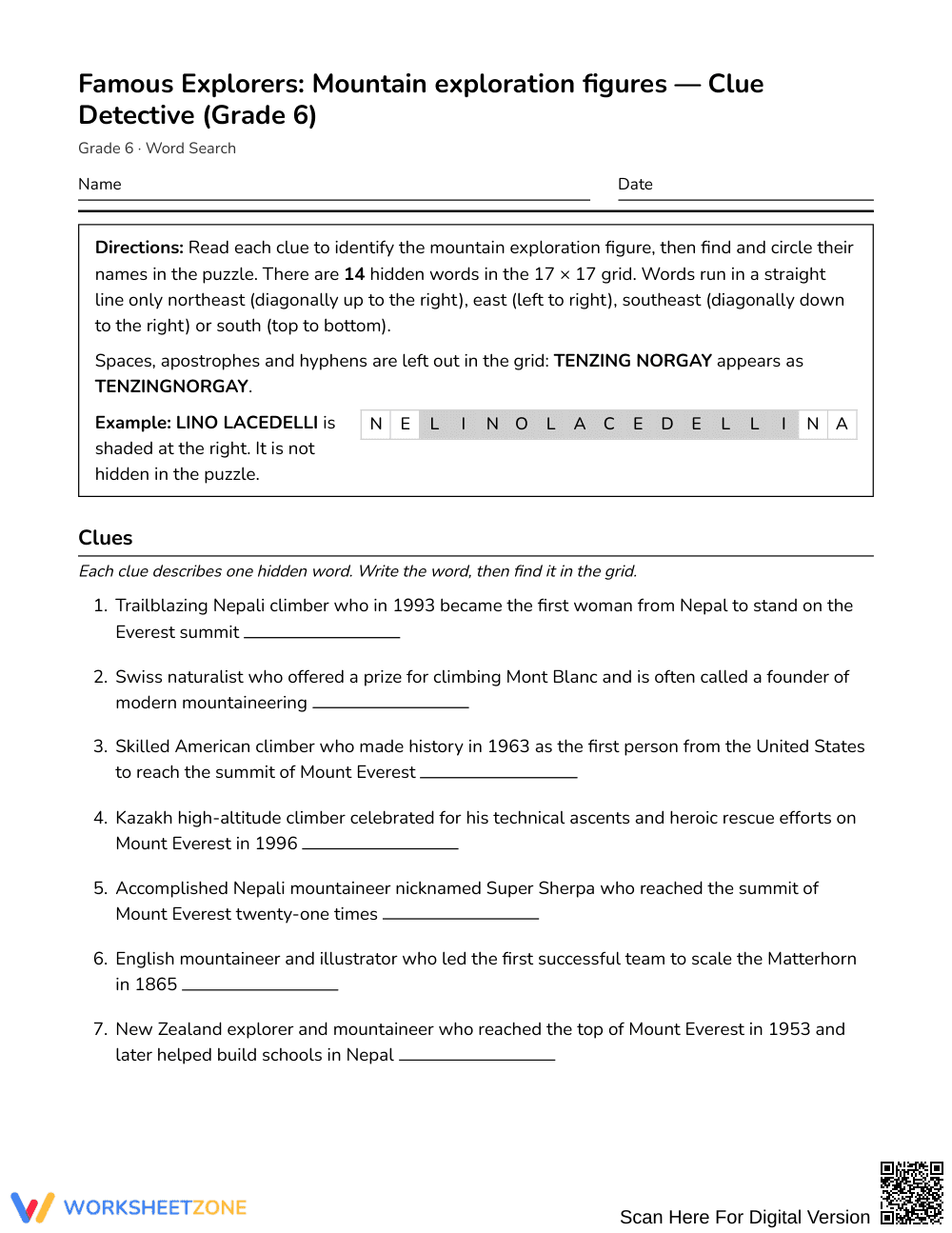
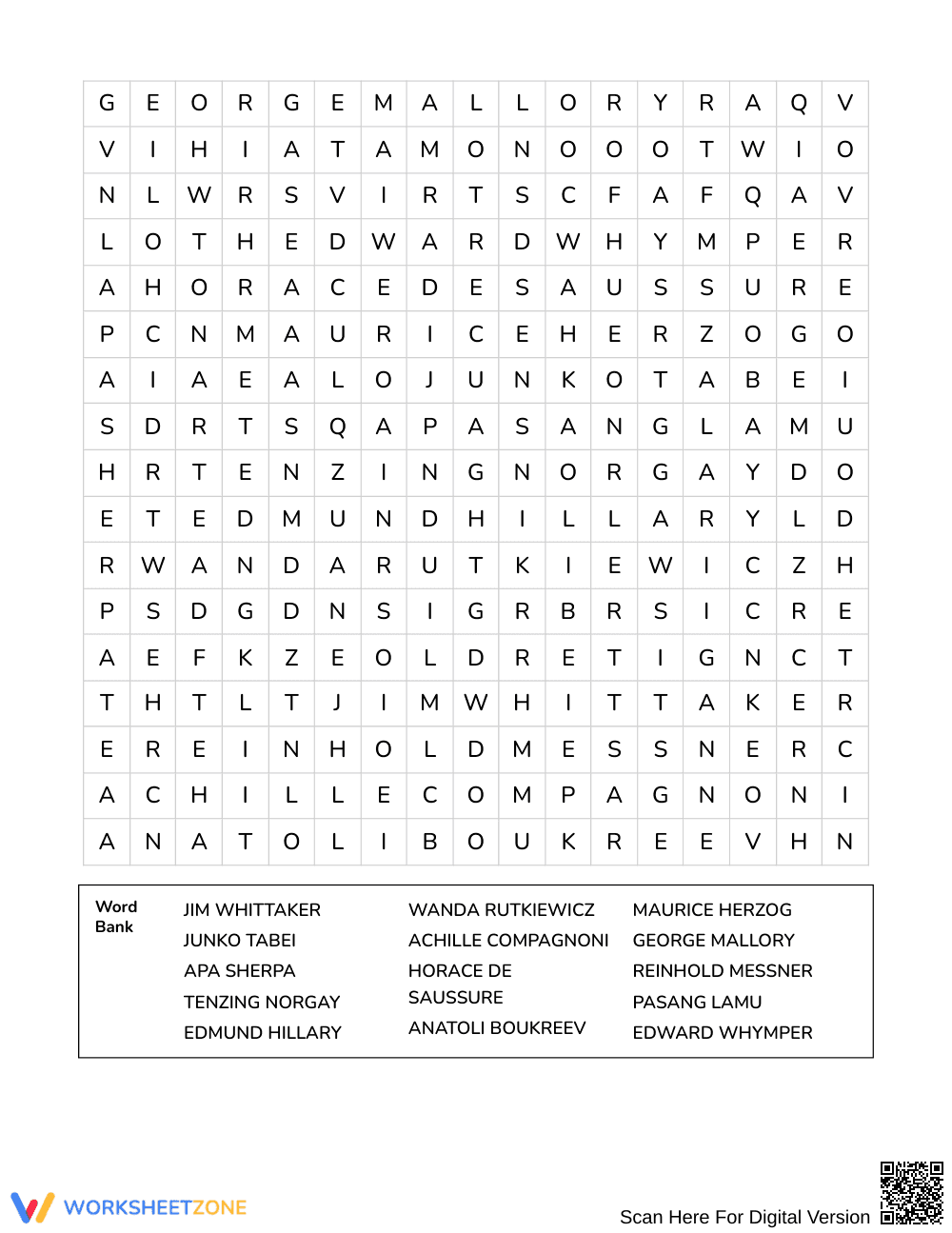
This Grade 6 Social Studies word search reinforces key world history vocabulary by challenging students to identify 14 famous mountain exploration figures. Learners read biographical clues to identify pioneering mountaineers before locating each name hidden in the puzzle grid, supporting historical recognition and reading comprehension through engaging content practice.
At a Glance
- Grade: Grade 6 · Subject: Social Studies
- Standard: Not standards-assessed — vocabulary enrichment
- Skill Focus: Mountain exploration figures
- Format: 3 pages · 14 words · Answer key included · PDF
- Best For: World history vocabulary review
- Time: 20–30 minutes
What's Inside
This 3-page printable activity features a full-page clue-based puzzle alongside a comprehensive 3-page solution key. Students engage with 14 descriptive biographical clues detailing milestone expeditions across Everest, K2, Annapurna, the Matterhorn, and Mont Blanc. Rather than relying on a simple word list, learners deduce names such as Tenzing Norgay, Edmund Hillary, and Junko Tabei before scanning the grid.
Puzzle Mechanics and Structure
The activity is built on a 17 × 17 letter grid containing 14 hidden names placed across four distinct orientations: northeast, east, southeast, and south. Words appear in forward and diagonal arrangements without backward spelling, offering accessible scanning for middle school learners. Students read each historical clue, match it to the shuffled word bank, and locate the climber's full name within the puzzle.
Standards Alignment
This resource serves as supplemental vocabulary enrichment and is not aligned to an assessed state standard. It enhances World History and geography instruction by introducing historical mountaineers and high-altitude exploration milestones from the nineteenth and twentieth centuries. Teachers can integrate this activity to build thematic background knowledge during units on global exploration, physical geography, or world cultures.
How to Use It
Deploy this word search during direct instruction as an engaging mid-unit check, or after a lesson on global geography to consolidate historical figures. For a quick formative check, observe whether students identify climbers directly from clue details or depend on peer confirmation. Most Grade 6 learners will complete the clue analysis and word search within 20 to 30 minutes.
Who It's For
This activity is designed for Grade 6 Social Studies students learning about world geography and modern exploration. It offers approachable differentiation for varied reading levels through contextual clues and structured word searches. Pair this puzzle with an introductory text on Himalayan geography or an anchor chart highlighting notable twentieth-century global expeditions.
Content-area vocabulary acquisition relies on structured exposure to specialized terms and figures, particularly in middle school social studies. According to Fisher & Frey (2014), intentional word exposure embedded within clue-based tasks and contextual practice strengthens long-term concept retention and informational reading comprehension. This Grade 6 Social Studies word search reinforces student knowledge of 14 pioneering mountain exploration figures through active clue deduction. By linking biographical descriptions of iconic mountaineers like Edmund Hillary and Junko Tabei with spatial puzzle-solving, the activity encourages active retrieval rather than passive memorization. Research demonstrates that multi-step retrieval practices enhance biographical recall and geographic spatial awareness across diverse learner groups. As an enrichment tool, this non-assessed resource provides educators with an accessible, high-engagement method for reinforcing world history topics while building foundational academic vocabulary for secondary historical inquiry.


