































Free Greek Geography Word Search | Grades 4–5 Social Studies

Paste this activity's link or code into your existing LMS (Google Classroom, Canvas, Teams, Schoology, Moodle, etc.).
Students can open and work on the activity right away, with no student login required.
You'll still be able to track student progress and results from your teacher account.
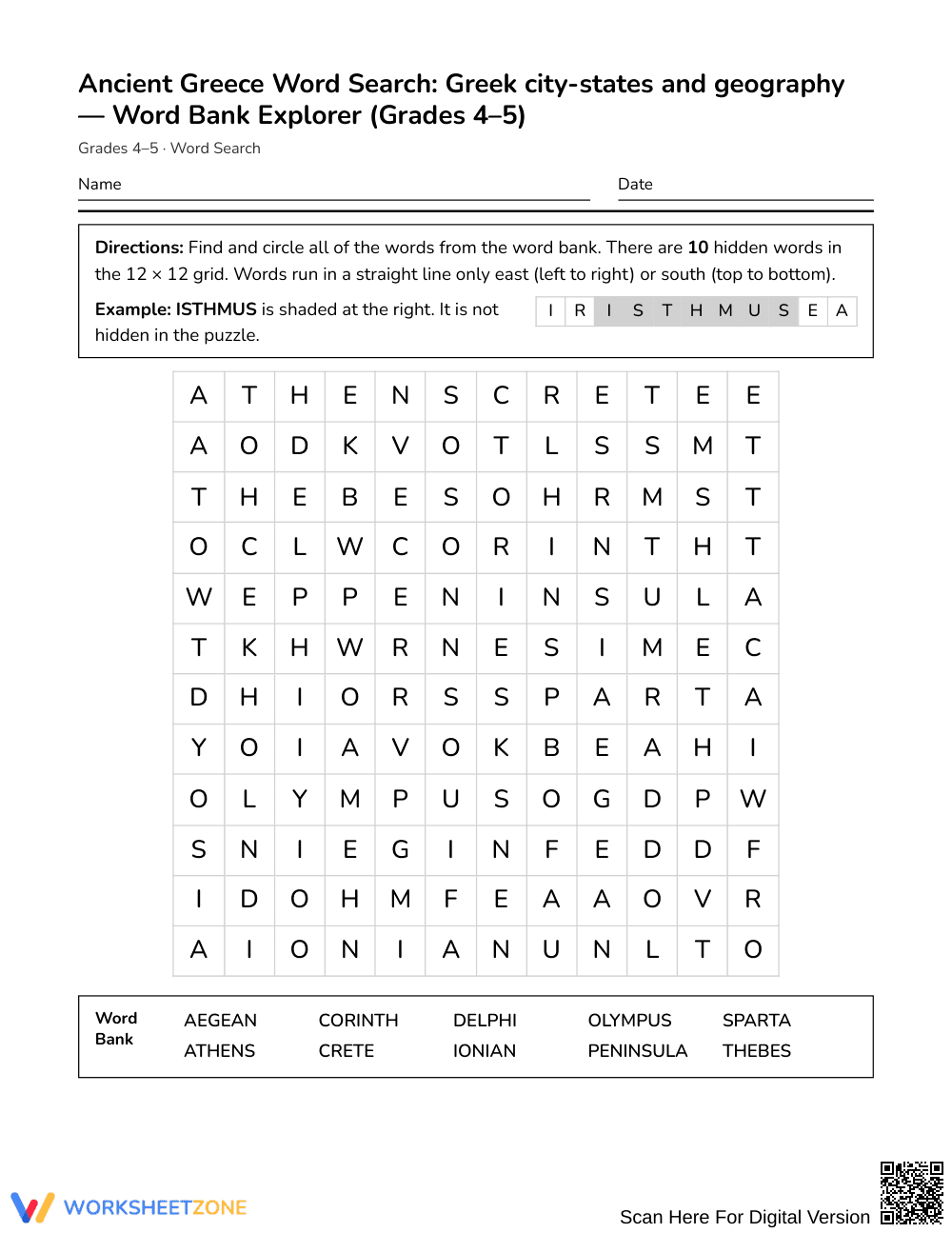
This Ancient Greece word search builds vocabulary recognition by prompting students in Grades 4–5 to locate 10 key terms related to Greek city-states and physical geography. By scanning the letter grid, learners reinforce spelling, build historical background knowledge, and familiarize themselves with critical Mediterranean regions before formal lessons begin.
At a Glance
- Grade: Grades 4–5 · Subject: Social Studies (World History)
- Standard: Not standards-assessed — vocabulary enrichment
- Skill Focus: Ancient Greek city-states, waterways, and regional geography
- Format: 1 printable page · 10 hidden vocabulary words · 2-page answer key included · PDF document
- Best For: Unit launch warm-up, independent vocabulary practice, and sub plans
- Time: 15–20 minutes
What's Inside
This single-page vocabulary resource features a clean search puzzle paired with an alphabetical word bank of 10 essential terms. It includes a complete two-page answer key showing full letter solutions for effortless grading. Designed for upper elementary learners, the layout offers clear typography and age-appropriate visual organization without distracting clutter.
Puzzle Mechanics
The activity utilizes a 12 × 12 grid built for accessible visual scanning. All 10 vocabulary terms run in two standard reading directions: horizontally from left to right (East) and vertically downward (South). Omitting diagonal and reverse words eliminates visual frustration while maintaining rigorous engagement. Students search for ten terms organized alphabetically in the word bank: Aegean, Athens, Corinth, Crete, Delphi, Ionian, Olympus, Peninsula, Sparta, and Thebes.
Standards Alignment
This resource serves as vocabulary enrichment and is not aligned to a formal standard. It provides foundational reinforcement of domain-specific historical terminology and geographic concepts. Teachers can use it to build prerequisite vocabulary knowledge before students encounter complex informational texts on ancient Mediterranean civilizations.
How to Use It
Introduce this word search before direct instruction to generate interest in Greek geography, or assign it after a lesson as an independent consolidation task. During the 15–20 minute activity, observe how efficiently students locate terms and reference the alphabetical list. Spot check whether learners recognize geographic features such as seas and peninsulas while finding them.
Who It's For
This activity supports Grades 4–5 social studies learners exploring ancient history. For students requiring extra support, pair the puzzle with a labeled Mediterranean map so they can match names to physical locations. For advanced learners, invite them to categorize the completed terms into geographic landforms, bodies of water, and city-states.
Explicit exposure to domain-specific terminology provides an essential bridge to comprehension in upper elementary social studies. Operating as an unaligned vocabulary enrichment tool rather than an assessed testing instrument, this resource targets Greek city-states and geography across a 12 × 12 grid containing 10 hidden terms. According to Fisher & Frey (2014), intentional word exposure and repeated visual engagement with specialized academic language directly enhance students' background schema and reading fluency in content-area texts. By locating terms horizontally and vertically, fourth and fifth graders build orthographic familiarity with complex classical names such as Corinth, Delphi, and Peninsula. This foundational orthographic practice lowers cognitive load during subsequent historical analysis, enabling learners to participate more equitably in classroom discussions. The puzzle functions effectively within 15 to 20 minutes as an accessible instructional entry point that anchors historical vocabulary before students encounter rigorous primary-source excerpts.


