
































Free Greek Architecture Word Search | Grade 6 Social Studies

Paste this activity's link or code into your existing LMS (Google Classroom, Canvas, Teams, Schoology, Moodle, etc.).
Students can open and work on the activity right away, with no student login required.
You'll still be able to track student progress and results from your teacher account.
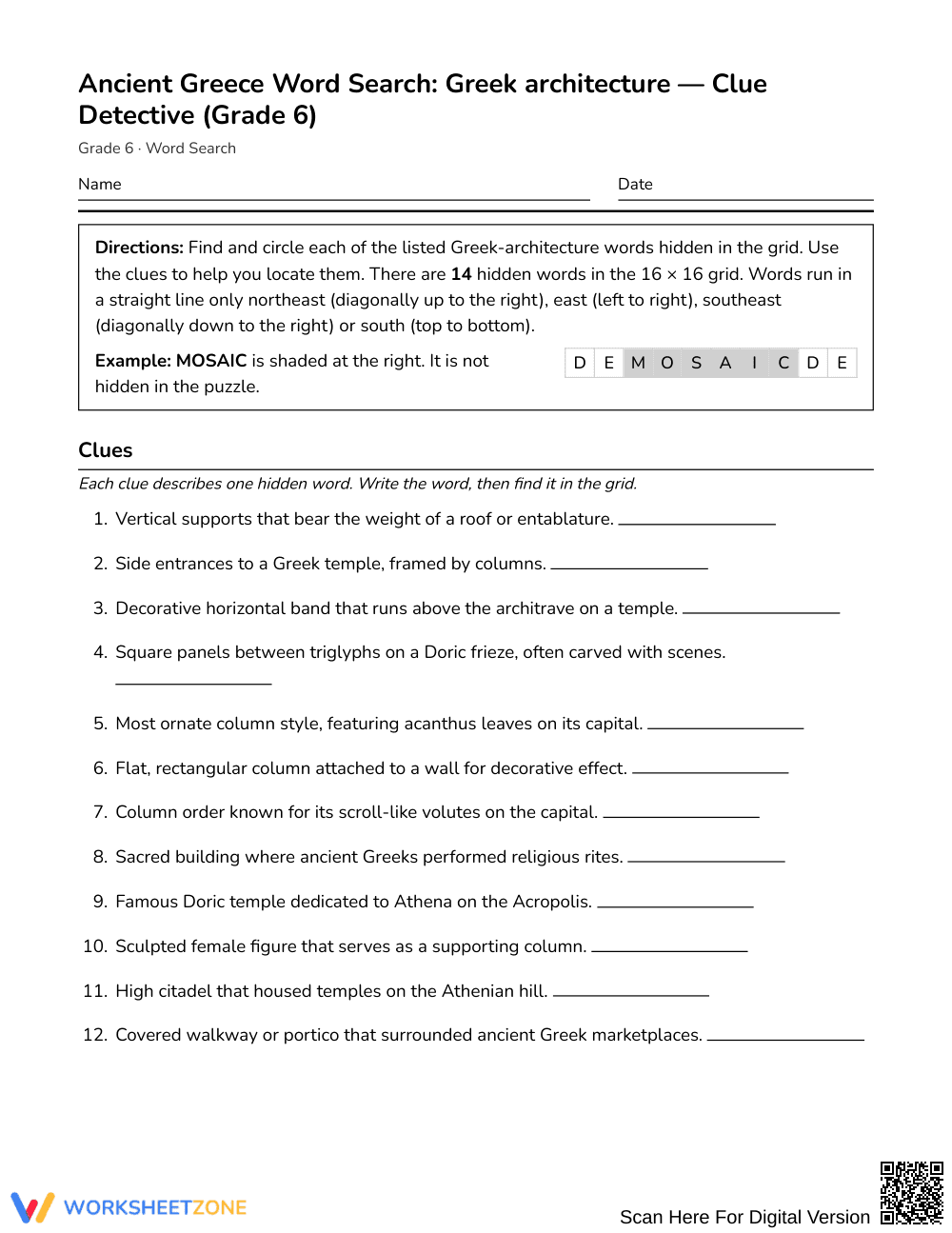
This Greek architecture word search reinforces essential classical history vocabulary for Grade 6 students studying ancient civilizations. Learners locate 14 key architectural terms by matching definitions to structural features, building retention of core World History concepts while exploring temple elements, classical column orders, and civic spaces.
At a Glance
- Grade: Grade 6 · Subject: Social Studies (World History)
- Standard: Not standards-assessed — vocabulary enrichment
- Skill Focus: Greek architecture terminology and structural features
- Format: 3 pages · 14 words · Full answer key included · PDF format
- Best For: World History unit review, vocabulary reinforcement, and sub plans
- Time: 15–25 minutes of focused student work
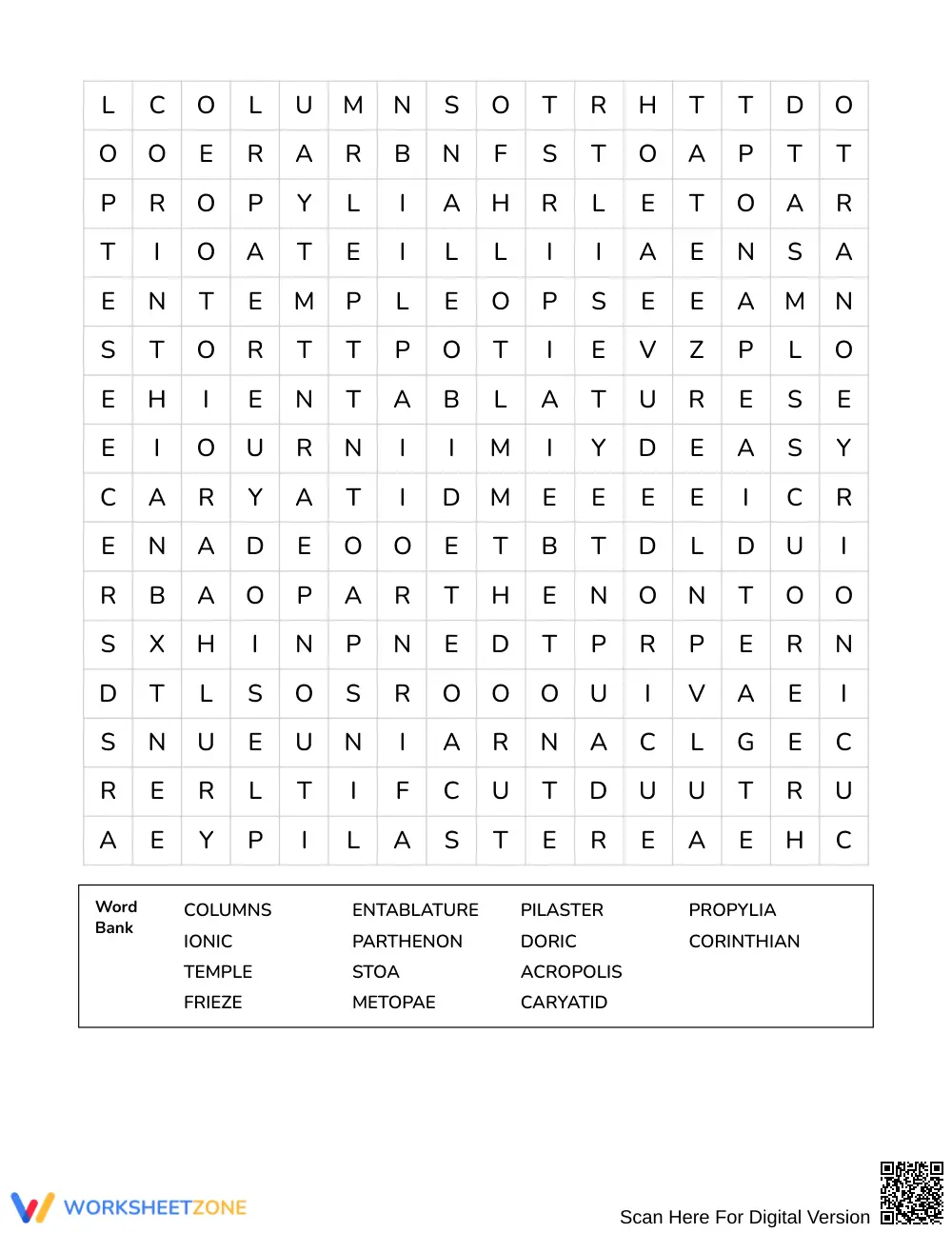
This 3-page printable activity features a 16 × 16 letter grid with 14 hidden vocabulary words related to ancient Greek architecture. Rather than relying on a simple word bank, the resource provides a Clue Detective section with informative definitions for each term, including classical column orders, structural components, and iconic landmarks. A complete 3-page answer key provides clear visual grids marking every word location for rapid checking.
Puzzle Structure and Mechanics
Students search a 16 × 16 character grid with four search orientations: northeast (diagonal up-right), east (horizontal forward), southeast (diagonal down-right), and south (vertical down). A shuffled word bank encourages students to scan actively. Each hidden term pairs directly with an architectural clue—such as defining Ionic volutes or identifying the Acropolis—prompting learners to read the historical definition before locating the term within the grid.
Curriculum and Enrichment Context
This resource serves as targeted vocabulary enrichment rather than formal assessment, and it is not aligned to a state or national standard. It reinforces essential academic vocabulary required in Grade 6 Social Studies and World History units covering ancient Mediterranean civilizations. Teachers can use the activity to build domain-specific literacy before reading complex informational texts about classical Greece.
How to Use It
Deploy this word search during an introductory lesson on classical Greek culture as a vocabulary pre-teaching activity, or assign it after direct instruction to consolidate retention of architectural orders. While students work, circulate to observe whether they read clue definitions or merely hunt for letter strings, offering targeted prompts to clarify structural terms. Students typically finish the puzzle in 15 to 25 minutes.
Who It's For
This activity is designed for Grade 6 World History classes, middle school social studies electives, and cross-curricular humanities units. For learners needing additional reading support, allow collaborative partner-solving or pre-highlight unfamiliar vocabulary terms in the clue section. The puzzle pairs naturally with an illustrated diagram of classical temple facades or a primary-source reading on Periclean Athens.
Integrating domain-specific vocabulary puzzles into middle school social studies supports long-term informational recall and historical concept mastery. According to Fisher & Frey (2014), intentional exposure to specialized academic vocabulary within meaningful contexts significantly strengthens student reading comprehension across content-area texts. This Grade 6 Greek architecture word search activates associative learning by coupling structural definitions with systematic spatial word location across 14 architectural terms, including classical column styles, temple components, and civic landmarks. By examining contextual clues for concepts like the Parthenon, entablatures, and caryatids before finding each term within the 16 × 16 grid, sixth-grade learners develop visual and semantic familiarity with foundational World History concepts. This vocabulary enrichment provides an engaging entry point that reinforces domain literacy, deepens conceptual understanding during ancient civilization units, and prepares middle school students for subsequent informational document analysis.


