





























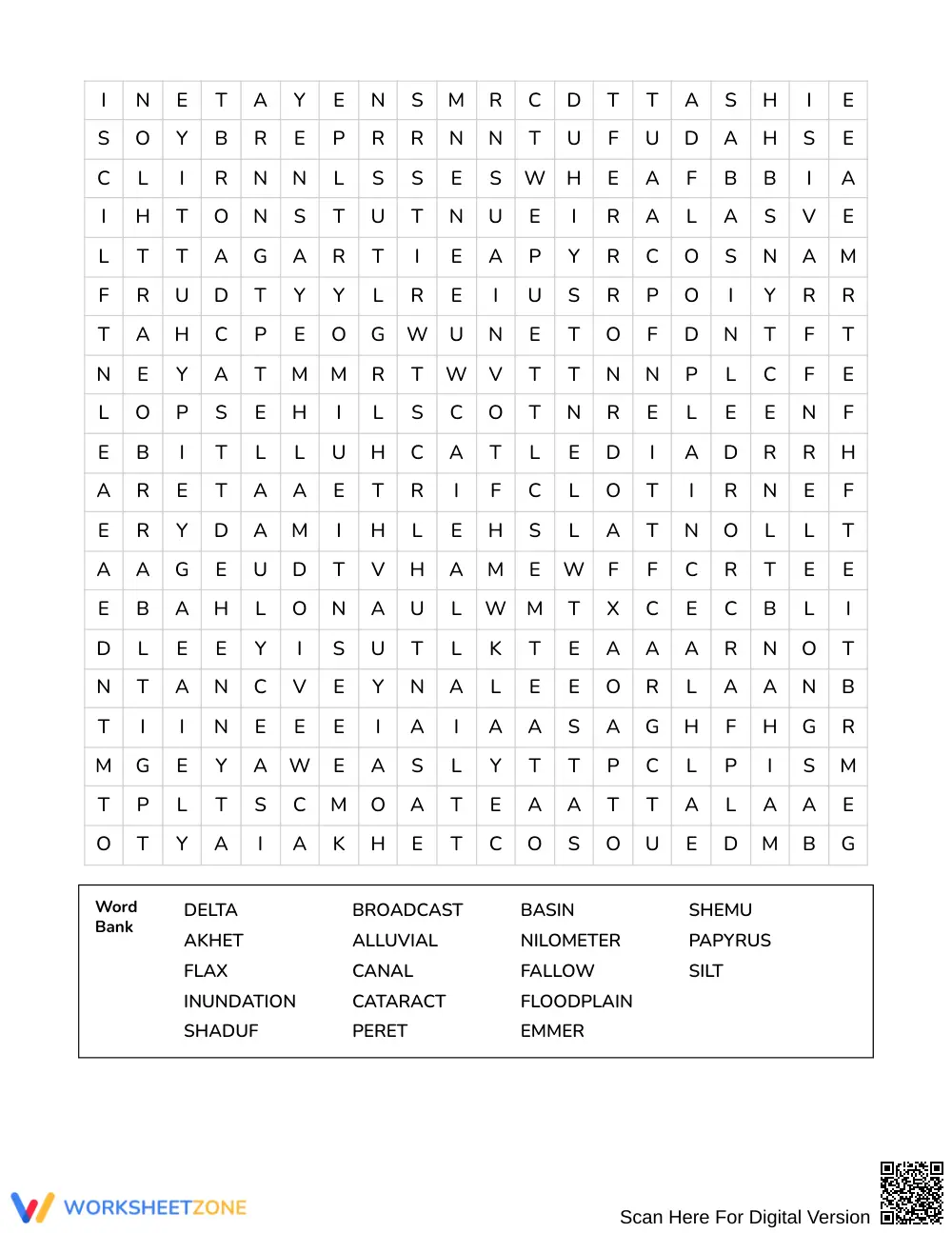


Free Gift of Nile Word Search | Grades 7–8 Social Studies

Paste this activity's link or code into your existing LMS (Google Classroom, Canvas, Teams, Schoology, Moodle, etc.).
Students can open and work on the activity right away, with no student login required.
You'll still be able to track student progress and results from your teacher account.
Students explore how Nile river conditions shaped ancient Egyptian farming by completing a focused word search that reinforces key terminology and concepts. The activity builds vocabulary fluency, supports textual comprehension, and prepares learners for deeper discussion of seasonal cycles and agricultural decisions.
At a Glance
- Grade: Grades 7–8 · Subject: Social Studies
- Standard:
Not standards-assessed — vocabulary enrichmentThis activity enriches key terminology without formal standard alignment.- Skill Focus: River conditions and farming decisions, emphasizing seasonal flood cycles and agricultural practices.
- Format: 3 pages · 18 words · Answer key included · PDF, ready for quick classroom use.
- Best For: Vocabulary review in Social Studies, especially after lessons on ancient Egypt.
- Time: Approximately 10–15 minutes per class.
The three‑page packet contains a 20 × 20 grid word search, a shuffled word bank of 18 key terms, and clear clues that link each term to Nile river conditions and farming decisions. An answer key on a separate page shows each hidden word highlighted for easy checking.
- Grid size: 20 × 20 squares provide ample space for intersecting vocabulary.
- Directions: Words may run horizontally, vertically, or diagonally (N, NE, E, SE, S, SW, W, NW).
- Word bank & clues: A shuffled list of 18 terms with concise definitions guides students to locate each word.
This activity is designed solely for vocabulary enrichment and does not map to any specific state or national standard. It supports language development by reinforcing content‑specific terminology related to ancient Egyptian agriculture.
Use the word search as a quick warm‑up after a lecture on Nile flood cycles, allowing students to apply new terms immediately. Alternatively, employ it as a closure activity at the end of a unit, collecting completed grids to gauge retention; note which clues required extra prompting. Expected completion time is 10–15 minutes.
The puzzle targets Grades 7–8 learners studying ancient Egypt, offering a single‑level challenge suitable for mixed‑ability classes. It pairs well with the “Gift of the Nile” reading passage or an anchor chart of Egyptian seasonal cycles, reinforcing the same terminology across formats.
Word searches are an evidence‑based strategy for reinforcing domain‑specific vocabulary, promoting both recognition and recall. Fisher & Frey (2014) highlight that focused word‑study activities improve students’ ability to decode and use academic language across content areas. By embedding 18 Nile‑related terms within a searchable grid, this resource aligns with research‑backed practices that boost lexical acquisition while keeping engagement high. The repetitive visual scanning required by a word search supports working memory and reinforces pattern recognition, which are critical components of reading comprehension development. Moreover, the activity’s low‑stakes format encourages independent practice, allowing teachers to collect informal data on terminology mastery without formal testing. Because the puzzle is printable, it can be reused across semesters, providing a sustainable tool for reinforcing content while supporting differentiated instruction.


