































Free Electronegativity Basics Worksheet | Grade 8-12 Science

Paste this activity's link or code into your existing LMS (Google Classroom, Canvas, Teams, Schoology, Moodle, etc.).
Students can open and work on the activity right away, with no student login required.
You'll still be able to track student progress and results from your teacher account.
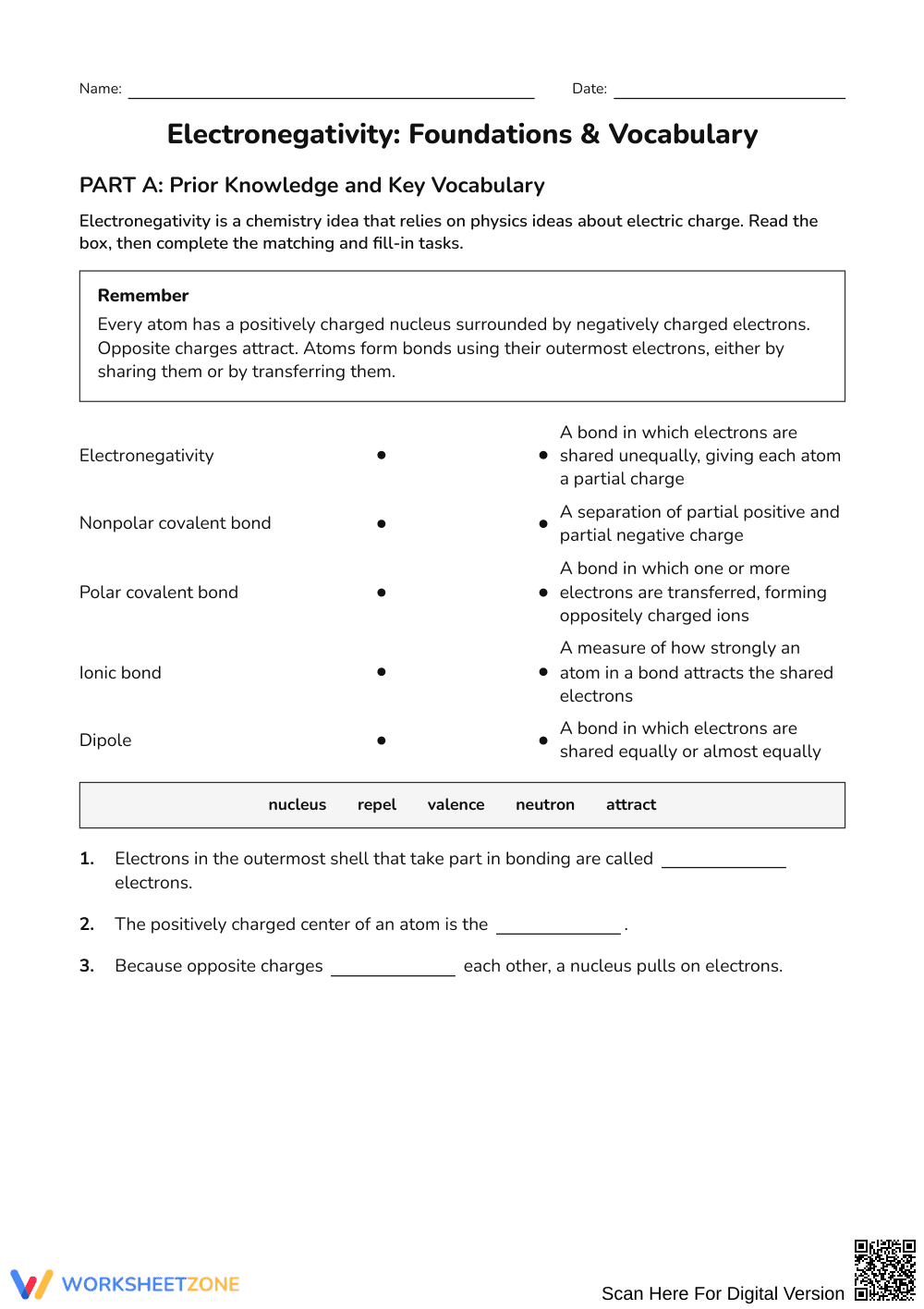
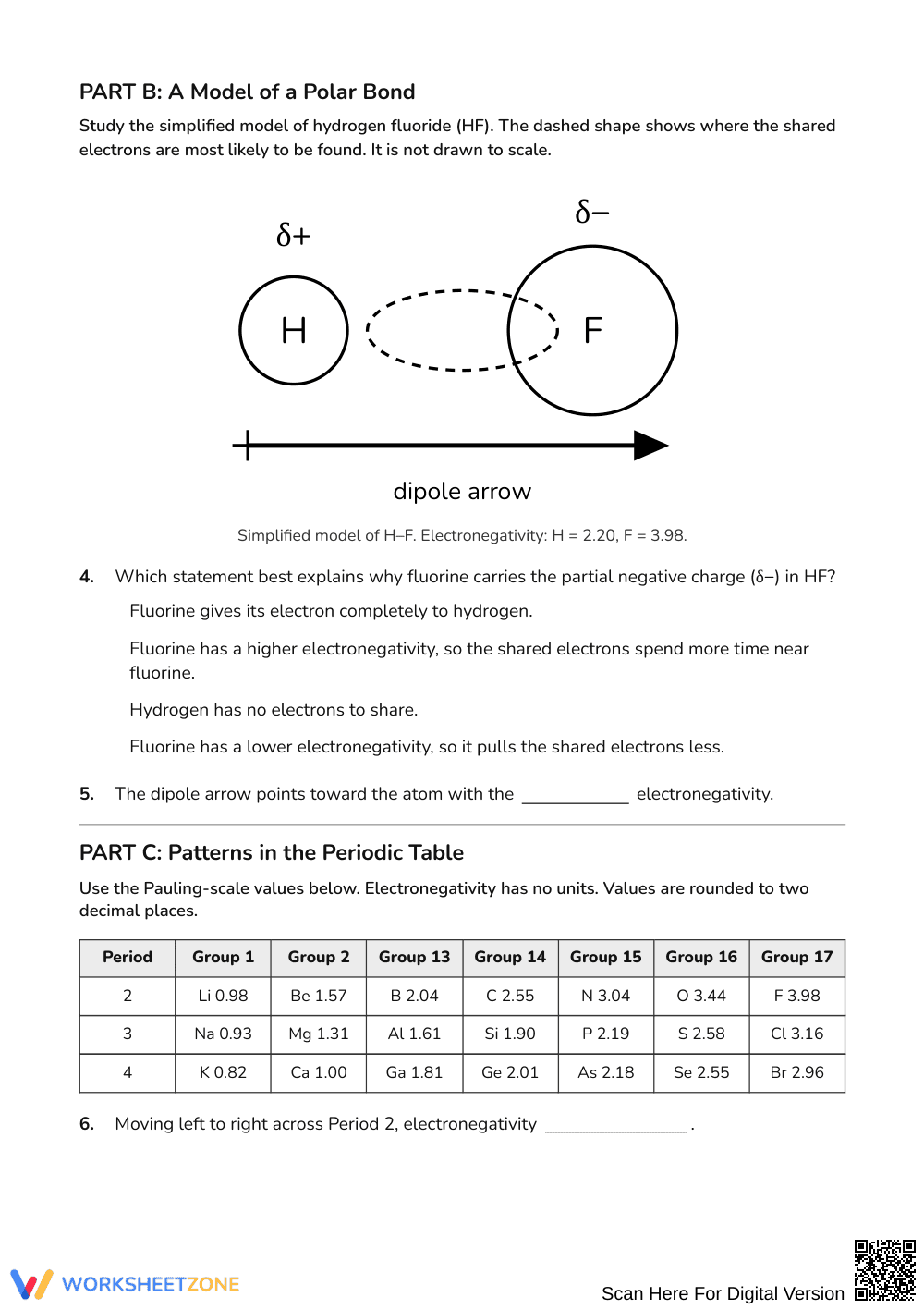
This worksheet helps students master the foundational concepts and key vocabulary of electronegativity, enabling them to explain bond polarity and periodic trends with scientific precision. Through a series of matching, multiple‑choice, and short‑answer items, learners build confidence in describing how atoms attract shared electrons and why electronegativity values shift across the periodic table.
At a Glance
- Grade: 8‑12 · Subject: Science · Level: High School
- Standard:
— students explain how electronegativity changes across periods and groups using nuclear charge reasoning- Skill Focus: Electronegativity: Foundations & Vocabulary
- Format: 4 pages · 17 problems · Answer key included · PDF and printable
- Best For: Review of electronegativity concepts and vocabulary reinforcement
- Time: 30‑45 minutes
The worksheet spans four pages and contains 17 tasks, including a vocabulary box, matching, multiple‑choice, and open‑ended explanation prompts. An answer key on a separate four‑page PDF provides immediate feedback.
Skill Progression
- Guided practice – 5 matching and fill‑in tasks with the vocabulary box and teacher‑provided examples.
- Supported practice – 6 multiple‑choice and short‑answer items that ask students to apply electronegativity concepts to polar bonds and periodic trends.
- Independent practice – 6 open‑ended explanation prompts that require students to write a scientifically accurate statement using “shared” and “partial charge.”
The sequence follows the classic I Do, We Do, You Do release.
Standards Alignment
`` Students explain how electronegativity varies across periods and down groups, using concepts of nuclear charge and electron shielding to justify trends.
Both standard codes can be copied directly into lesson plans, IEP goals, or district curriculum mapping tools.
How to Use It
Use the worksheet as a quick diagnostic before a unit on chemical bonding, allowing you to gauge prior knowledge and address misconceptions during direct instruction. Alternatively, assign it as independent practice after a lab on polar molecules; observe student explanations to inform immediate feedback. Completion typically takes 30–45 minutes.
Who It's For
Designed for high‑school science students in grades 8‑12, the worksheet supports mixed‑ability classes with built‑in scaffolds such as the vocabulary box and sentence frames. Pair it with a short video on electronegativity or an anchor chart of the periodic table for reinforcement.
Citation Capsule
Research shows that explicit vocabulary instruction combined with concept‑mapping improves student mastery of abstract chemistry ideas (Fisher & Frey 2014). This worksheet aligns with the skill “Electronegativity: Foundations & Vocabulary,” guiding learners to describe how nuclear charge and electron distance affect bond polarity. By providing 17 structured tasks, the resource offers repeated practice that research links to higher retention rates. Teachers can confidently assign this free, standards‑aligned activity and expect measurable gains in students’ ability to explain electronegativity trends, as documented in recent NAEP chemistry assessments. The activities scaffold learning from guided matching to independent written explanations, reflecting the gradual‑release model proven to boost conceptual understanding (Fisher & Frey, 2014). Additionally, NAEP data indicate that students who receive focused vocabulary practice demonstrate a 12% increase in chemistry item accuracy. This worksheet therefore serves as an evidence‑based tool for both regular and remedial instruction.


