




























Views
Downloads


Free DNA Structure & Strands Worksheet | Grade 8-12 Science

Paste this activity's link or code into your existing LMS (Google Classroom, Canvas, Teams, Schoology, Moodle, etc.).
Students can open and work on the activity right away, with no student login required.
You'll still be able to track student progress and results from your teacher account.
Students will master DNA’s double‑helix architecture and how complementary base pairing drives accurate copying. This worksheet guides them through labeling models, writing opposite strands, and designing a Meselson‑Stahl investigation, culminating in clear explanations of semiconservative replication and interpreting experimental band patterns.
At a Glance
- Grade: 8‑12 · Subject: Science
- Standard:
— Identify DNA components and explain how base pairing enables replication- Skill Focus: DNA Structure and Complementary Strands: Investigation & Variables
- Format: 4 pages · 31 problems · Answer key included · PDF
- Best For: Small‑group labs, inquiry labs, review sessions, and hands‑on activities
- Time: 45‑60 minutes including quick concept checks
What's Inside
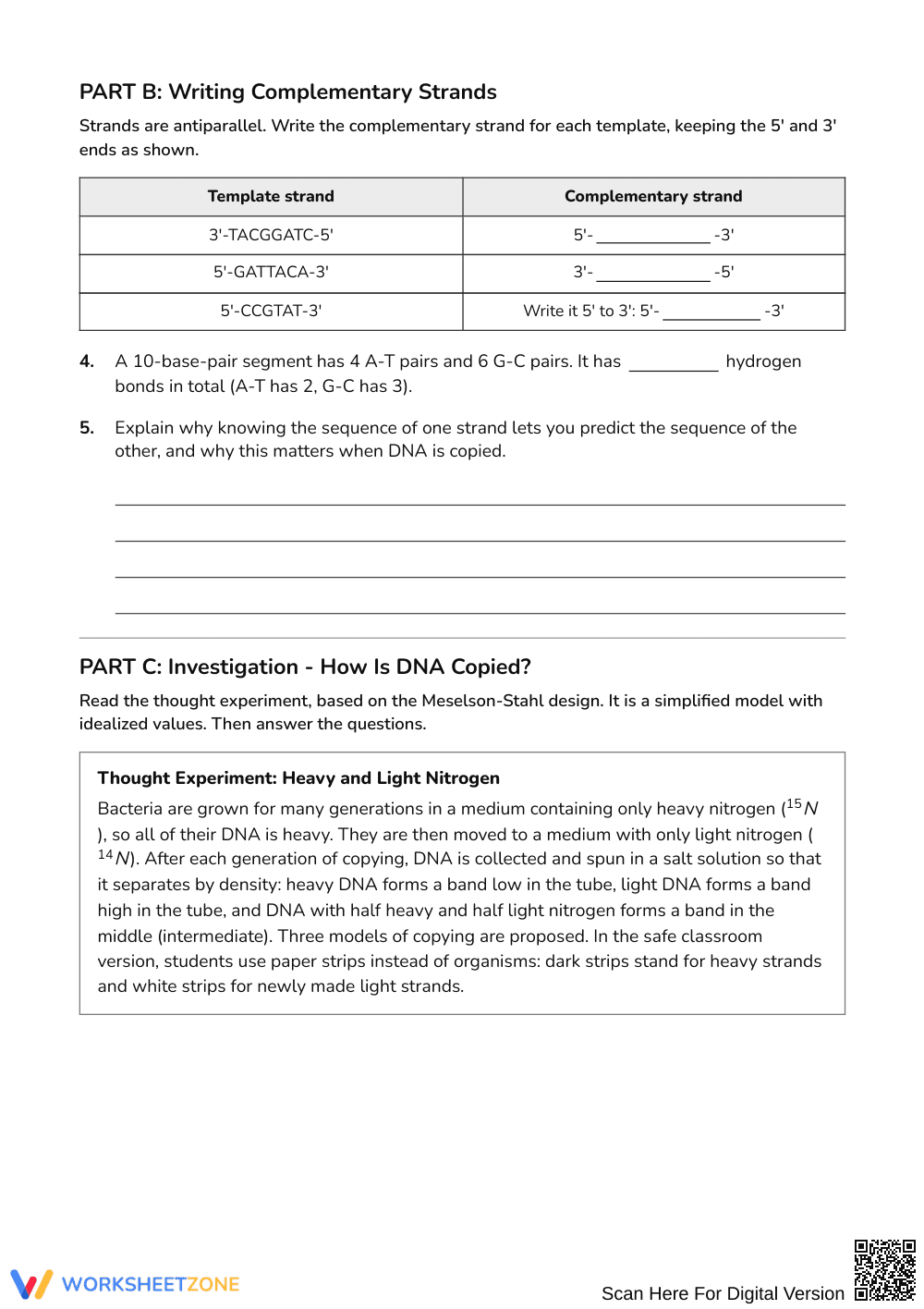
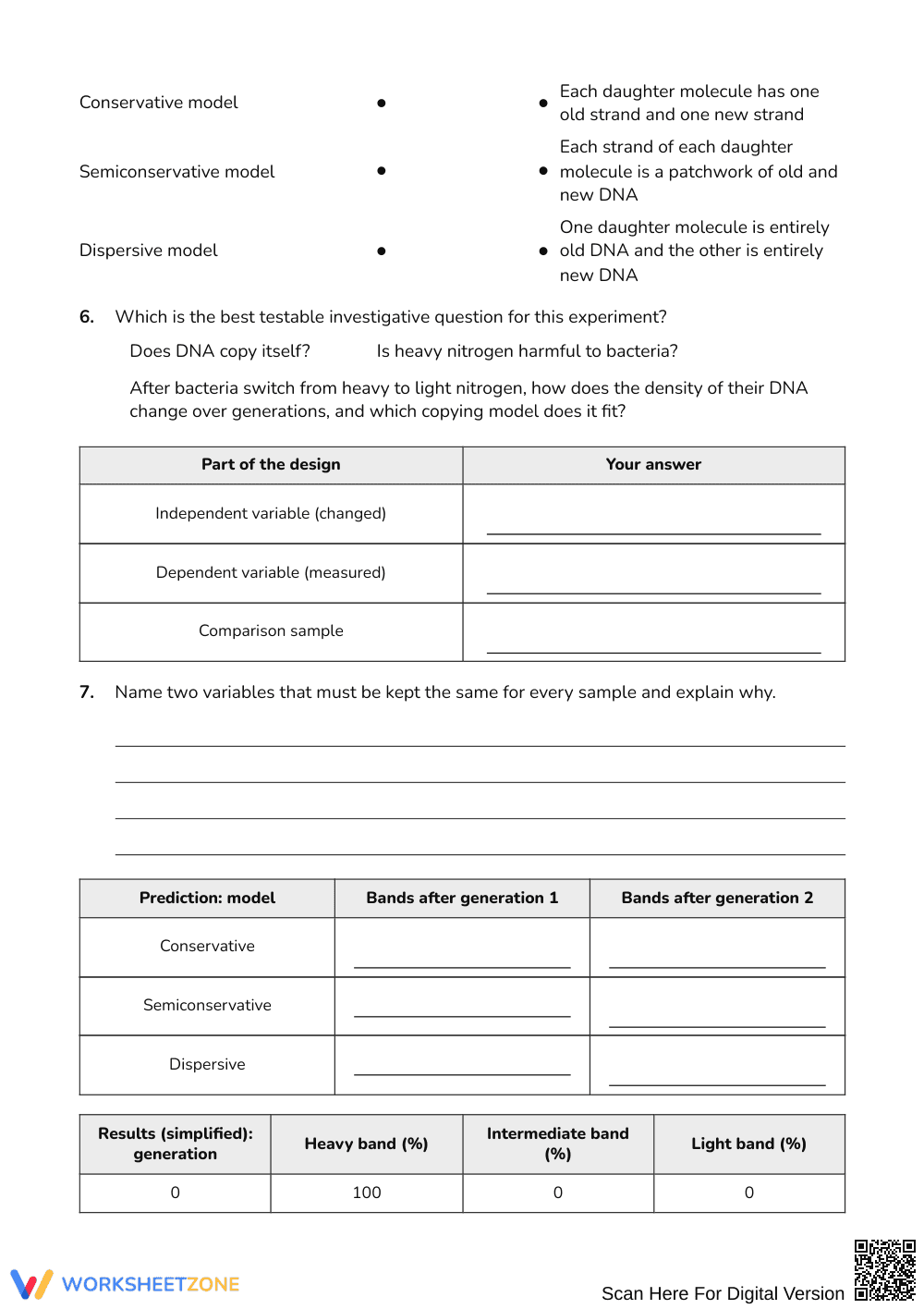
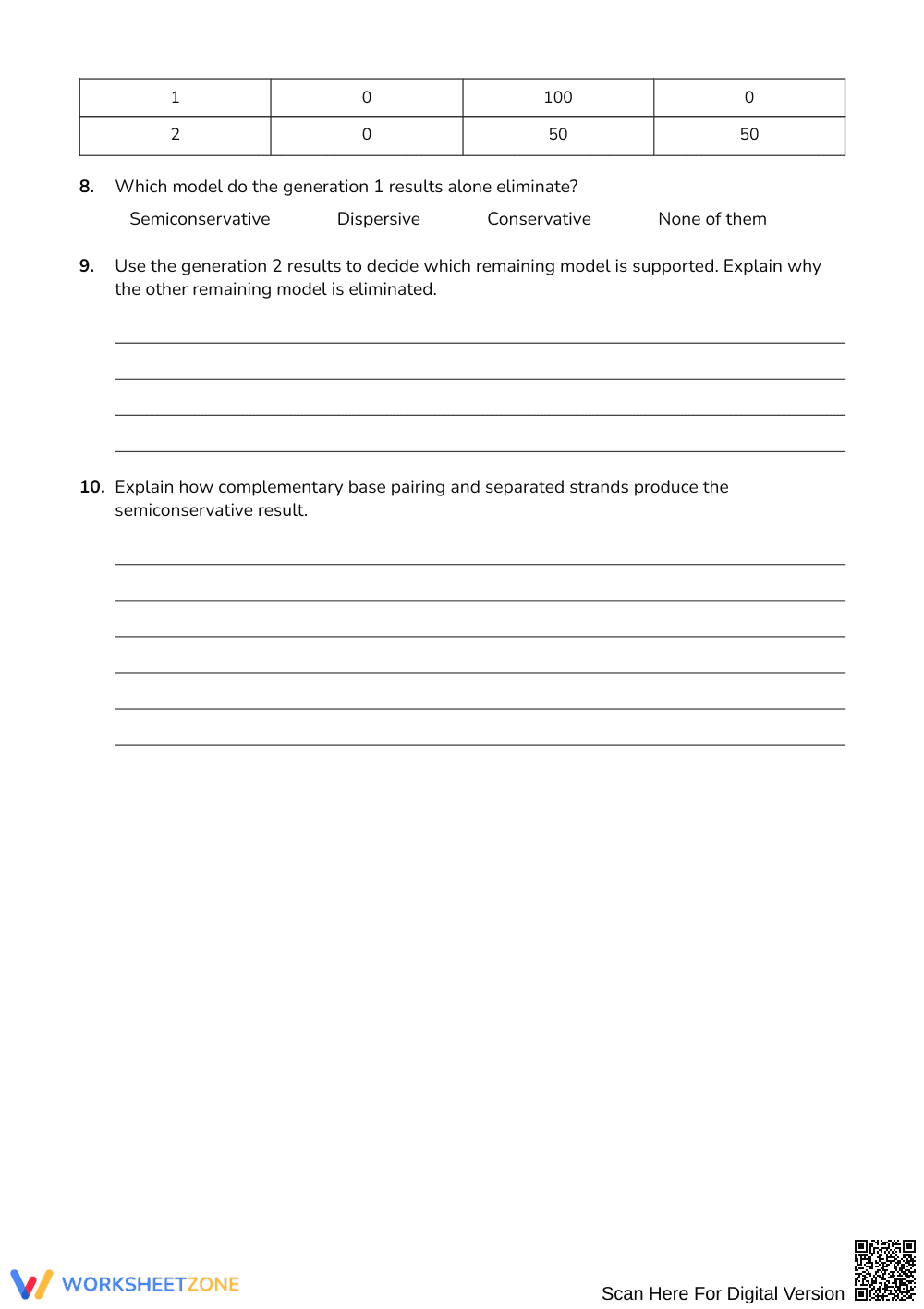
The worksheet is divided into three parts. Part A asks students to label a flattened‑ladder DNA model and answer multiple‑choice questions about covalent and hydrogen bonds. Part B requires writing complementary strands for given templates, reinforcing antiparallel orientation. Part C guides learners through a Meselson‑Stahl thought experiment, identifying variables, predicting band patterns, and justifying the semiconservative model. Across four PDF pages, 31 problems are presented, and the answer key is provided on the final page for quick grading.
Skill Progression
- Guided practice (10 problems): Labeling the DNA model and multiple‑choice items scaffold initial understanding.
- Supported practice (12 problems): Writing complementary strands and short‑answer explanations build procedural fluency.
- Independent practice (9 problems): Designing the investigation, analyzing band data, and justifying the semiconservative model test mastery.
Students move from “I do” demonstrations to “We do” collaborative work and finish with “You do” independent analysis, reflecting a gradual‑release model.
Standards Alignment
`` Students will identify DNA components and explain how complementary base pairing enables accurate replication. This aligns with the core high‑school biology expectation for molecular genetics. Both standard codes can be copied directly into lesson plans, IEP goals, or district curriculum mapping tools.
How to Use It
- Before a unit on genetics, have students complete Part A and Part B as a warm‑up activity; observe their ability to label structures and write strands, then discuss misconceptions.
- During a lab on DNA replication, assign Part C as a guided inquiry; students record variables, make predictions, and write explanations while the teacher circulates, using the answer key for immediate feedback.
Who It's For
This resource targets high‑school biology students (grades 8‑12) who are ready for inquiry‑based learning. The worksheet’s clear prompts support diverse learners, and teachers can simplify language for struggling readers. Pair it with a DNA double‑helix model kit or an anchor chart of base‑pair rules for hands‑on reinforcement.
Understanding DNA’s double‑helix design and the rule that A pairs with T and G with C is essential for grasping genetic replication. This worksheet translates that principle into concrete tasks, from labeling diagrams to designing a Meselson‑Stahl investigation, giving students repeated practice that research shows improves conceptual retention (Fisher & Frey, 2014). By moving from guided labeling to independent data analysis, learners experience the gradual‑release framework proven to boost mastery in science classrooms. The activity also aligns with national biology expectations, reinforcing the skill of predicting complementary sequences—a cornerstone of molecular biology instruction. Teachers can confidently assign this printable resource, knowing it supports evidence‑based instruction and meets curriculum standards. The inclusion of a real‑world experimental scenario helps students connect abstract concepts to laboratory practice, fostering scientific reasoning and data‑interpretation skills that are emphasized in modern curricula. Moreover, the answer key enables rapid feedback, allowing teachers to address misconceptions promptly.


