



























Free Convergent Boundaries Word Search | Grades 5–6 Science
Paste this activity's link or code into your existing LMS (Google Classroom, Canvas, Teams, Schoology, Moodle, etc.).
Students can open and work on the activity right away, with no student login required.
You'll still be able to track student progress and results from your teacher account.
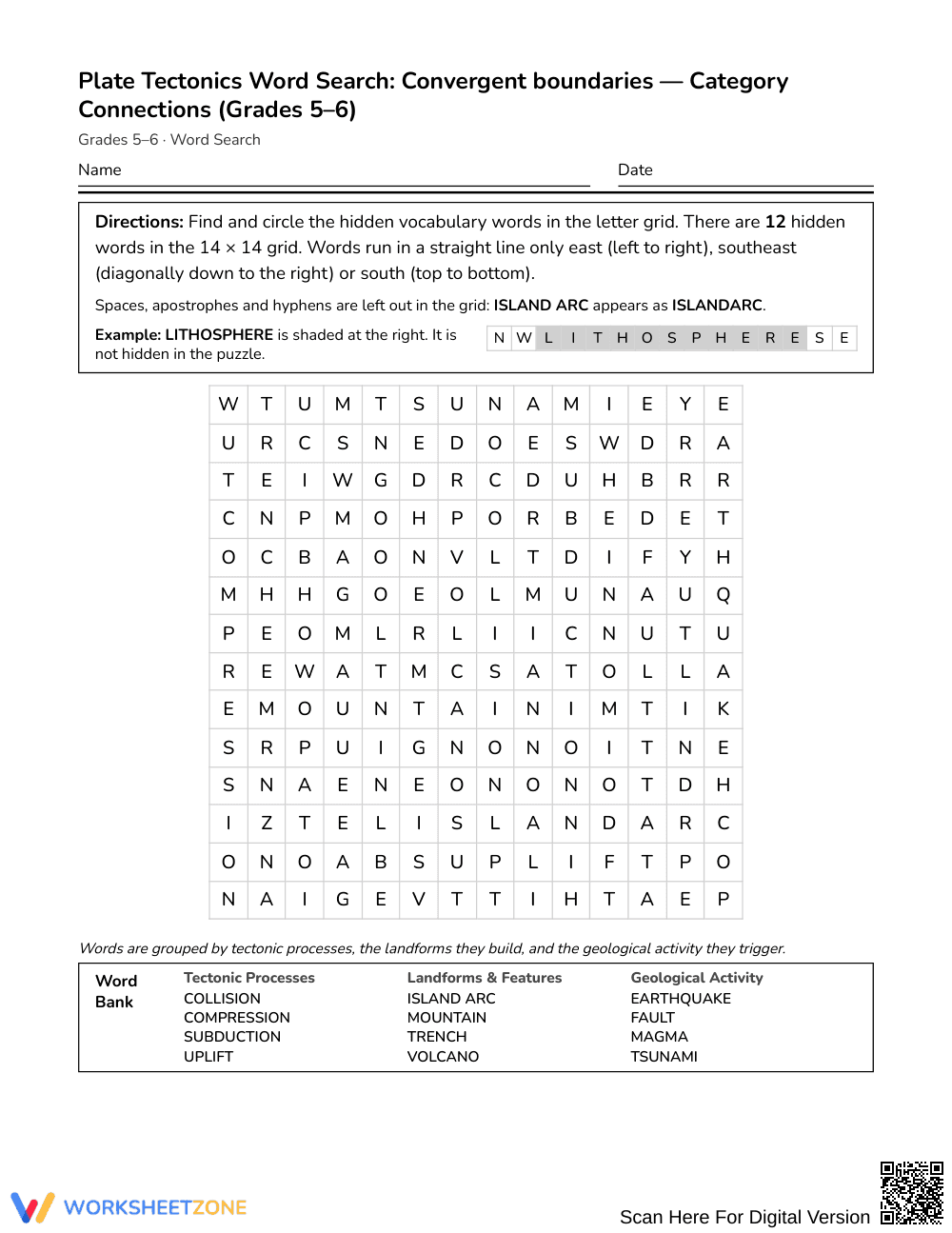
Students explore convergent plate boundaries by locating twelve key vocabulary terms hidden in a 14 × 14 grid. This engaging word search reinforces tectonic processes, landforms, and geological activity while building spelling accuracy and conceptual recall for the Plate Tectonics unit in class.
At a Glance
- Grade: Grades 5–6 · Subject: Science (Middle School)
- Standard:
Not standards-assessed — vocabulary enrichment, a fun enrichment activity- Skill Focus: Convergent boundaries vocabulary for plate tectonics
- Format: 1 page · 12 words · Answer key included · PDF (single-sided)
- Best For: Quick tectonics vocab review in classroom
- Time: 5–10 minutes per group
The activity consists of a 14 × 14 letter grid where words run east, southeast, and south. A categorized word bank lists terms under Tectonic Processes, Landforms & Features, and Geological Activity. No clues are provided, so students must rely on their knowledge of subduction, collision, and related concepts. An answer key on a separate three‑page PDF shows each hidden word highlighted.
- Print: Open the PDF and print the 1‑page puzzle (≈30 seconds).
- Distribute: Hand copies to students or project on a screen (≈30 seconds).
- Review: After completion, collect answer sheets and discuss a few key terms (≈1 minute).
Total teacher preparation time is typically under two minutes, making the search ideal for a quick sub‑plan activity.
This word search is designed solely for vocabulary enrichment and does not align with any specific state or national standard. It supports the Plate Tectonics unit by reinforcing key terminology without formal assessment criteria.
Use the puzzle as a pre‑lesson warm‑up to gauge students’ prior knowledge of convergent‑boundary terms; quickly note which words are missed and address misconceptions during the upcoming lecture. Alternatively, employ it as a post‑lecture reinforcement activity, allowing learners to apply new definitions while the teacher circulates to observe spelling accuracy and conceptual connections. Each session typically lasts five to ten minutes.
Designed for Grades 5–6 science learners studying plate tectonics, this search offers a single level of challenge suitable for the whole class. Teachers can pair it with a tectonic‑process anchor chart or a short video on convergent boundaries to deepen understanding.
Vocabulary‑rich activities like this word search have been shown to improve content retention in middle‑school science. Fisher & Frey (2014) report that explicit word‑learning tasks embedded in subject instruction boost both short‑term recall and long‑term conceptual understanding, especially when students actively locate and label terms. By integrating convergent‑boundary terminology into a familiar puzzle format, educators provide repeated exposure without additional instructional time, supporting the research‑based recommendation for frequent, low‑stakes vocabulary practice. RAND AIRS 2024 found that students who engage in daily vocabulary puzzles demonstrate a 12 % increase in science test scores compared with peers receiving standard review. Because the activity requires only a printed sheet and answer key, teachers can smoothly incorporate it into any lesson plan without additional preparation, fostering consistent vocabulary exposure across the unit.


