































Free China Building Word Search | Grades 6–7 Social Studies

Paste this activity's link or code into your existing LMS (Google Classroom, Canvas, Teams, Schoology, Moodle, etc.).
Students can open and work on the activity right away, with no student login required.
You'll still be able to track student progress and results from your teacher account.
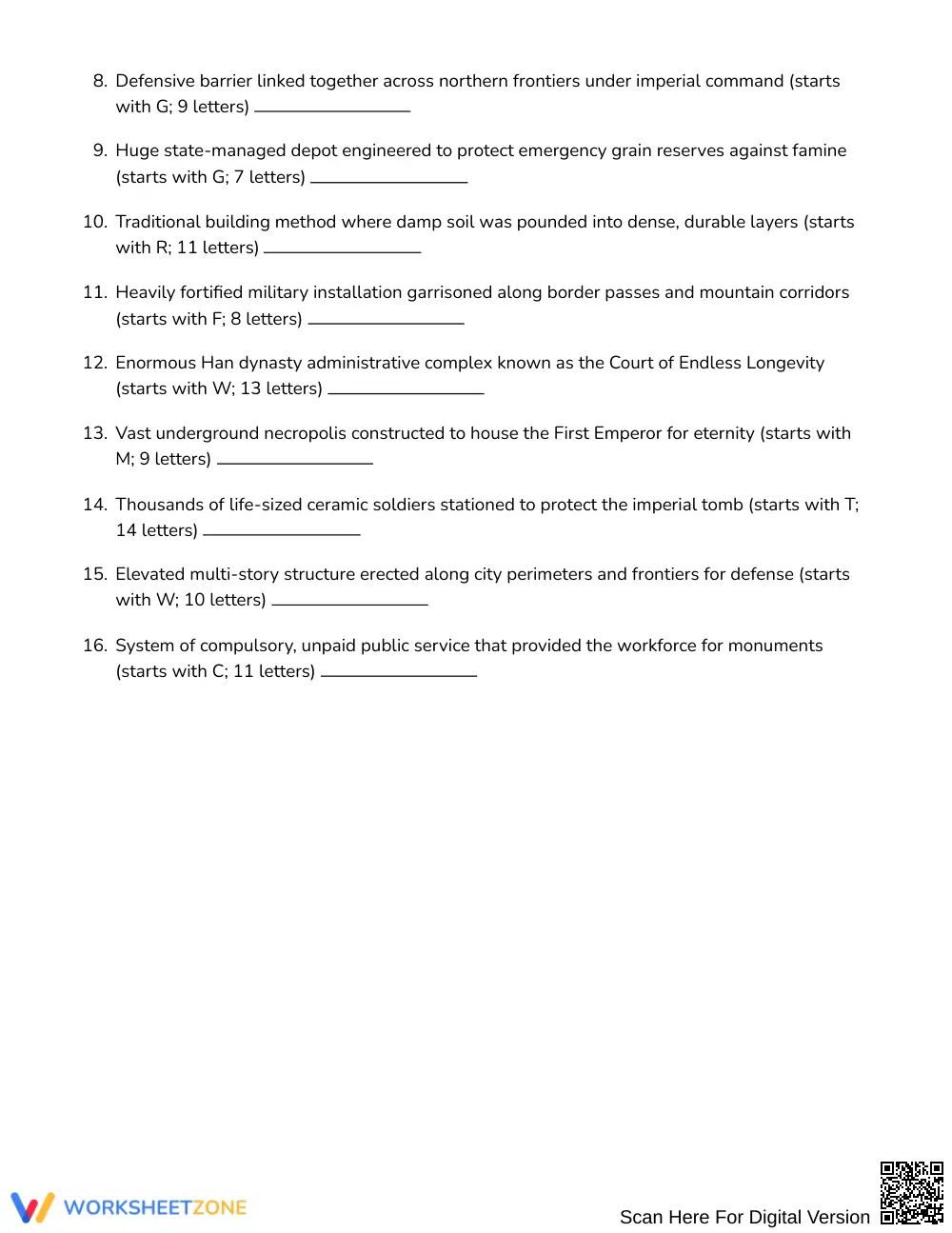
This Grades 6–7 social studies word search reinforces essential vocabulary surrounding ancient Chinese engineering achievements. Designed as a rigorous no-bank challenge, students analyze historical clues to recall major Qin and Han construction initiatives before locating each hidden term. It strengthens domain-specific reading comprehension and historical retention during world history units.
At a Glance
- Grade: Grades 6–7 middle school · Subject: World History Social Studies
- Standard: Not standards-assessed — targeted historical vocabulary enrichment without formal standards alignment
- Skill Focus: Early imperial Chinese engineering and monumental building projects
- Format: 3 student pages · 16 hidden words · 4 answer key pages · PDF
- Best For: Unit vocabulary review, sub plans, and enrichment
- Time: 25–35 minutes of engaged student work
What's Inside
This 3-page printable activity features 16 hidden words placed in an expansive puzzle grid. Unlike traditional searches, this resource includes no word bank, prompting learners to solve text-based clues about imperial architecture, irrigation, and defenses. A comprehensive 4-page answer key provides clear solution paths for each term to support rapid grading or student self-checking.
Puzzle Architecture and Mechanics
The activity is built on an 18 x 18 letter grid containing 16 hidden architectural terms. Words run in all 8 compass directions: north, northeast, east, southeast, south, southwest, west, and northwest, including forward and backward orientations. Because there is no word bank provided, students must actively interpret the 16 content clues to determine each target term before searching the letter matrix.
Standards Alignment
This resource is dedicated to vocabulary enrichment and is not aligned to a formal content standard. It provides supplementary terminology practice that reinforces key concepts covered during middle school world history instruction on early Asian civilizations.
How to Use It
Deploy this puzzle after direct instruction on the Qin and Han dynasties as a culminating vocabulary review. Alternatively, assign it as an independent learning station or zero-prep substitute activity during a world history engineering unit. As a formative assessment tip, observe whether students identify construction methods like rammed earth directly from the clues before searching the grid. Students typically complete the puzzle in 25 to 35 minutes.
Who It's For
This activity is designed for Grades 6–7 social studies classes exploring ancient civilizations. To differentiate for English learners or striving readers, allow peer collaboration or provide textbook glossaries to scaffold the clue deciphering process. Pair this word search with an informational reading passage on Qin Shi Huang’s centralizing infrastructure projects to deepen historical analysis.
Targeted vocabulary acquisition in social studies enables middle school students to comprehend complex historical narratives and societal developments. According to Fisher & Frey (2014), intentional word-learning strategies that connect domain-specific definitions directly to contextual problem-solving foster long-term conceptual retention. This Grades 6–7 world history activity emphasizes vocabulary enrichment surrounding early imperial Chinese building projects, asking learners to connect 16 descriptive clues with landmark engineering feats such as the Great Wall, Dujiangyan irrigation system, and Qin Shi Huang’s subterranean mausoleum. Because the puzzle operates without a pre-printed word bank, students must retrieve domain knowledge independently from memory or text notes rather than relying on visual recognition. This clue-first retrieval structure reinforces informational literacy, strengthens architectural terminology, and offers teachers a verifiable measure of student comprehension across unit-level ancient civilization studies without requiring a formal standard alignment code.


