

































Free Boyle's Law Assessment Worksheet | Grades 8–12 Science

Paste this activity's link or code into your existing LMS (Google Classroom, Canvas, Teams, Schoology, Moodle, etc.).
Students can open and work on the activity right away, with no student login required.
You'll still be able to track student progress and results from your teacher account.
Master Boyle's Law with this comprehensive assessment that guides students through particle models, data tables, graphs, calculations, and real‑world applications, culminating in confident predictions of pressure‑volume behavior. Students will interpret visual representations, solve quantitative problems, and justify explanations using scientific reasoning.
At a Glance
- Grade: 8–12 · Subject: Science (middle to high school)
- Standard:
— Use models and experimental data to explain pressure‑volume relationships in gases- Skill Focus: Boyle's Law assessment focusing on quantitative reasoning and conceptual explanation
- Format: 4 pages of clear layout · 19 problems ranging from basic to complex · Answer key included · PDF ready for printing
- Best For: Review before unit test, lab activity, or homework assignment
- Time: Estimated completion 20–30 minutes for most students
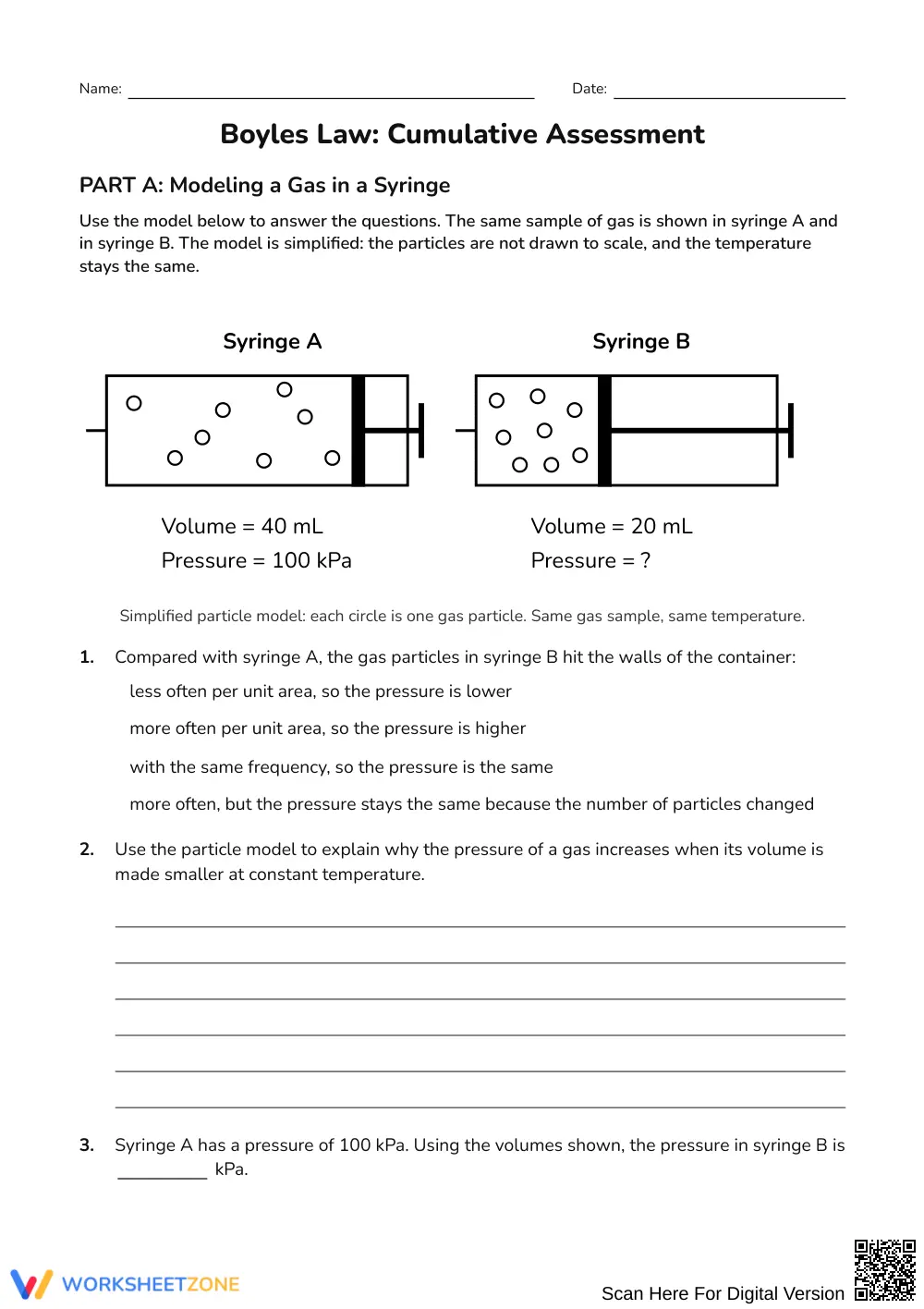
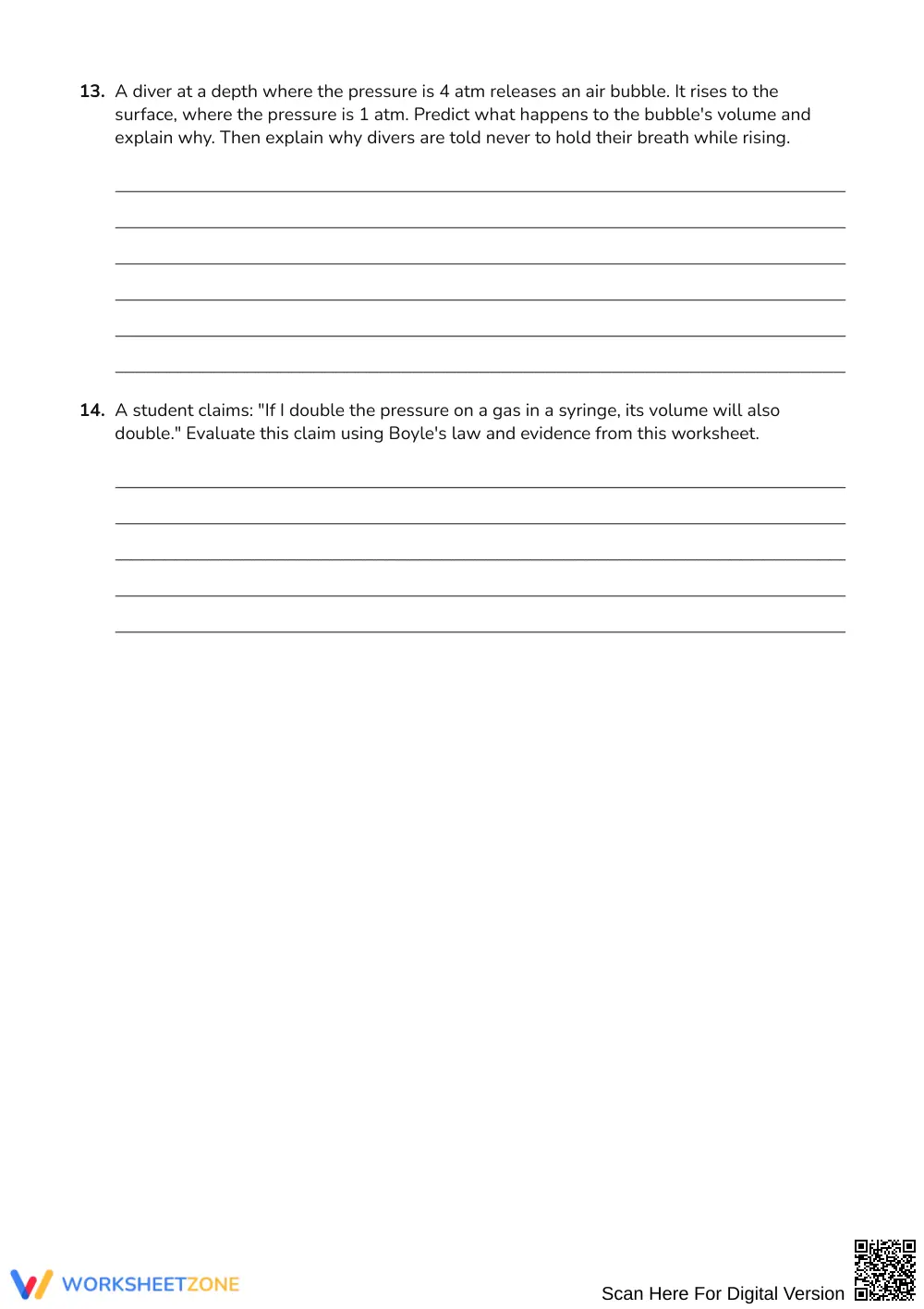
What’s Inside – The worksheet is divided into four parts: Part A offers a particle‑model scenario with multiple‑choice items; Part B presents a data table and two graphs for interpretation; Part C requires step‑by‑step calculations using P₁V₁ = P₂V₂; Part D challenges students with prediction and real‑world application questions. All 19 tasks are spread across four printable pages, and a complete answer key is provided.
- Guided practice: Part A modeling and multiple‑choice questions (6 problems) with sentence frames to support initial reasoning.
- Supported practice: Part B data‑table and graph analysis plus short‑answer prompts (7 problems) with a worked example illustrating the inverse relationship.
- Independent practice: Part C calculations and Part D prediction/application tasks (6 problems) requiring full written solutions.
The worksheet follows the gradual‑release model: I Do, We Do, You Do.
Standards Alignment – `` Students apply Boyle’s Law to predict how pressure and volume change when temperature and amount of gas are held constant. Both standard codes can be copied directly into lesson plans, IEP goals, or district curriculum mapping tools.
How to Use It – Use the assessment as a pre‑lab check to gauge students’ readiness to explore gas‑law experiments, then revisit after the lab for a post‑lab reflection. Alternatively, assign it as a formative quiz at the end of a unit; observe student explanations to inform immediate reteaching. Expected completion time is 20–30 minutes.
Who It’s For – Designed for grades 8‑12 science classes studying gas laws, especially students who need visual‑model support and quantitative practice. The built‑in sentence frames and worked example provide scaffolding for struggling learners, while the extension questions in Part D challenge advanced students. Pair it with a short video on the kinetic molecular theory for a seamless lesson flow.
Research shows that explicit modeling combined with guided problem solving improves conceptual retention in middle and high school science classrooms (Fisher & Frey, 2014). This assessment operationalizes that pedagogical evidence by guiding students through multiple levels of cognitive demand. Learners begin by analyzing particle diagrams to visualize microscopic gas behavior before translating those observations into mathematical equations and graphical plots. According to cognitive load theory, providing structured scaffolds such as worked calculation steps and visual cues reduces extraneous mental effort, allowing students to focus directly on core relationships between pressure and volume (Sweller, 2011). By connecting particulate diagrams directly to quantitative calculations, students build a durable conceptual foundation rather than relying on rote memorization. Science educators can implement this resource during direct instruction, collaborative practice, review stations, or formal evaluation to monitor student understanding and ensure all learners master foundational gas behavior principles thoroughly.


