
































Free Bone Growth Word Search | Grades 6–7 Science

Paste this activity's link or code into your existing LMS (Google Classroom, Canvas, Teams, Schoology, Moodle, etc.).
Students can open and work on the activity right away, with no student login required.
You'll still be able to track student progress and results from your teacher account.
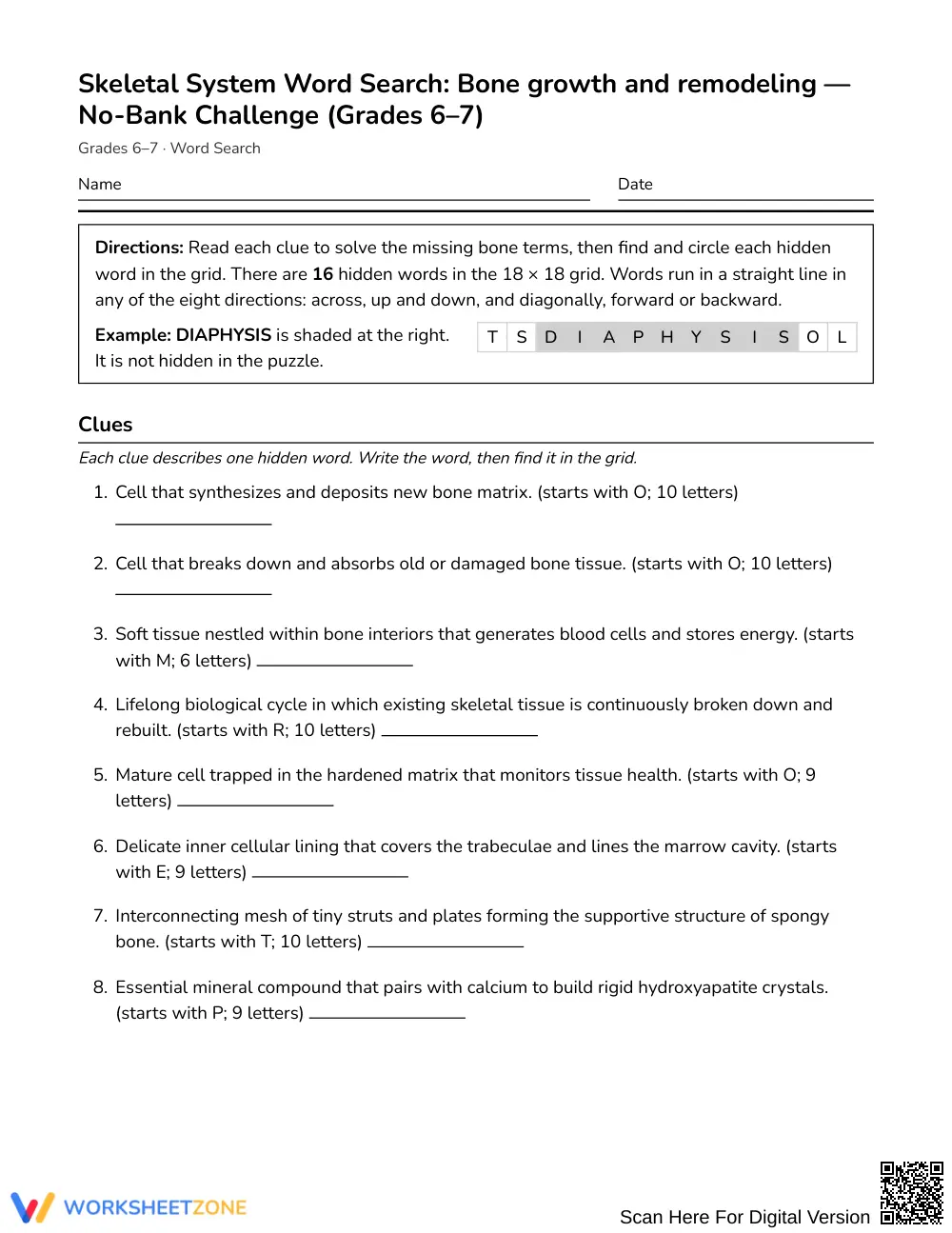
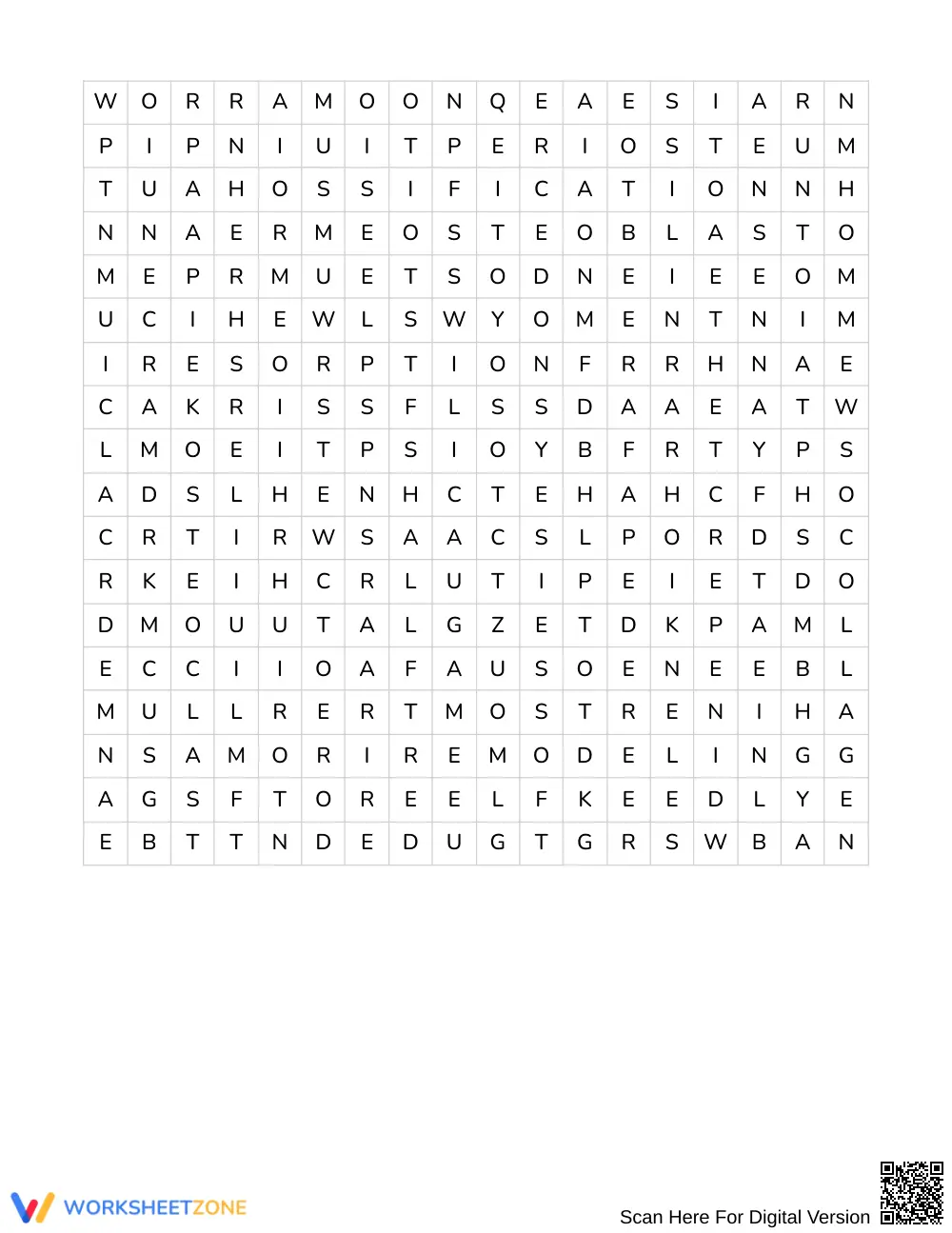
Students engage with bone vocabulary through this engaging word search, reinforcing key terms related to bone growth and remodeling while sharpening spelling and pattern‑recognition skills. The activity requires learners to read concise scientific clues, locate sixteen hidden words in an 18 × 18 grid, and then review definitions to cement understanding of skeletal processes.
At a Glance
- Grade: Grades 6–7 · Subject: Science
- Standard:
Not standards-assessed — vocabulary enrichment for skeletal system- Skill Focus: bone growth and remodeling terminology
- Format: 3 pages · 16 words · Answer key included · PDF
- Best For: vocabulary review in anatomy unit, suitable for small groups or independent work
- Time: 5–10 minutes
The activity spans three printable pages, featuring an 18 × 18 letter grid and sixteen bone‑related terms. An answer key on a separate page shows each word highlighted in the grid. No word bank or clues are needed beyond the provided definitions, making the puzzle self‑contained.
- Print: Open the PDF and print the 3‑page packet (≈1 min).
- Distribute: Hand the packets to learners or place on desks (≈30 s).
- Review: Students read clues, find the 16 words, then check the answer key (5–10 min).
Total teacher preparation time is typically under two minutes, making it ideal for quick sub‑plans.
This resource is designed for vocabulary enrichment and is not aligned to any specific state or national standard. It complements the skeletal system unit by reinforcing key terminology.
Before a lesson on bone remodeling, use the word search as a warm‑up to activate prior knowledge; observe which terms students locate quickly to gauge familiarity. After the lecture, assign the puzzle for independent practice; walk around noting accuracy of word identification as a quick formative check. Students typically finish in 5–10 minutes.
Designed for Grades 6–7 science learners studying the skeletal system. The activity requires no additional scaffolding, but teachers can pair it with a skeletal‑system anchor chart or a short video on bone growth for deeper context.
Word searches are proven to boost vocabulary retention by engaging learners in active decoding and visual pattern recognition. This bone‑growth and remodeling word search supports the plain‑English skill of identifying and defining key scientific terms, a strategy highlighted by Fisher & Frey (2014) as effective for reinforcing domain‑specific language in middle‑school science. By coupling concise definitions with a searchable grid, students practice reading comprehension while reinforcing spelling of complex terminology. The activity’s quick, zero‑prep format aligns with research indicating that brief, focused vocabulary tasks can improve content mastery without sacrificing instructional time. Incorporating this puzzle into a skeletal‑system unit offers a low‑stakes opportunity for formative assessment, allowing teachers to monitor term familiarity and address misconceptions promptly. Furthermore, the visual nature of word searches taps into dual‑coding theory, helping students encode information both verbally and visually, which research by the National Center for Education Statistics (NCES) shows can increase recall by up to 20%.


