































Free Ancient China Word Search | Grades 7–8 Social Studies

Paste this activity's link or code into your existing LMS (Google Classroom, Canvas, Teams, Schoology, Moodle, etc.).
Students can open and work on the activity right away, with no student login required.
You'll still be able to track student progress and results from your teacher account.
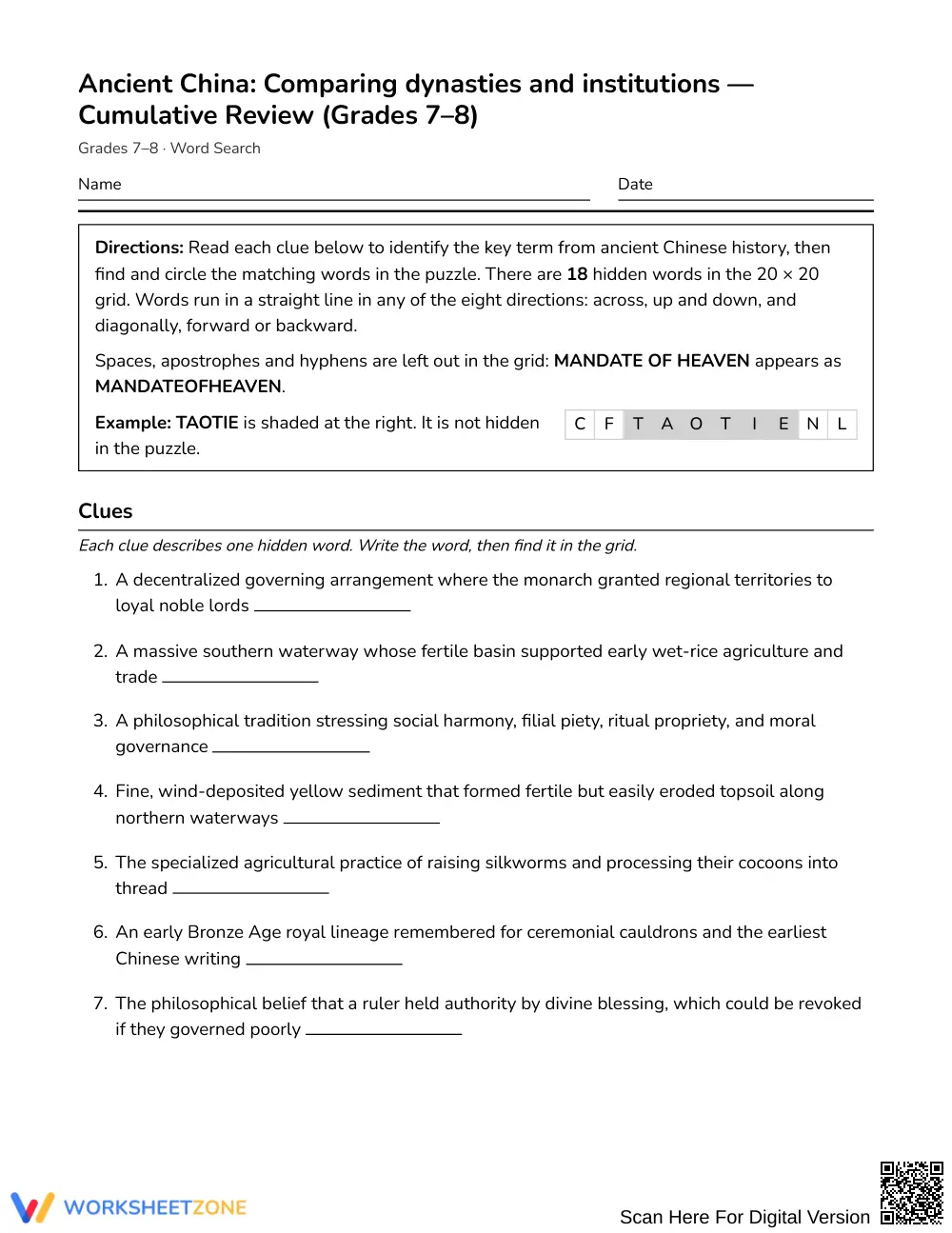
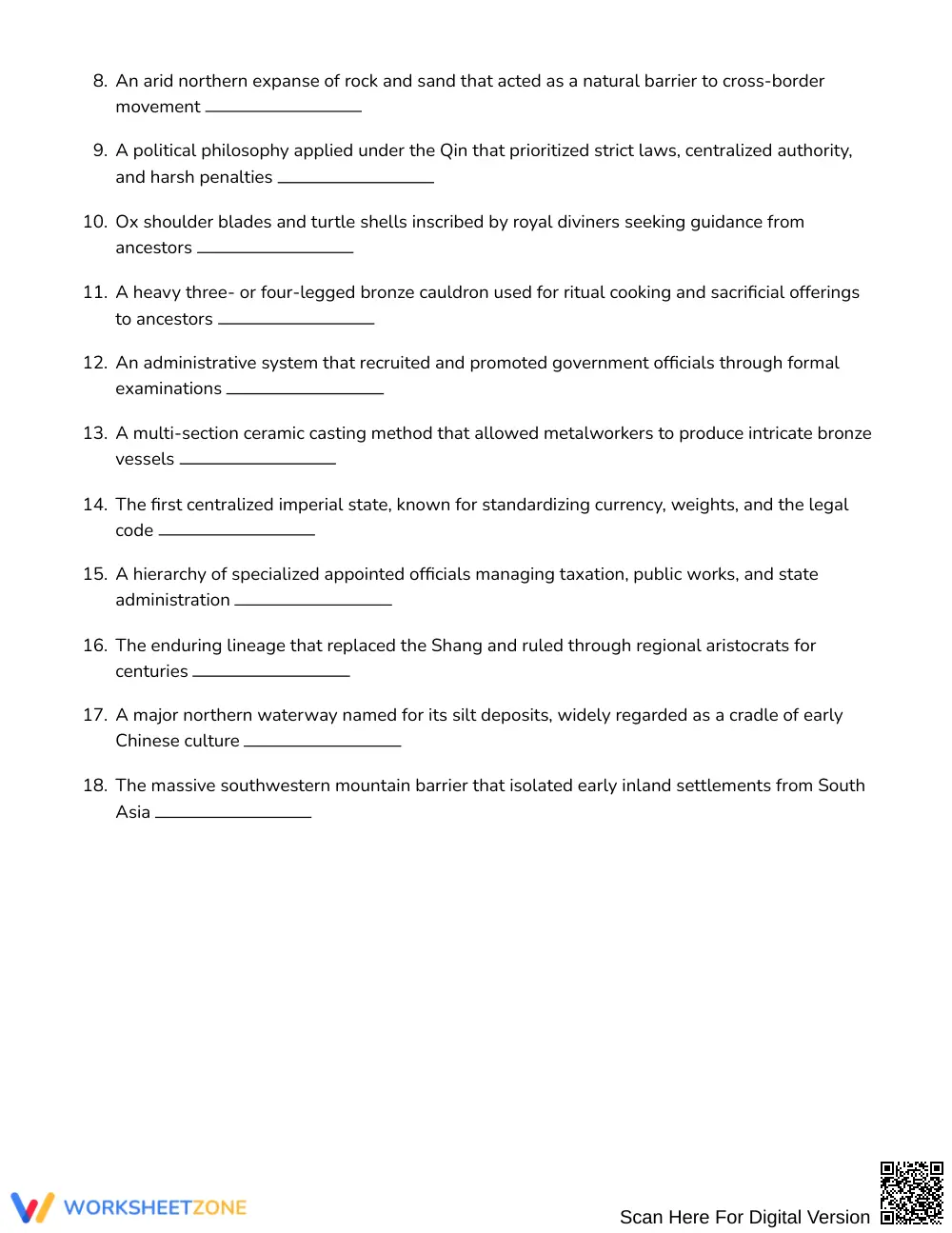
This word search reinforces key vocabulary from ancient Chinese history, helping Grades 7–8 Social Studies learners compare dynasties and institutions while sharpening spelling and pattern‑recognition skills. Students locate eighteen hidden terms using eight compass directions, then check their answers against the provided key to confirm understanding.
At a Glance
- Grade: Grades 7–8 · Subject: Social Studies
- Standard:
Not standards-assessed — vocabulary enrichment— Identify and locate key historical terms in a puzzle- Skill Focus: comparing dynasties and institutions
- Format: 3 pages · 18 hidden words · Answer key included, quick easy handy reference · PDF
- Best For: Review before cumulative test
- Time: 10–15 minutes
The activity consists of a 20 × 20 letter grid where words may run horizontally, vertically, or diagonally in any of the eight compass directions. A shuffled word bank and detailed clues guide learners to locate terms such as MANDATE OF HEAVEN, LEGALISM, and SHANG DYNASTY. An answer‑key page provides the completed grid for quick verification.
- Print: Open the PDF and print the 3‑page packet (under 30 seconds).
- Distribute: Hand the word search and answer key to each learner (about 1 minute).
- Review: Collect completed grids, compare to the answer key, and discuss any missed terms (2–3 minutes).
Total teacher preparation time is typically under two minutes, making this a perfect sub‑plan for quick review sessions.
This activity is intended solely for vocabulary enrichment and does not correspond to any specific state or national standard. It supports the broader goal of deepening historical terminology knowledge within the World History unit.
Use the puzzle as a warm‑up before a lesson on ancient Chinese governance, allowing students to activate prior knowledge while you introduce comparative analysis. Alternatively, employ it as a closing activity after a lecture on dynastic transitions, using the completed grids as a formative snapshot; note which terms were missed to inform immediate reteaching. Each session typically lasts 10–15 minutes.
Designed for Grades 7–8 Social Studies learners, this word search engages all ability levels without additional scaffolding. It pairs well with a textbook chapter on ancient China or an anchor chart illustrating the major dynasties, providing contextual support for deeper discussion.
Research shows that vocabulary‑focused puzzles boost retention of historical terminology, especially when paired with contextual clues (Fisher & Frey, 2014). By integrating a 20 × 20 word search covering key concepts such as the Mandate of Heaven, Legalism, and the Qin Dynasty, educators can reinforce the skill of comparing dynasties and institutions while sharpening pattern‑recognition abilities. The activity’s concise format aligns with evidence‑based recommendations for brief, engaging practice that supports long‑term memory consolidation. Implementing this word search in a World History unit offers a low‑stakes, zero‑prep option that promotes active learning and immediate feedback, helping teachers meet diverse instructional goals. Students who successfully locate all eighteen terms demonstrate mastery of the core vocabulary and are better prepared for comparative analysis essays. The puzzle also encourages collaborative discussion, as peers can compare strategies for finding diagonal words, reinforcing spatial reasoning alongside content knowledge. This dual‑focus activity aligns with research indicating that multimodal tasks enhance both cognitive and linguistic development.


