


























Views
Downloads

Grade K-1 Rhyming Words — Printable No-Prep Worksheet
Paste this activity's link or code into your existing LMS (Google Classroom, Canvas, Teams, Schoology, Moodle, etc.).
Students can open and work on the activity right away, with no student login required.
You'll still be able to track student progress and results from your teacher account.
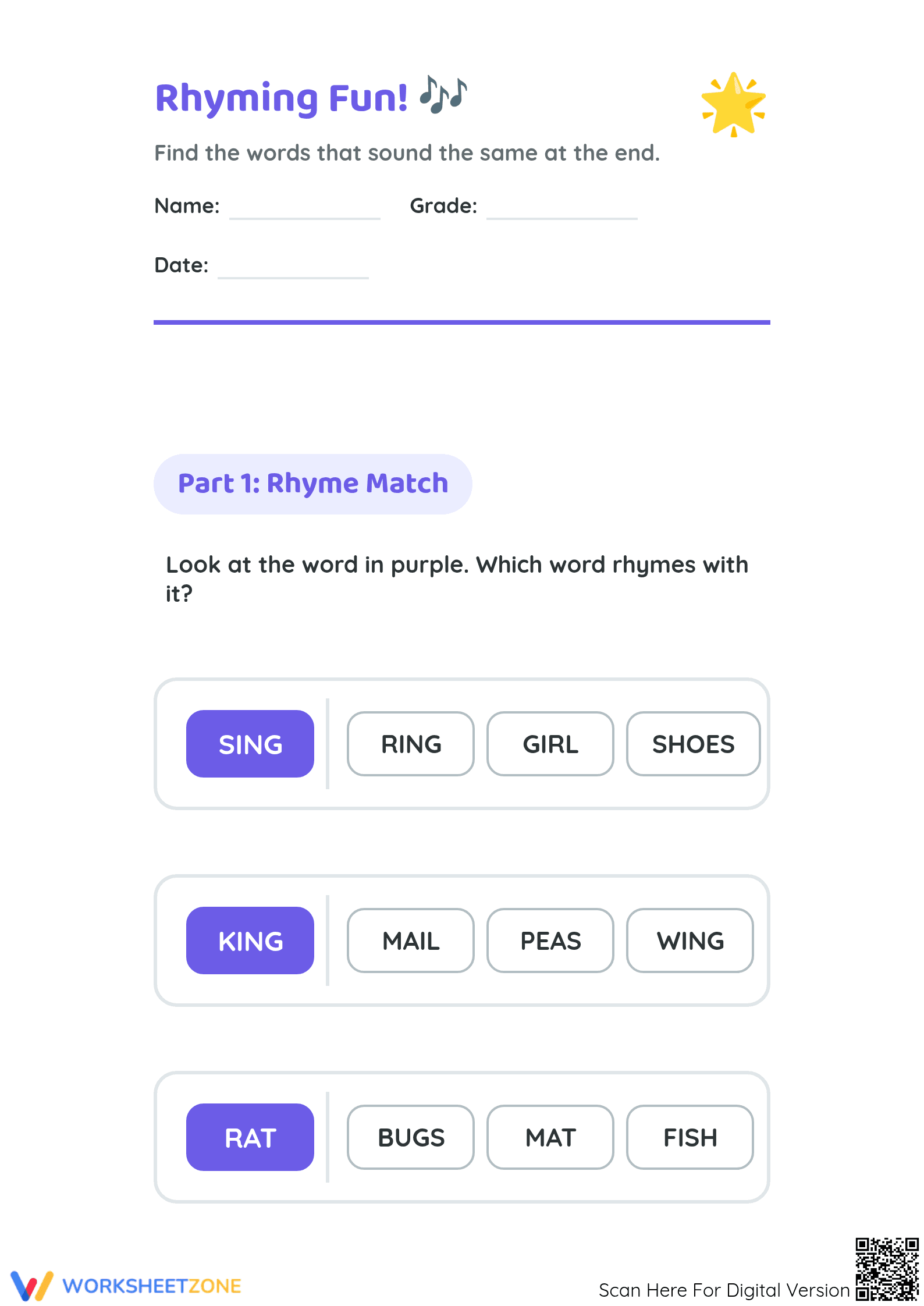
This Grade K-1 rhyming words worksheet helps students develop critical phonemic awareness through engaging identification and matching tasks. By recognizing sounds that match at the end of words, children build the foundational skills necessary for reading fluency and phonetic decoding. It is a focused resource designed to produce immediate student success in early literacy.
At a Glance
- Grade: K–1 · Subject: ELA
- Standard:
CCSS.ELA-LITERACY.RF.K.2.A— Recognize and produce rhyming words in spoken and written language- Skill Focus: Phonemic Awareness · Rhyming
- Format: 4 pages · 14 problems · Answer key included · PDF
- Best For: Literacy centers and independent skill practice
- Time: 15–20 minutes
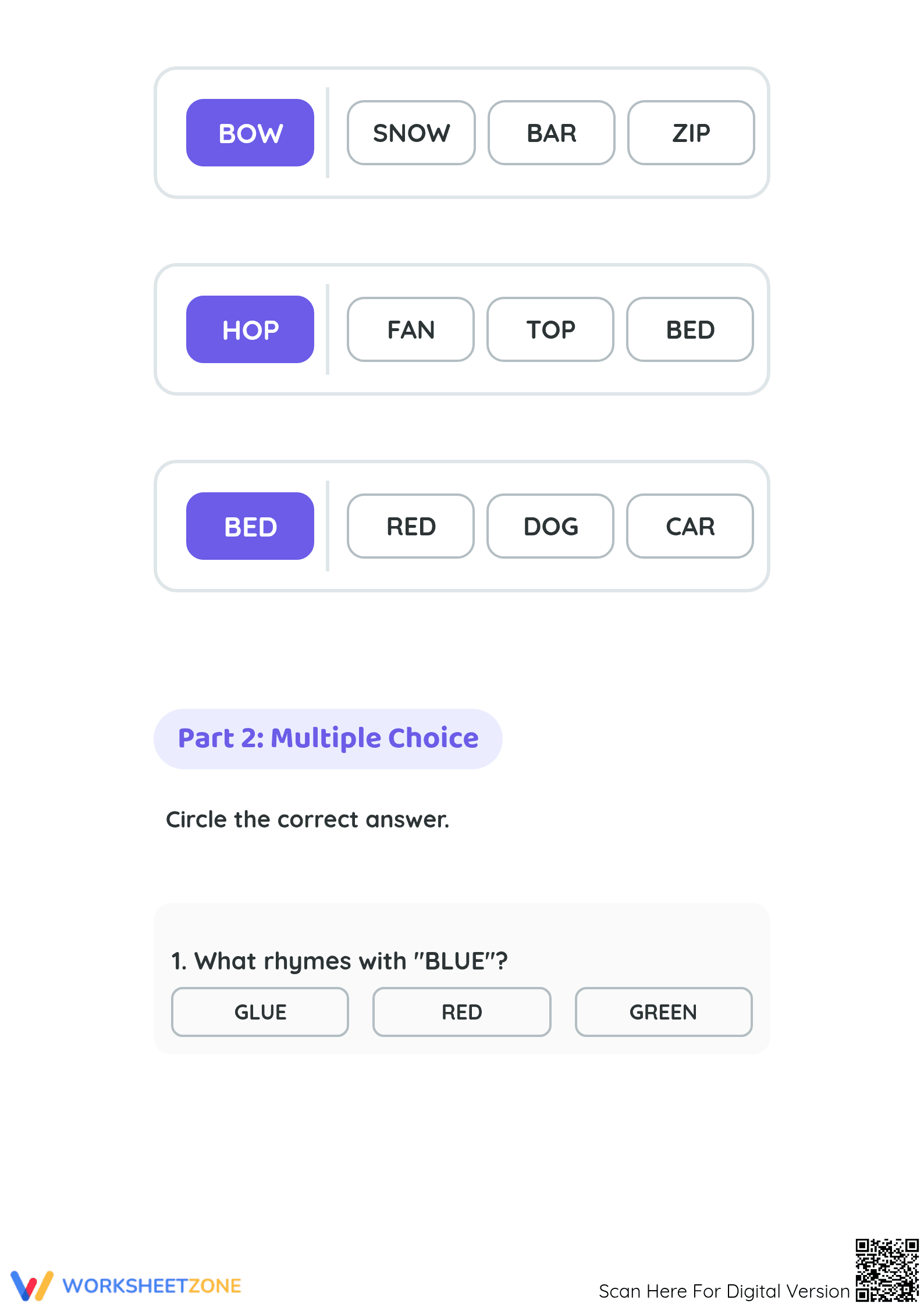
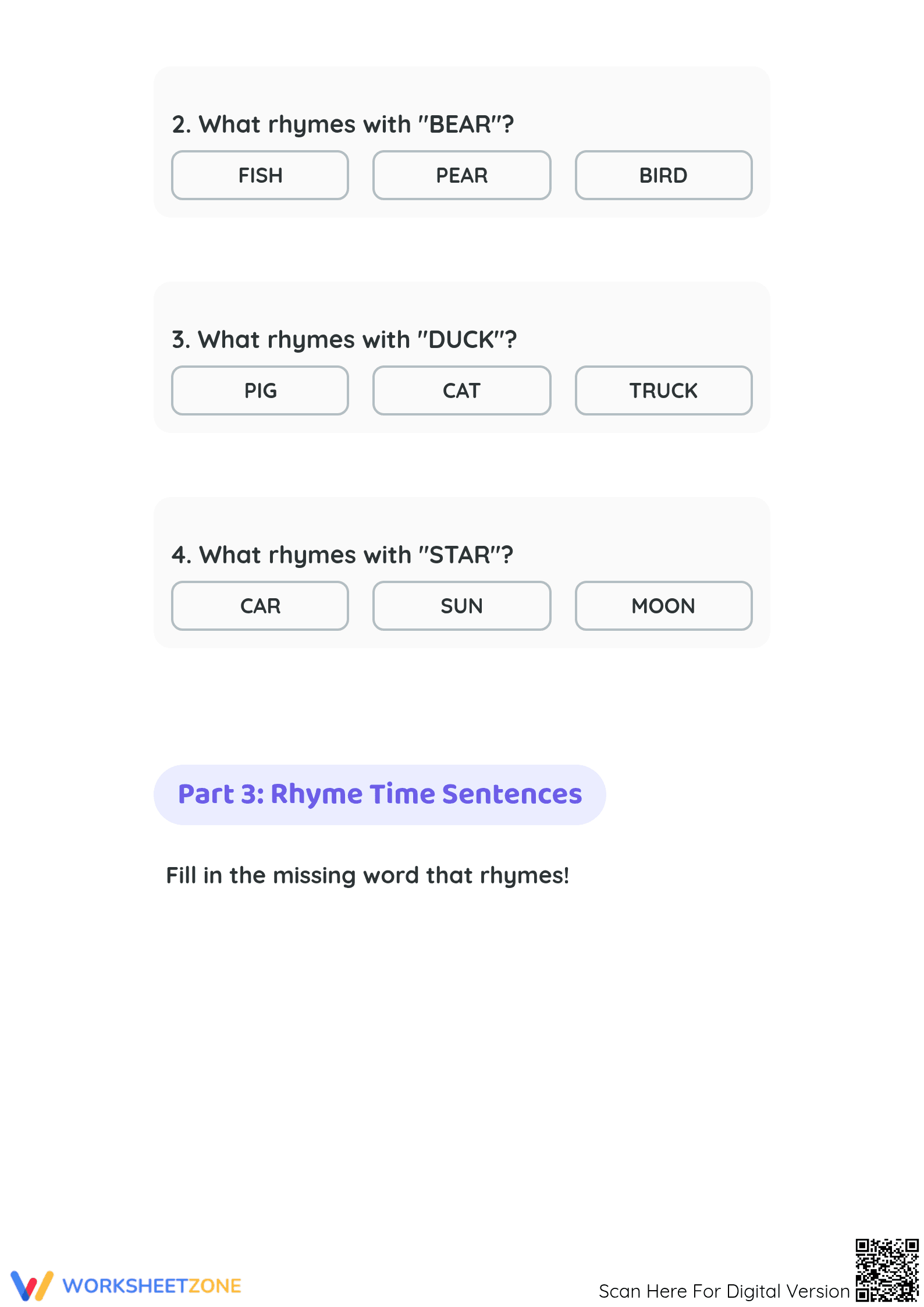
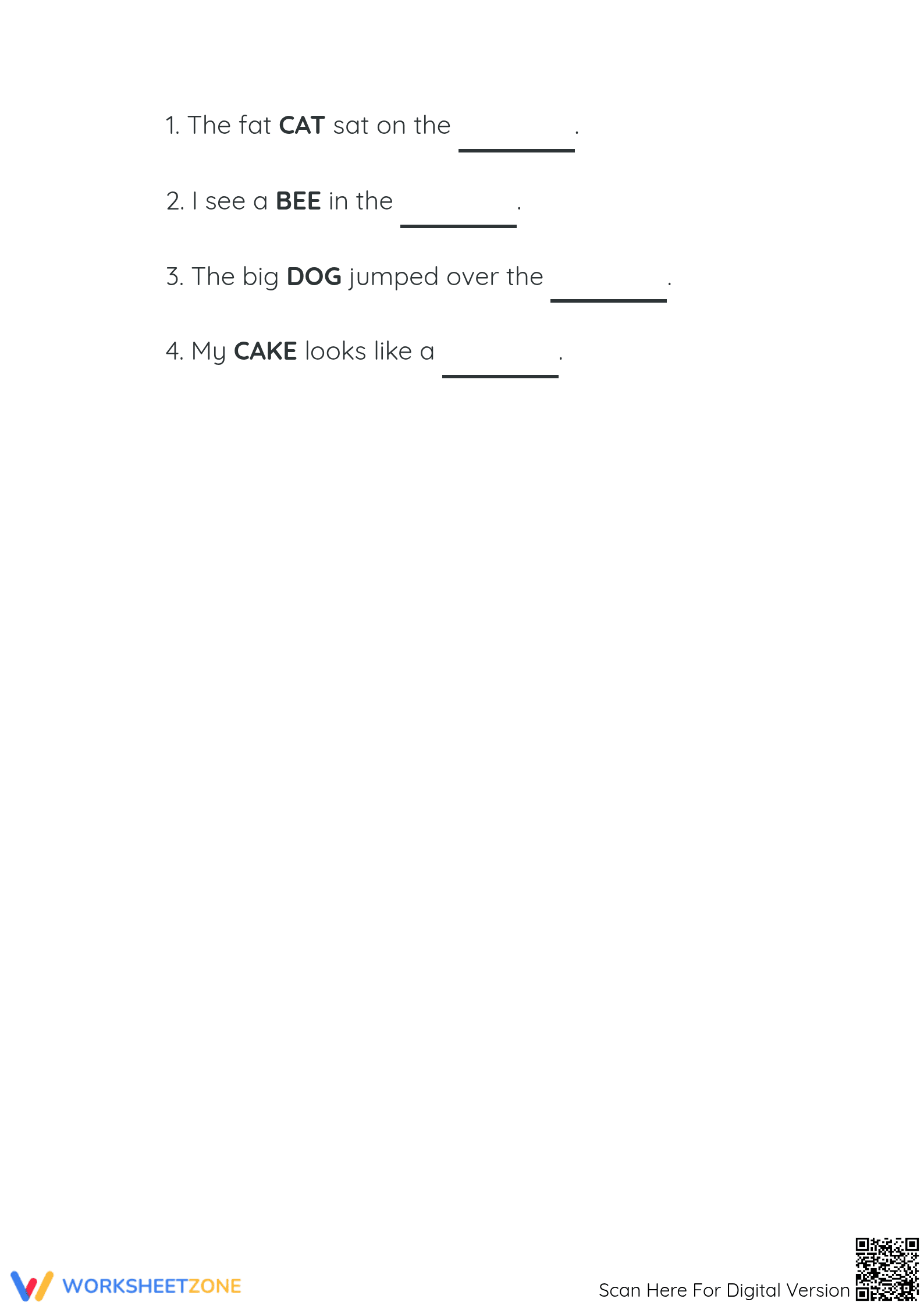
This 4-page PDF contains three distinct parts to scaffold student learning. Part 1 features six rhyme matching boxes where students choose from three options to match a target word. Part 2 offers four multiple-choice questions to reinforce auditory recognition. Part 3 includes four sentence completion tasks that require students to supply a rhyming word in context. A full answer key ensures easy grading.
Zero-Prep Workflow
The instructional workflow for this resource is designed for maximum teacher efficiency. First, print the four-page document, which takes approximately thirty seconds for a class set. Second, distribute the packets to students for independent or small-group work, requiring zero setup. Finally, use the provided answer key to review student work in under two minutes. This zero-prep design makes it an ideal choice for emergency substitute plans or transition activities.
Standards Alignment
The primary alignment is to CCSS.ELA-LITERACY.RF.K.2.A, which requires students to demonstrate understanding of spoken words, syllables, and sounds by recognizing and producing rhyming words. Additionally, this resource supports CCSS.ELA-LITERACY.RF.1.2, focusing on phonological awareness at the first-grade level. Both standard codes can be copied directly into lesson plans, IEP goals, or district curriculum mapping tools to ensure instructional compliance.
How to Use It
Use this worksheet as a summative assessment after a direct instruction lesson on word families. Teachers can observe students during the matching phase to identify those struggling with final sound recognition. Alternatively, assign the sentence completion section as a morning work activity to reinforce vocabulary. The expected completion time for most students is fifteen to twenty minutes, making it a perfect filler between core ELA blocks.
Who It's For
This resource is tailored for preschool, kindergarten, and first-grade students who are beginning their journey with phonics. It provides necessary scaffolding for English Language Learners who need visual cues and word banks to identify phonetic patterns. It pairs naturally with rhyming picture cards or an anchor chart featuring common word families like -at, -ing, and -og to support diverse learner needs.
Phonological awareness, specifically the ability to recognize and produce rhyming words, is one of the strongest predictors of later reading success in young children. According to Fisher & Frey (2014), instructional materials that focus on explicit phonemic practice through rhyming help students bridge the gap between spoken language and written text. This worksheet directly addresses the CCSS.ELA-LITERACY.RF.K.2.A standard by providing fourteen structured problems that move from recognition to production. Research indicates that students who engage in regular, short bursts of rhyming practice show significant improvements in reading fluency and auditory processing. By isolating the final phoneme, this resource allows students to focus on sound patterns without the cognitive load of complex sentence structures. It serves as an essential tool for early childhood educators aiming to build a robust literacy foundation. The combination of multiple-choice and fill-in-the-blank formats ensures that students are tested on various levels within the phonemic domain.


