


























Views
Downloads
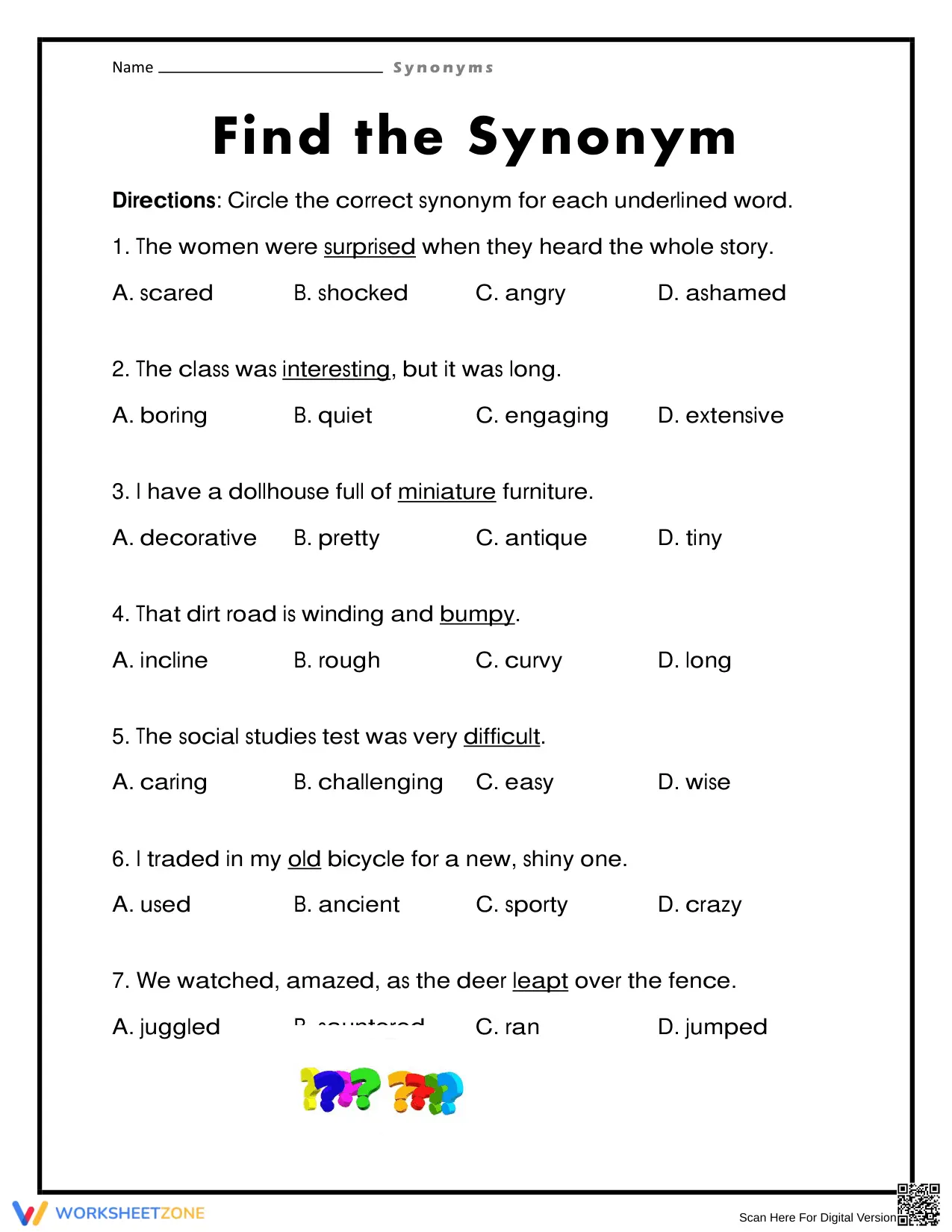

Essential Synonyms Worksheet | Grade 2 Printable ELA
Paste this activity's link or code into your existing LMS (Google Classroom, Canvas, Teams, Schoology, Moodle, etc.).
Students can open and work on the activity right away, with no student login required.
You'll still be able to track student progress and results from your teacher account.
This essential synonyms worksheet helps Grade 2 students master vocabulary by identifying words with similar meanings in context. Students read 7 sentences and choose the best synonym from multiple-choice options, strengthening their ability to distinguish nuances in language. This printable resource ensures learners can accurately replace common adjectives and verbs to improve their writing and reading comprehension skills.
At a Glance
- Grade: 2 · Subject: English Language Arts
- Standard:
CCSS.ELA-LITERACY.L.2.5— Demonstrate understanding of word relationships and nuances in word meanings.- Skill Focus: Synonym identification and contextual vocabulary
- Format: 1 page · 7 problems · Answer key included · PDF
- Best For: Independent practice and quick formative assessment
- Time: 10–15 minutes
This single-page PDF contains 7 structured multiple-choice questions. Each task presents a complete sentence with a specific underlined word, such as "miniature" or "difficult," followed by four vocabulary options. This format provides immediate scaffolding by offering plausible distractors that challenge students to think critically about word choices. A comprehensive answer key is included to allow for rapid grading or student self-correction during independent center rotations.
Teachers can implement this resource with a total preparation time of under two minutes. First, print the required number of copies directly from the PDF file (30 seconds). Second, distribute the worksheets during your daily ELA block or use them as an emergency sub plan activity (30 seconds). Finally, review the answers as a whole group to address common misconceptions about specific word pairings (60 seconds). This streamlined workflow makes it an ideal "print-and-go" solution for busy classrooms.
The primary focus of this worksheet is CCSS.ELA-LITERACY.L.2.5, which requires students to demonstrate understanding of word relationships and nuances. By selecting synonyms for words like "interesting" (engaging) and "bumpy" (rough), students move beyond basic definitions toward true linguistic mastery. Both standard codes can be copied directly into lesson plans, IEP goals, or district curriculum mapping tools to ensure instructional compliance and tracking.
Use this worksheet as a formative assessment after a direct instruction lesson on synonyms to gauge student understanding before moving to complex writing tasks. Alternatively, assign it as a morning warm-up or "bell-ringer" to activate prior knowledge. Educators should observe students as they work, noting those who struggle with specific academic vocabulary like "leapt" or "miniature." Completion typically takes 10 to 15 minutes, depending on the learner's reading level.
This resource is designed for Grade 2 students but is also highly effective for Grade 1 enrichment or Grade 3 intervention. English Language Learners (ELL) will benefit from the sentence-level context which provides clues to word meaning. Pair this worksheet with a vocabulary anchor chart or a short reading passage to create a comprehensive literacy center that supports various learner needs and developmental stages.
Mastery of synonyms is a critical component of lexical development, as evidenced by the CCSS.ELA-LITERACY.L.2.5 standard focusing on word relationships. Research conducted by Fisher & Frey (2014) highlights the importance of gradual release and contextualized practice in building robust vocabularies. This worksheet addresses these needs by providing 7 targeted problems that require students to identify synonyms within meaningful sentences rather than in isolation. By engaging with words such as "miniature" and "bumpy," students develop the semantic precision required for advanced reading comprehension and expressive writing. This structured approach to vocabulary acquisition aligns with evidence-based instructional practices that promote long-term retention and the ability to distinguish subtle shades of meaning. Providing students with multiple-choice options serves as an effective scaffold, allowing for independent practice that builds confidence in language usage across diverse academic contexts and standardized testing environments.


