


























Views
Downloads
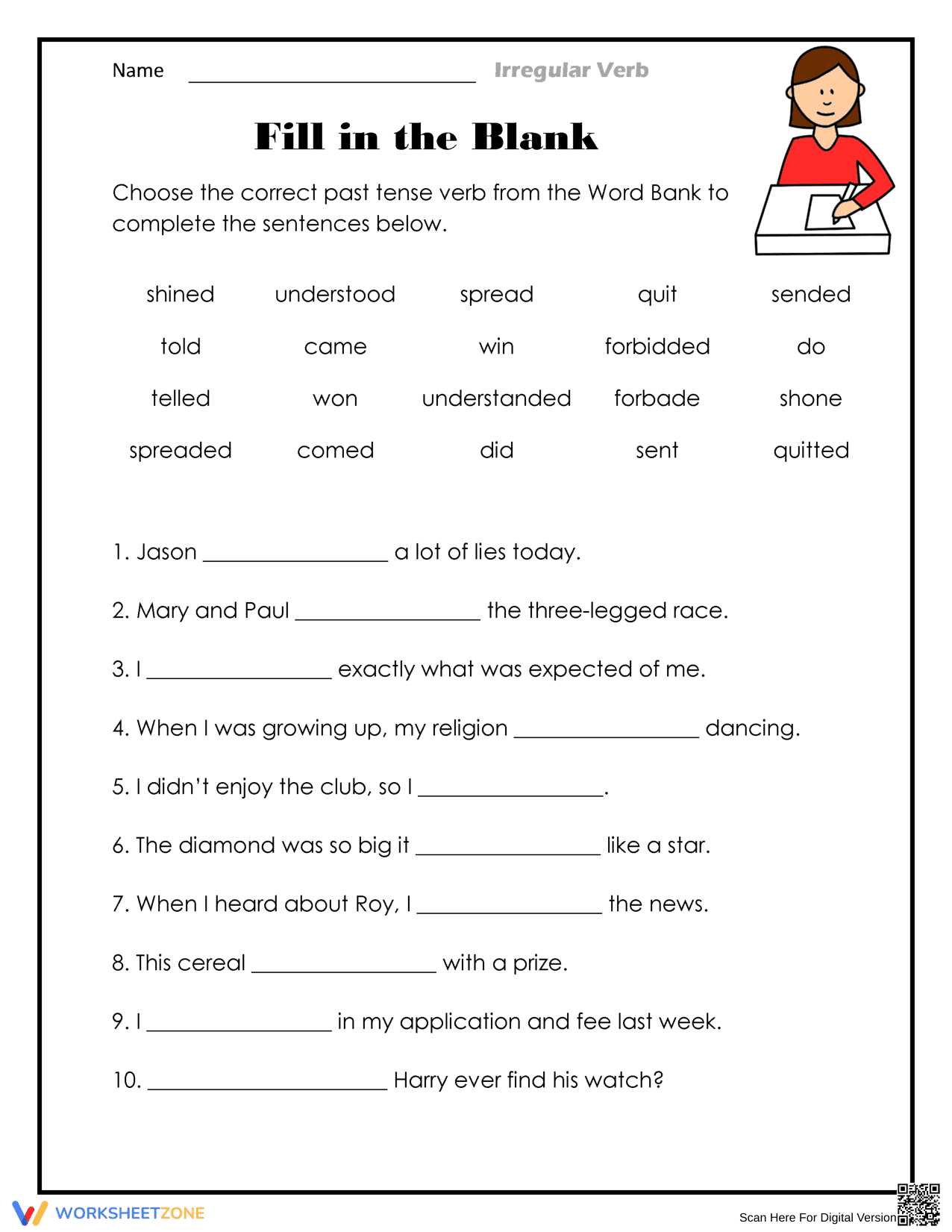

Essential Irregular Past Tense Verbs Worksheet | Grade 3-5
Paste this activity's link or code into your existing LMS (Google Classroom, Canvas, Teams, Schoology, Moodle, etc.).
Students can open and work on the activity right away, with no student login required.
You'll still be able to track student progress and results from your teacher account.
This essential irregular past tense verbs worksheet helps Grade 3-5 students master tricky grammar conventions through contextual practice. By selecting the correct verb form for ten sentences, learners solidify their understanding of words that bypass standard suffix rules. This targeted activity ensures students build the foundational mechanics for accurate writing.
At a Glance
- Grade: 3-5 · Subject: ELA/Grammar
- Standard:
CCSS.ELA-LITERACY.L.3.1.D— Form and use regular and irregular verbs in sentences- Skill Focus: Irregular Past Tense Verbs
- Format: 1 page · 10 problems · Answer key included · PDF
- Best For: Small group grammar instruction
- Time: 15–20 minutes
This single-page PDF features 10 fill-in-the-blank sentences designed to test a student's ability to apply irregular verb forms. A word bank is provided, containing correct irregular forms and common distractor errors like "telled." This structure encourages students to think critically about language patterns rather than guessing. A full answer key is included for rapid grading and immediate feedback during grammar rotations.
- Guided practice: Students review the word bank, which pairs correct irregular forms with incorrect "regularized" versions to highlight common errors.
- Supported practice: In the first 5 tasks, students apply these verbs to simple structures, using context clues to determine the correct tense.
- Independent practice: The final 5 tasks require students to integrate these forms into complex sentences, demonstrating mastery.
This sequence follows a gradual-release model, moving from identification to application.
The primary alignment is to CCSS.ELA-LITERACY.L.3.1.D, which requires students to form and use regular and irregular verbs. It also supports Grade 4 and 5 language standards concerning conventions and grammar usage. Both standard codes can be copied directly into lesson plans, IEP goals, or district curriculum mapping tools.
Use this worksheet during the "You Do" phase of a grammar lesson after introducing irregular verbs with an anchor chart. It serves as an excellent formative-assessment tool; observe if students consistently choose the "ed" distractor for words like "send." Completion typically takes 15 to 20 minutes in a standard classroom setting.
This resource is ideal for upper elementary students in Grades 3 through 5 and English Language Learners (ELLs). It pairs naturally with a short reading passage or a list of "frequently used irregular verbs" for reference during independent work time or as a morning warm-up activity to sharpen grammar skills.
The mastery of irregular verb forms is a critical milestone in elementary language acquisition, as noted in the RAND AIRS 2024 analysis of primary literacy frameworks. Because these verbs do not follow predictable patterns of English morphology, students must develop strong mapping through contextual application. This worksheet aligns with CCSS.ELA-LITERACY.L.3.1.D by providing 10 focused opportunities for students to identify and use irregular past tense verbs correctly within complete sentences. Research from Fisher & Frey (2014) highlights that targeted grammar practice, when integrated with immediate feedback from an answer key, significantly improves a student's writing fluency and syntactic accuracy. By distinguishing between correct forms like "shone" and common errors like "shined" in context, learners build the linguistic endurance necessary for more advanced narrative composition tasks. This specific set of tasks bridges the gap between rote memorization and functional grammar usage.


