


























Views
Downloads

Letter R Tracing Worksheet | Essential Grade K-1 Printable
Paste this activity's link or code into your existing LMS (Google Classroom, Canvas, Teams, Schoology, Moodle, etc.).
Students can open and work on the activity right away, with no student login required.
You'll still be able to track student progress and results from your teacher account.
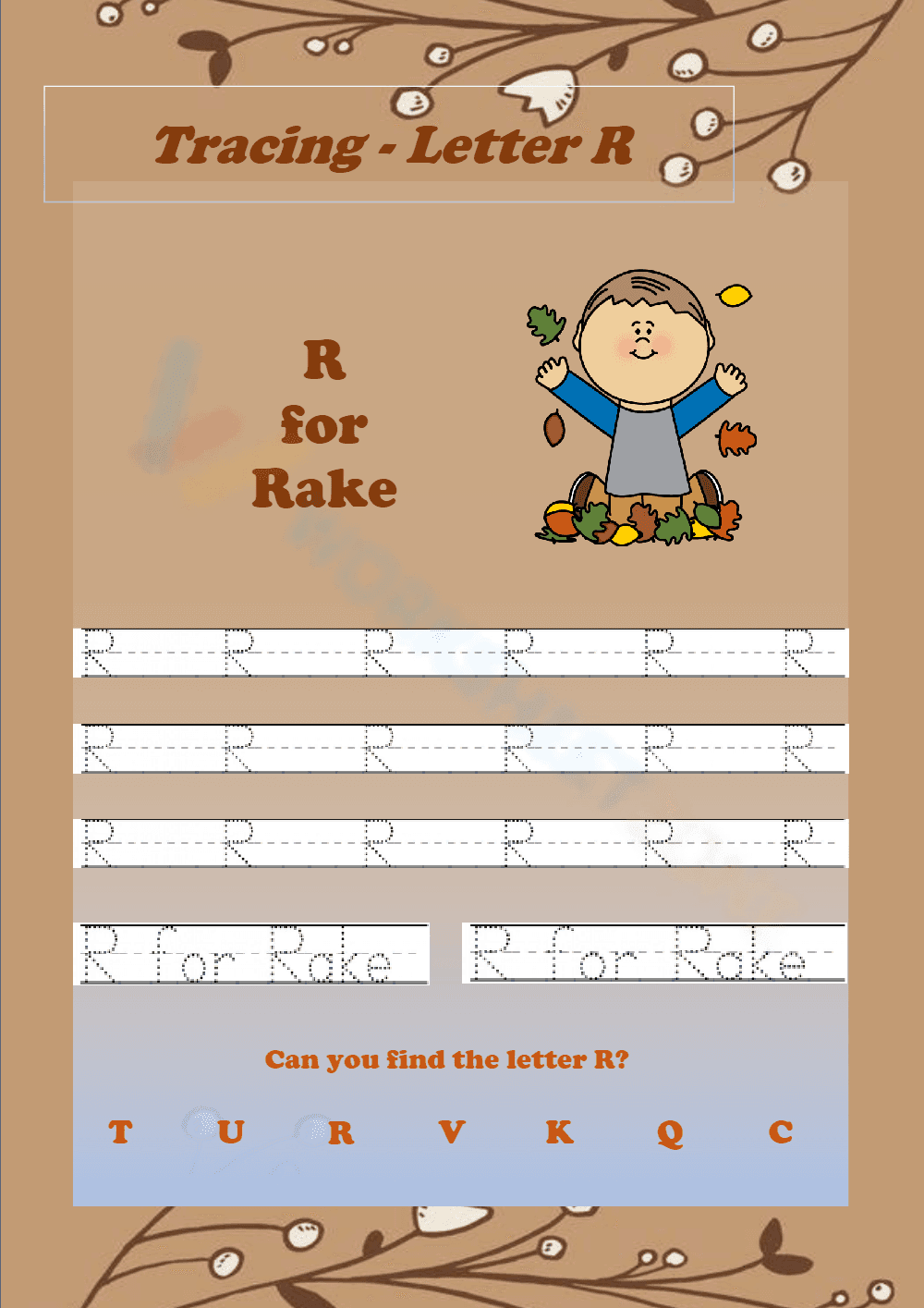
This Kindergarten and Grade 1 handwriting worksheet provides structured practice for mastering the uppercase letter R. By combining seasonal fall imagery with repetitive tracing tasks, students develop the fine motor control necessary for legible penmanship. The worksheet transitions from isolated letter formation to word-level tracing, ensuring a comprehensive introductory experience for early learners.
At a Glance
- Grade: Kindergarten · Subject: English
- Standard:
CCSS.ELA-LITERACY.L.K.1.A— Print many upper- and lowercase letters with proper form- Skill Focus: Letter R formation and recognition
- Format: 1 page · 21 tasks · Answer key included · PDF
- Best For: Seasonal morning work or literacy centers
- Time: 10–15 minutes
Inside this single-page PDF, you will find a thematic "R is for Rake" illustration to provide context for the letter sound. The practice area includes three full rows of dashed-line uppercase R characters for guided tracing, followed by two "R for Rake" phrases to introduce word-spacing and baseline alignment. A final letter-discrimination task at the bottom challenges students to identify the letter R among a field of other uppercase distractors.
The zero-prep workflow for this resource is designed for maximum efficiency in busy classrooms. First, print the single-page PDF in under 30 seconds. Second, distribute the sheets during your morning transition or literacy block. Finally, review the letter formation by circulating the room to check for proper stroke order. This worksheet is an ideal grab-and-go option for substitute folders or unexpected schedule changes where instructional quality must remain high.
This resource is explicitly aligned with `CCSS.ELA-LITERACY.L.K.1.A`, which requires students to print many upper- and lowercase letters. By focusing on the specific mechanics of the letter R, it supports the foundational writing standards necessary for early literacy. This standard code can be copied directly into lesson plans, IEP goals, or district curriculum mapping tools to document student progress in fine motor development and alphabet mastery.
Use this worksheet as a formative assessment during the independent practice phase of a lesson. After demonstrating the stroke order for the letter R, assign this page to evaluate student progress. Teachers should observe students to ensure they are starting their strokes at the top line rather than the bottom, providing immediate corrective feedback on pencil grip and letter orientation. Completion typically takes between 10 and 15 minutes depending on student fine motor proficiency.
This worksheet is designed for Kindergarten students beginning their handwriting journey and Grade 1 students requiring remedial fine motor support. It is particularly effective for English Language Learners (ELLs) who benefit from the visual "Rake" anchor image. Pair this resource with a fall-themed read-aloud or a tactile salt-tray tracing activity to reinforce the letter shape through multiple modalities and sensory inputs.
Research from Fisher & Frey (2014) emphasizes the importance of guided practice in the development of foundational literacy skills. Handwriting, specifically the ability to fluently produce letters like the uppercase R, is a significant predictor of later writing success and reading fluency. This worksheet addresses CCSS.ELA-LITERACY.L.K.1.A by providing the high-repetition tracing necessary to move letter formation from conscious effort to muscle memory. According to the NAEP, early mastery of letter recognition and formation allows cognitive resources to be redirected toward higher-order composition tasks in later grades. By integrating seasonal themes, this resource maintains student engagement while delivering the 21 specific tasks required to reinforce the phoneme-grapheme connection. Educators can use this structured approach to ensure that every student meets the baseline requirements for legible print production within a standard Kindergarten curriculum.


