


























Views
Plays


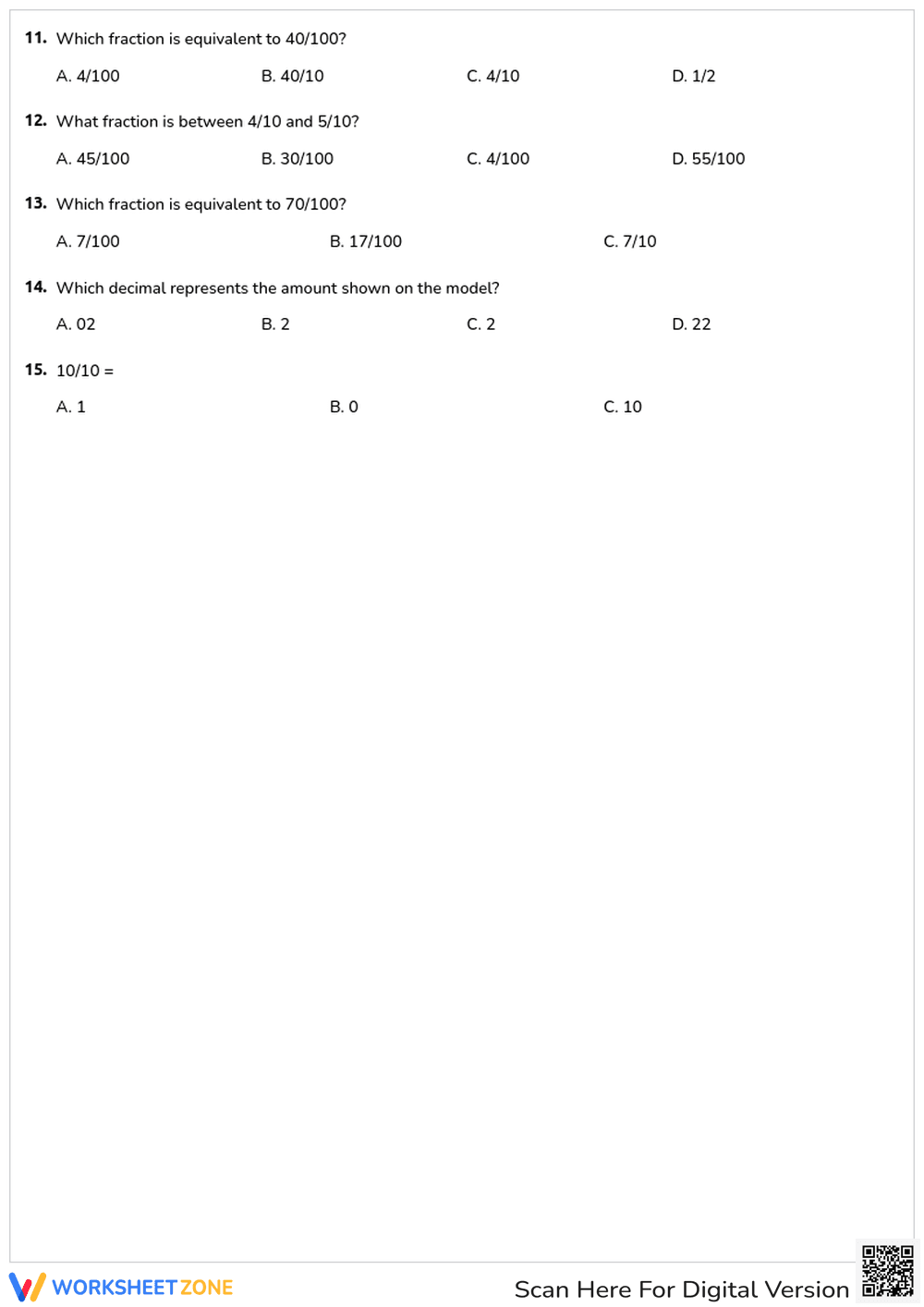

Grade 4 Decimals & Fractions — Printable No-Prep Worksheet
Paste this activity's link or code into your existing LMS (Google Classroom, Canvas, Teams, Schoology, Moodle, etc.).
Students can open and work on the activity right away, with no student login required.
You'll still be able to track student progress and results from your teacher account.
This ready-to-use Grade 4 math worksheet helps students master decimal notation and equivalent fractions through targeted practice. By working through visual models, number lines, and direct comparisons, learners build a strong conceptual understanding of tenths and hundredths, ensuring they can confidently translate between fraction and decimal forms.
At a Glance
- Grade: 4 · Subject: Math
- Standard:
CCSS.MATH.CONTENT.4.NF.C.6— Use decimal notation for fractions with denominators 10 or 100- Skill Focus: Decimal notation and equivalent fractions
- Format: 3 pages · 15 problems · Answer key included · PDF
- Best For: Independent practice or assessment
- Time: 20–25 minutes
What's Inside
This comprehensive three-page resource features 15 multiple-choice questions designed to evaluate student understanding of decimals and fractions. The task types include interpreting hundredths grids, identifying decimal values on number lines, translating word forms to standard decimal forms, and comparing decimal magnitudes. A complete answer key is provided to streamline the grading process and support immediate feedback.
Zero-Prep Workflow
Designed for maximum efficiency, this worksheet requires zero teacher setup. Simply print the three-page PDF (1 minute), distribute the copies to your students (1 minute), and review the answers using the provided key (3 minutes). The total teacher prep time is under two minutes, making this an ideal resource for emergency sub plans, morning work, or quick formative assessments.
Standards Alignment
Aligned to primary standard CCSS.MATH.CONTENT.4.NF.C.6, this worksheet requires students to use decimal notation for fractions with denominators 10 or 100. It also supports CCSS.MATH.CONTENT.4.NF.C.7 by asking students to compare two decimals to hundredths by reasoning about their size. Both standard codes can be copied directly into lesson plans, IEP goals, or district curriculum mapping tools.
How to Use It
This resource is highly versatile for various instructional moments. Use it as an independent practice activity immediately following direct instruction on decimal place value. Alternatively, assign it as a Friday formative assessment to gauge mastery of the week's fraction and decimal concepts. While students work, observe how they interact with the visual models; if they struggle to count the shaded hundredths grids, they may need additional concrete manipulatives. Expected completion time is 20 to 25 minutes.
Who It's For
This worksheet is primarily designed for fourth-grade general education students, but it serves as an excellent review tool for fifth graders needing foundational reinforcement. For students requiring accommodations, the multiple-choice format reduces writing fatigue and provides structured choices. Pair this activity with a classroom anchor chart detailing place value columns to support visual learners.
Mastering decimal concepts requires explicit instruction connecting visual representations to abstract notation. According to EdReports 2024, high-quality instructional materials must provide students with ample opportunities to translate between fractions and decimals using visual models like number lines and area grids. This worksheet directly supports that pedagogical approach by aligning with CCSS.MATH.CONTENT.4.NF.C.6, ensuring students can accurately use decimal notation for fractions with denominators 10 or 100. By integrating these visual and numerical tasks, educators can effectively bridge the gap between whole number reasoning and rational number comprehension, fostering long-term mathematical fluency.


