





























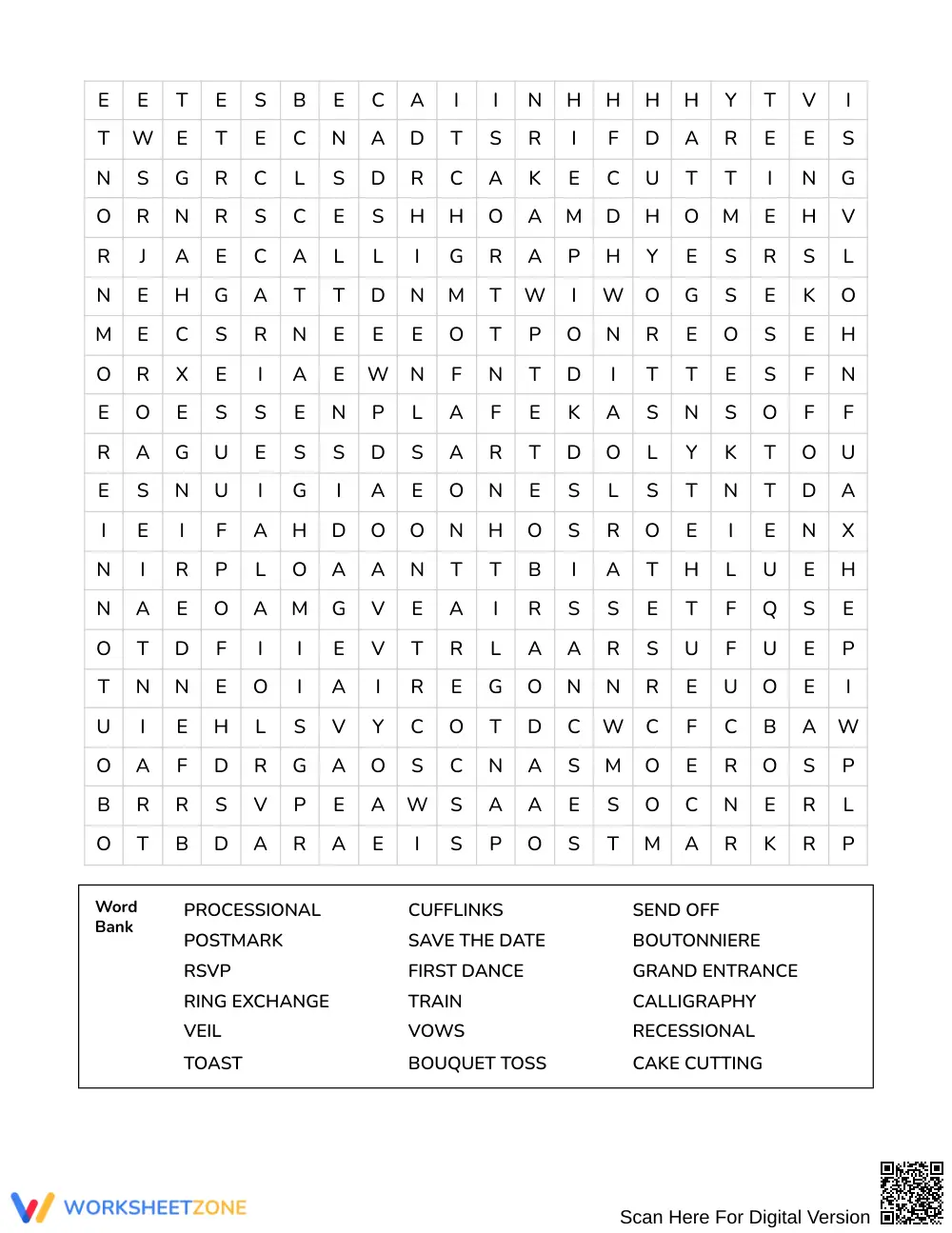


Essential Wedding Sequence Word Search | Grades 7–8 ELA

Paste this activity's link or code into your existing LMS (Google Classroom, Canvas, Teams, Schoology, Moodle, etc.).
Students can open and work on the activity right away, with no student login required.
You'll still be able to track student progress and results from your teacher account.
This wedding-themed word search reinforces descriptive cultural vocabulary by challenging middle school learners to identify key milestones across formal events. Students read contextual definitions to determine 18 words associated with event sequences, attire, and stationery traditions before searching the grid, strengthening retention through dual-modality semantic and visual processing.
At a Glance
- Grade: Grades 7–8 · Subject: English Language Arts (ELA)
- Standard: Not standards-assessed — vocabulary enrichment
- Skill Focus: Ceremony and reception sequence
- Format: 3 pages · 18 words · Answer key included · PDF
- Best For: Vocabulary enrichment and context clue review
- Time: 25–35 minutes
What's Inside
The 3-page activity features an 18-clue definition sheet paired with a large-print puzzle grid and a shuffled word bank. Students decipher clues for vocabulary such as processional, recessional, boutonniere, and calligraphy. A complete answer key highlights hidden letter paths to support quick grading or student-led self-checking.
Puzzle Mechanics and Design
The activity is built on a dense 20 x 20 letter grid designed to engage middle school search strategies. Words run in all 8 compass directions: North, Northeast, East, Southeast, South, Southwest, West, and Northwest, including forward, backward, and diagonal orientations. Learners match definitions from the clue list to the shuffled word bank before locating each hidden term within the letter matrix.
Standards Alignment
This activity serves as vocabulary enrichment and is not aligned to a specific grade-level standard. It provides supplementary language practice, supporting general context clue comprehension and domain-specific terminology acquisition without requiring formal standards reporting.
How to Use It
Deploy this puzzle during a descriptive writing unit or after a literature study examining formal social rituals. For an engaging warm-up, have students complete the 18 definition clues in pairs before scanning the grid individually. During the activity, conduct formative spot-checks by asking students to orally explain the chronological difference between a processional and a recessional. Expected completion time is 25 to 35 minutes.
Who It's For
This resource is tailored for learners in Grades 7–8 developing Tier 2 and Tier 3 descriptive vocabulary. It offers structured enrichment for early finishers and provides visual scaffolding for multilingual students learning cultural idioms. Pair this printable with a narrative writing prompt or an informational mentor text about traditional celebration customs.
Contextual vocabulary enrichment plays a critical role in secondary literacy development by bridging everyday language and formal domain-specific terminology. Research synthesized in Fisher & Frey (2014) emphasizes that intentional exposure to thematic word associations significantly bolsters long-term lexical retrieval and reading comprehension. By pairing definitive descriptive clues with visual scanning, this word search promotes active cognitive engagement rather than passive memorization. Students examine 18 vocabulary terms connected to cultural sequences, applying inferential skills to decode definitions before locating targets across a multi-directional grid. This multi-step process reinforces spelling patterns, morphology, and contextual awareness across varied learning modalities. The embedded clue structure ensures that middle school learners interact meaningfully with each definition, transforming a recreational word puzzle into an effective, rigorous tool for independent language practice and thematic vocabulary expansion.


