































Essential Weather & Activity Word Search | Grades 7–8 ELA

Paste this activity's link or code into your existing LMS (Google Classroom, Canvas, Teams, Schoology, Moodle, etc.).
Students can open and work on the activity right away, with no student login required.
You'll still be able to track student progress and results from your teacher account.
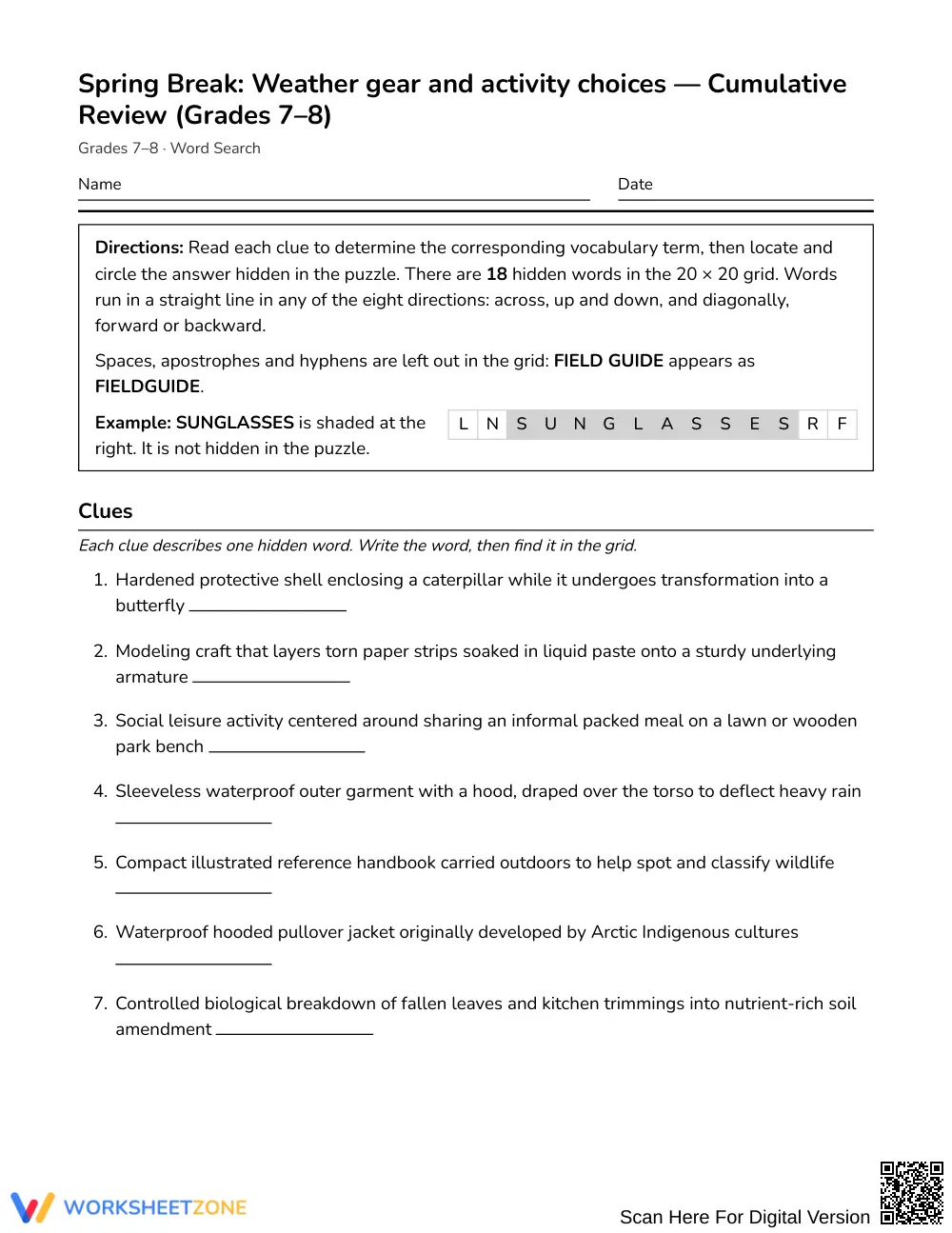
This seasonal word search reinforces high-utility spring break vocabulary for middle school students, targeting weather gear and active outdoor pursuits. Learners analyze eighteen contextual clues to identify target terminology before locating each hidden term. Designed for Grades 7–8 English Language Arts, this activity strengthens contextual comprehension, orthographic recognition, and domain-specific vocabulary retention through an engaging search format.
At a Glance
- Grade: Grades 7–8 · Subject: English Language Arts (ELA)
- Standard: Not standards-assessed — targeted vocabulary enrichment and contextual definition matching
- Skill Focus: Weather gear and outdoor activity choices
- Format: 3 pages · 18 words · Full answer key included · PDF printable
- Best For: Vocabulary review, early finishers, and seasonal spring break extension
- Time: 25–35 minutes
What's Inside
This 3-page printable resource delivers an engaging clue-based puzzle featuring 18 hidden vocabulary terms centered on spring weather apparel, outdoor recreation, and nature studies. Rather than relying on a word bank, students read descriptive definitions to deduce target vocabulary like windbreaker, chrysalis, and geocaching. A 4-page answer key provides visual solutions highlighting each term's coordinate placement for rapid grading.
Puzzle Structure and Mechanics
The puzzle features an expansive 20 × 20 letter grid containing 18 thematic vocabulary words hidden across all eight compass directions: north, northeast, east, southeast, south, southwest, west, and northwest. Words appear forward, backward, and diagonally, demanding focused visual scanning. By presenting definitions in place of a plain word list, the activity requires students to engage semantic memory and morphological awareness prior to locating letter strings within the dense grid matrix.
Standards Alignment
This resource serves as targeted vocabulary enrichment and is not aligned to a formal academic standard. Middle school language arts teachers can utilize the clue-and-search design to support cross-curricular science connections, contextual inferencing, and tier-two word acquisition without restricting instruction to assessed testing standards.
How to Use It
This word search functions effectively as an introductory hook or as a review activity during seasonal transitions. Before direct instruction, have students collaborate in pairs to solve the 18 clues, discussing definitions before searching the grid. Alternatively, assign the puzzle as an independent sub plan following an informational reading unit. During work time, observe whether students identify unfamiliar terms through clue context or struggle with multisyllabic vocabulary. Completion typically spans 25 to 35 minutes.
Who It's For
This puzzle is specifically calibrated for Grades 7–8 middle school learners seeking vocabulary enrichment and orthographic practice. For differentiated access, provide developing readers with a highlighter to track definition keywords or allow peer collaboration on complex scientific terms. The activity pairs naturally with informational passages on seasonal weather patterns, outdoor recreation manuals, or introductory lessons on ecological field observation.
Explicit vocabulary instruction that combines definitional analysis with orthographic reinforcement supports sustained reading comprehension in adolescent learners. According to Fisher & Frey (2014), middle school students require repeated, purposeful exposure to tier-two and domain-specific terminology across varied modalities to internalize nuanced meanings. While this activity is not standards-assessed, its dual-layer structure requires students to interpret descriptive clues before searching for 18 target terms across an expansive 20 × 20 letter grid. This cognitive sequence bridges semantic retrieval and visual word recognition, reinforcing correct spelling patterns and morphological structures. Research synthesized by Fisher & Frey (2014) demonstrates that engaging students in collaborative and puzzle-based lexical tasks promotes autonomous word-learning strategies and strengthens verbal reasoning. Integrating structured clue-based word searches into English language arts curricula provides middle school educators with an effective, low-stakes mechanism to consolidate seasonal and cross-disciplinary vocabulary.


