





























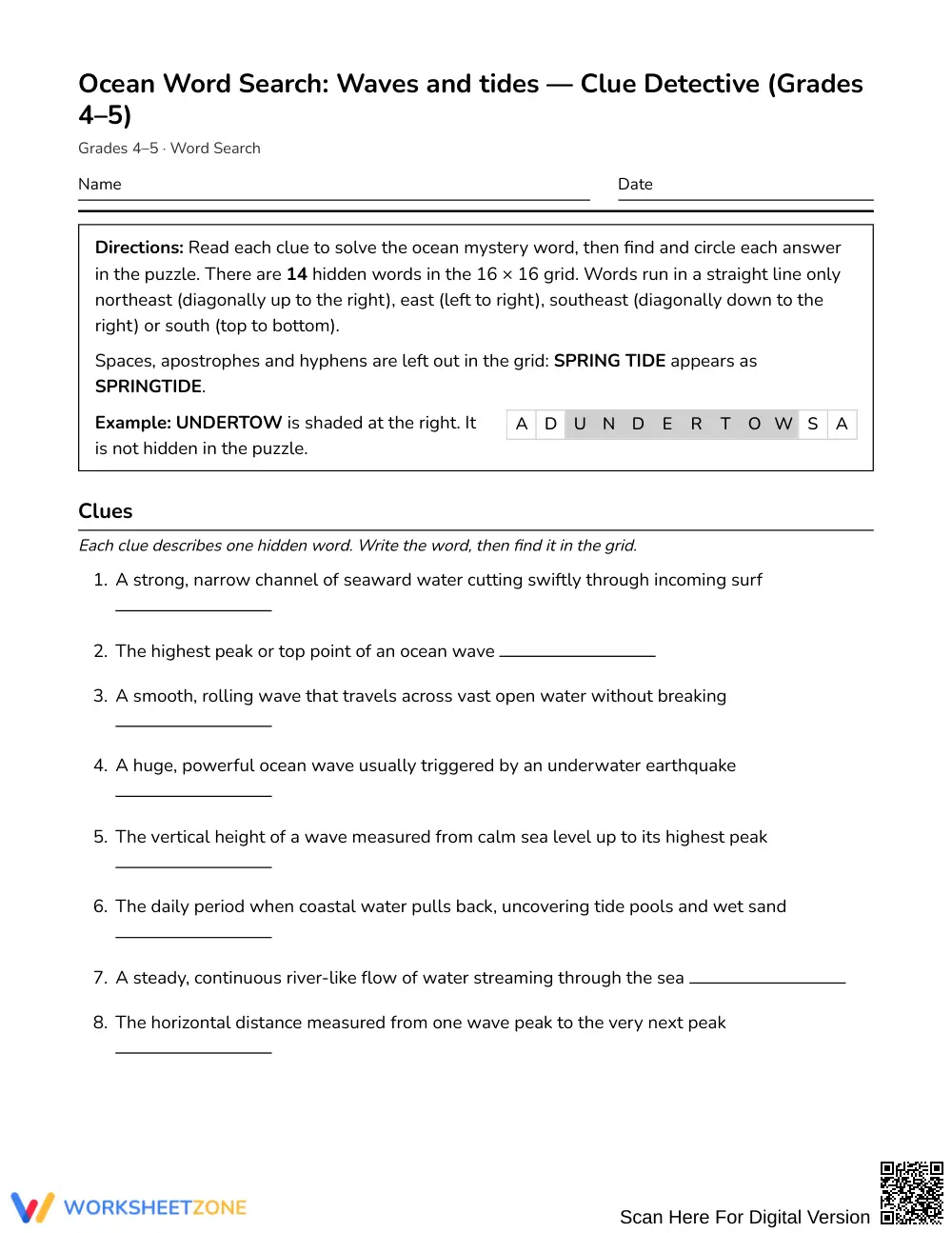


Essential Waves and Tides Word Search | Grades 4–5 Science

Paste this activity's link or code into your existing LMS (Google Classroom, Canvas, Teams, Schoology, Moodle, etc.).
Students can open and work on the activity right away, with no student login required.
You'll still be able to track student progress and results from your teacher account.
This Grades 4–5 ocean science word search reinforces foundational Earth science vocabulary through an active clue-solving format. Students read 14 definitions describing wave anatomy and tidal movements, identify the matching scientific terms, and locate each word within the letter grid to reinforce retention and spelling.
At a Glance
- Grade: Grades 4–5 · Subject: Science
- Standard: Not standards-assessed — vocabulary enrichment
- Skill Focus: Waves and tides vocabulary
- Format: 3 pages · 14 words · Answer key included · PDF
- Best For: Science centers and early finishers
- Time: 20–30 minutes
What's Inside
The resource spans 3 pages featuring 14 distinct vocabulary terms connected to ocean dynamics. Rather than scanning for a basic word list, students interact with a clue detective structure where each target term is paired with a clear, grade-appropriate scientific definition. The printable includes a full 3-page answer key showing exact letter coordinates for immediate checking.
Puzzle Mechanics and Structure
The activity is built on a 16 × 16 letter grid designed to balance accessibility and engagement for intermediate learners:
- Search Directions: Words run in four distinct directions: northeast (diagonal), east (horizontal forward), southeast (diagonal), and south (vertical downward).
- Clue Detective Clues: Fourteen science clues define essential coastal concepts, including crest, trough, tsunami, spring tide, neap tide, gravity, and amplitude.
- Shuffled Word Bank: Words are arranged in a shuffled list, requiring students to link definitions directly to terms before searching the grid.
Standards Alignment
This science word search serves as targeted vocabulary enrichment and is not aligned to a specific state or national content standard. It provides supplementary terminology exposure that supports general Earth science units covering marine systems, water movement, and lunar gravity.
How to Use It
Deploy this puzzle directly after introducing ocean wave anatomy or coastal tide cycles during whole-group instruction. As students search, conduct a quick formative check by asking learners to read a definition aloud and explain how gravity produces spring versus neap tides in their own words. The activity also functions effectively as a quiet independent station or reliable sub plan, requiring approximately 20 to 30 minutes for complete student execution.
Who It's For
This activity is designed for Grades 4–5 elementary science classrooms, homeschool settings, and upper-elementary intervention groups needing targeted vocabulary review. Pair this word search naturally with an ocean wave diagram, coastal tide anchor chart, or introductory marine science reading passage.
Explicit vocabulary acquisition remains a foundational driver of reading comprehension and scientific literacy across the intermediate elementary grades. Research documented in Fisher & Frey (2014) emphasizes that intentional exposure to domain-specific terminology through varied contextual tasks strengthens conceptual recall, student discourse, and reading fluency in core content areas like science. By integrating descriptive clues rather than an isolated word bank, this clue detective puzzle requires students to process ocean concepts such as wavelength, breakers, and tidal shifts before tracking visual letter patterns across the 16 × 16 grid. This dual cognitive process reinforces accurate spelling, morphological awareness, and semantic memory without adding prep time for educators.


