































Essential Volume & Unit Errors Worksheet | Grade 7 Science

Paste this activity's link or code into your existing LMS (Google Classroom, Canvas, Teams, Schoology, Moodle, etc.).
Students can open and work on the activity right away, with no student login required.
You'll still be able to track student progress and results from your teacher account.
This physical science worksheet strengthens diagnostic skills by challenging seventh-grade students to audit flawed lab data, resolve metric unit mismatches, and calculate accurate density values. Students evaluate realistic measurement mistakes, explain underlying scientific misconceptions, and recalculate correct quantities to identify unknown solid materials accurately.
At a Glance
- Grade: 7 · Subject: Science
- Standard: Physical Science — Calculate density and correct measurement errors across metric units
- Skill Focus: Correct Volume and Unit Errors
- Format: 5 pages · 8 problems · Answer key included · PDF
- Best For: Physical science error analysis and review
- Time: 40–50 minutes
What's Inside
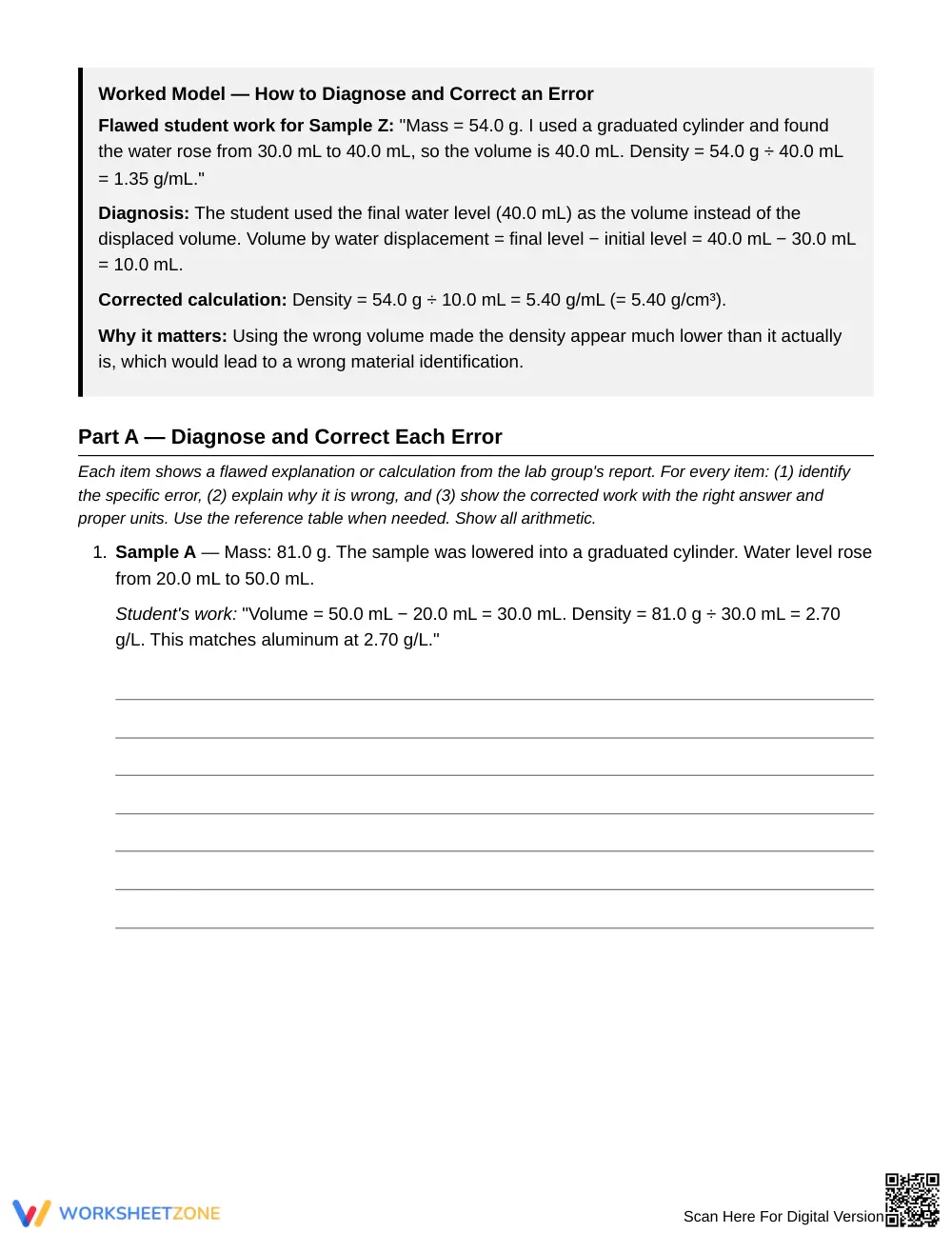
This 5-page printable resource includes 8 diagnostic tasks paired with a 4-page comprehensive answer key. Students reference a clear density formula box, common metric conversion factors, and a synthetic reference table of known material densities. A fully worked diagnostic model walks learners through analyzing water displacement mistakes before they complete independent items.
Skill Progression
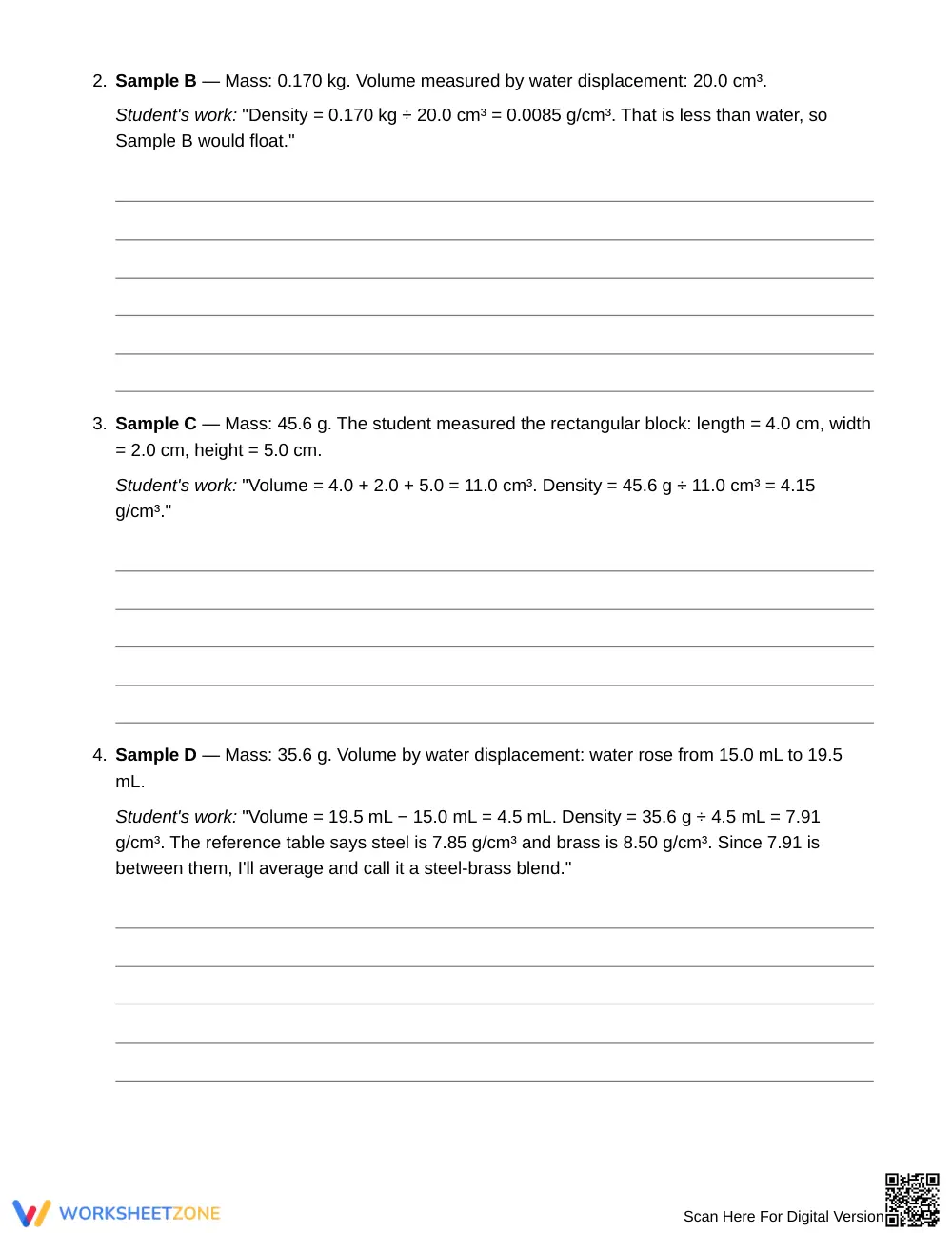
- Guided Practice (Worked Model & Samples A–B): Students review an annotated model diagnosing water displacement errors before tackling structured tasks focused on unit labels and mass unit conversions from kilograms to grams.
- Supported Practice (Samples C–E): Learners evaluate geometric volume calculations, rectifying common errors involving rectangular prism summation and cylindrical radius formulas using reference data.
- Independent Practice (Samples F–H): Students resolve multi-step metric prefix conversions, examine anomalous buoyancy observations, and convert millimeter dimensions to standard density units.
This gradual-release structure reflects the classic I Do, We Do, You Do framework, transitioning students from scaffolded error detection to autonomous mathematical critique.
Standards Alignment
This resource aligns with middle school physical science standards for characteristic properties, requiring students to analyze and interpret data on the properties of substances before and after substances interact. Standard identifiers can be copied directly into lesson plans, IEP goals, or district curriculum mapping tools.
How to Use It
Assign this worksheet after direct instruction on density calculation and water displacement methods. Use it during mid-unit review to catch common misconceptions before formal lab reporting. As a formative assessment tip, check whether students convert cubic millimeters to cubic centimeters in Sample H to gauge unit conversion readiness. Expected completion time is 40 to 50 minutes.
Who It's For
This worksheet serves general Grade 7 science classrooms, physical science intervention groups, and accelerated Grade 6 science students. Pair this activity with hands-on graduated cylinder displacement labs or metric conversion anchor charts for optimal retention.
According to Fisher & Frey (2014), analyzing worked examples and identifying non-examples builds robust metacognitive monitoring and deep conceptual understanding in middle school science. When students evaluate realistic lab errors—such as confounding final fluid levels with displaced volume or misapplying geometric formulas—they develop deeper procedural fluency than calculation drills alone provide. This 5-page worksheet systematically reinforces middle school physical science expectations by requiring students to justify why an error occurred and recompute accurate density values across 8 synthetic data scenarios. The included 4-page reference key details every diagnostic justification, conversion step, and arithmetic check, providing reliable instructional support for classroom teachers and intervention specialists targeting physical property mastery.


