


























Views
Downloads



Essential Vibration Comparison Worksheet | Grade 6 Science
Paste this activity's link or code into your existing LMS (Google Classroom, Canvas, Teams, Schoology, Moodle, etc.).
Students can open and work on the activity right away, with no student login required.
You'll still be able to track student progress and results from your teacher account.
This Grade 6 physical science worksheet guides students to plan fair vibration comparisons and evaluate scientific models of sound pitch. Students evaluate competing claims about vibrating strings and air columns, isolate independent and controlled variables, and analyze acoustic data to determine how physical dimensions affect frequency and pitch.
At a Glance
- Grade: 6 · Subject: Science
- Standard: Middle School Physical Science — Plan investigations to determine relationships among vibrating matter, frequency, and pitch
- Skill Focus: Plan a Fair Vibration Comparison
- Format: 5 pages · 10 problems · Answer key included · PDF
- Best For: Sound and wave unit core practice
- Time: 40–50 minutes
What's Inside
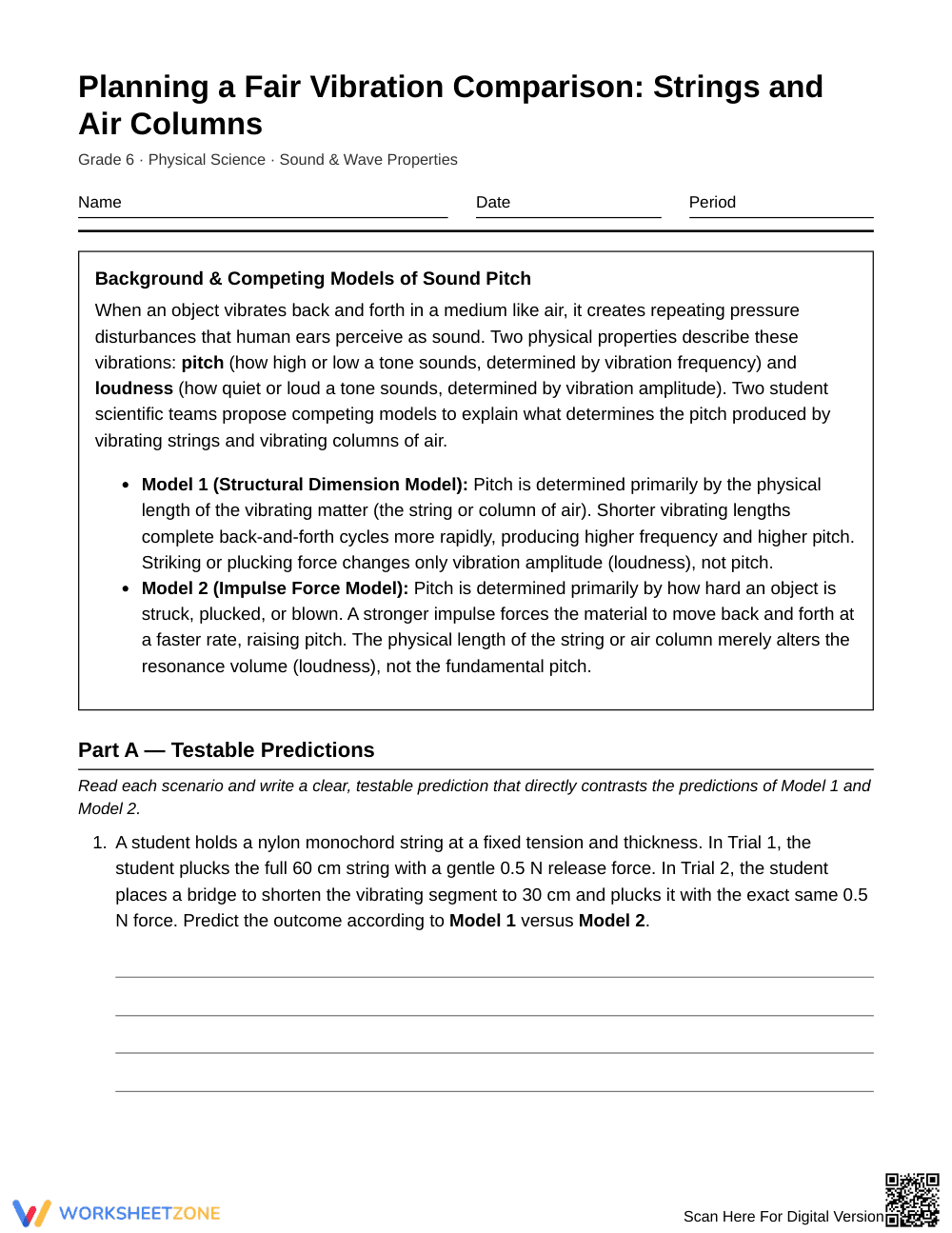
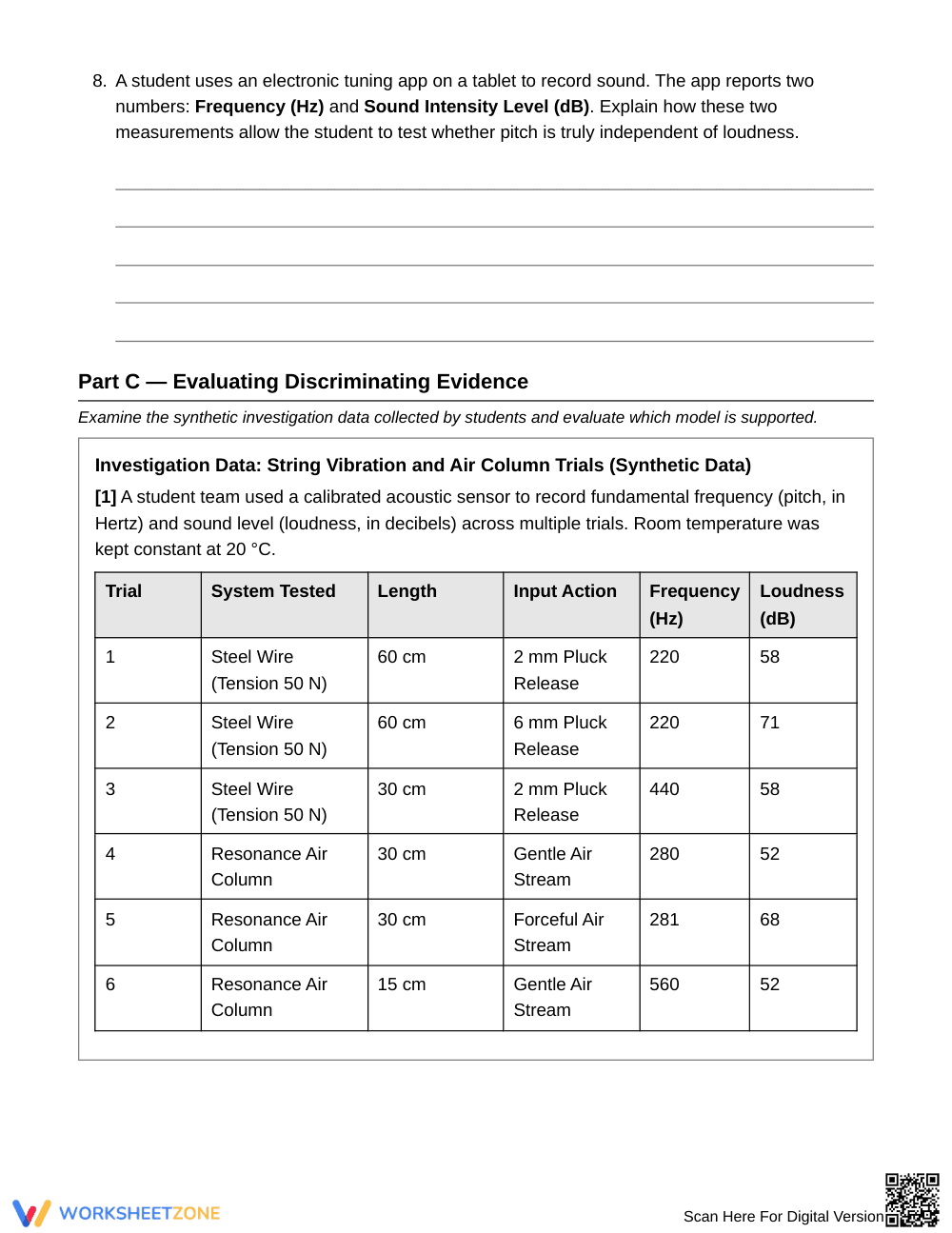
This 5-page printable resource includes 10 rigorous science tasks organized into three distinct parts, accompanied by a comprehensive 3-page answer key. The worksheet provides foundational background reading outlining two competing scientific models (the Structural Dimension Model versus the Impulse Force Model), structured scenario-based items, experimental design critiques, and a synthetic acoustic dataset comparing wire tension, column length, frequency (Hz), and loudness (dB).
Skill Progression
- Guided Practice (Part A, Problems 1–2): Students contrast competing theoretical models by generating testable predictions for monochord strings and resonant air columns under varied force and length conditions.
- Supported Practice (Part B, Problems 3–8): Students isolate independent, dependent, and controlled variables across multiple experimental designs, identifying confounding factors in multi-variable setups and explaining how measurement tools verify pitch-loudness independence.
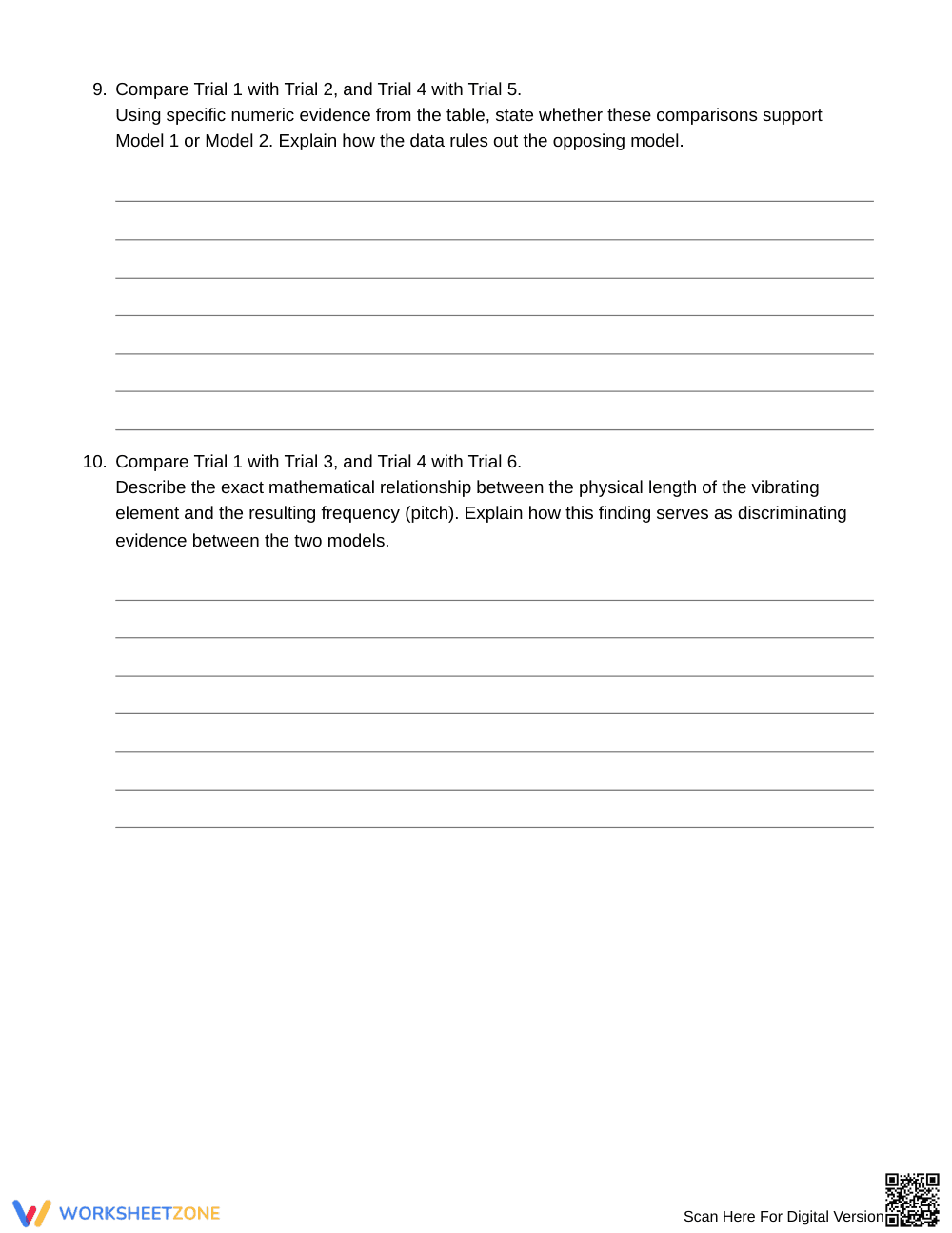
- Independent Practice (Part C, Problems 9–10): Students synthesize numeric data from six experimental trials to provide mathematical and conceptual evidence that validates the structural model while disproving the impulse force model.
This sequence follows a gradual-release instructional model that transitions students from theoretical prediction to rigorous data-based scientific argumentation.
Standards Alignment
This investigation directly supports middle school physical science standards addressing wave properties, sound transmission, and experimental variable control. Students demonstrate how changing vibrating length systematically alters fundamental frequency while distinguishing pitch changes from amplitude variations. This standard focus aligns directly with district curriculum mapping tools, physical science scope and sequences, and inquiry-based lab frameworks.
How to Use It
Use this worksheet after direct instruction on wave properties, frequency, and amplitude. In a lab-prep context, have students complete Parts A and B prior to hands-on monochord or resonance tube investigations to establish rigorous variable-control criteria. During independent work, monitor student responses in Part B to verify that students do not confuse plucking force (amplitude) with vibrating length (frequency). Expected completion time is 40 to 50 minutes.
Who It's For
This resource is tailored for sixth-grade physical science students learning waves and sound mechanics. It provides built-in scaffolds for developing scientific thinkers through clear variable breakdowns while offering data-analysis challenges for advanced learners. Pair this worksheet with an interactive tuning fork demonstration or virtual sound wave simulator.
According to Fisher & Frey (2014), structured inquiry tasks that explicitly scaffold variable isolation and claim evaluation substantially deepen conceptual mastery in middle school science. This Grade 6 worksheet provides 10 targeted problems requiring students to contrast competing models, plan controlled vibration trials, and interpret frequency data across 5 structured pages. By distinguishing frequency from amplitude and isolating vibrating length from input force, students build critical experimental design skills aligned with middle school physical science objectives. The structured layout ensures measurable growth in scientific reasoning across diverse classroom settings.


