




























Views
Downloads



Essential Transpiration Word Search | Grades 4–5 Science

Paste this activity's link or code into your existing LMS (Google Classroom, Canvas, Teams, Schoology, Moodle, etc.).
Students can open and work on the activity right away, with no student login required.
You'll still be able to track student progress and results from your teacher account.
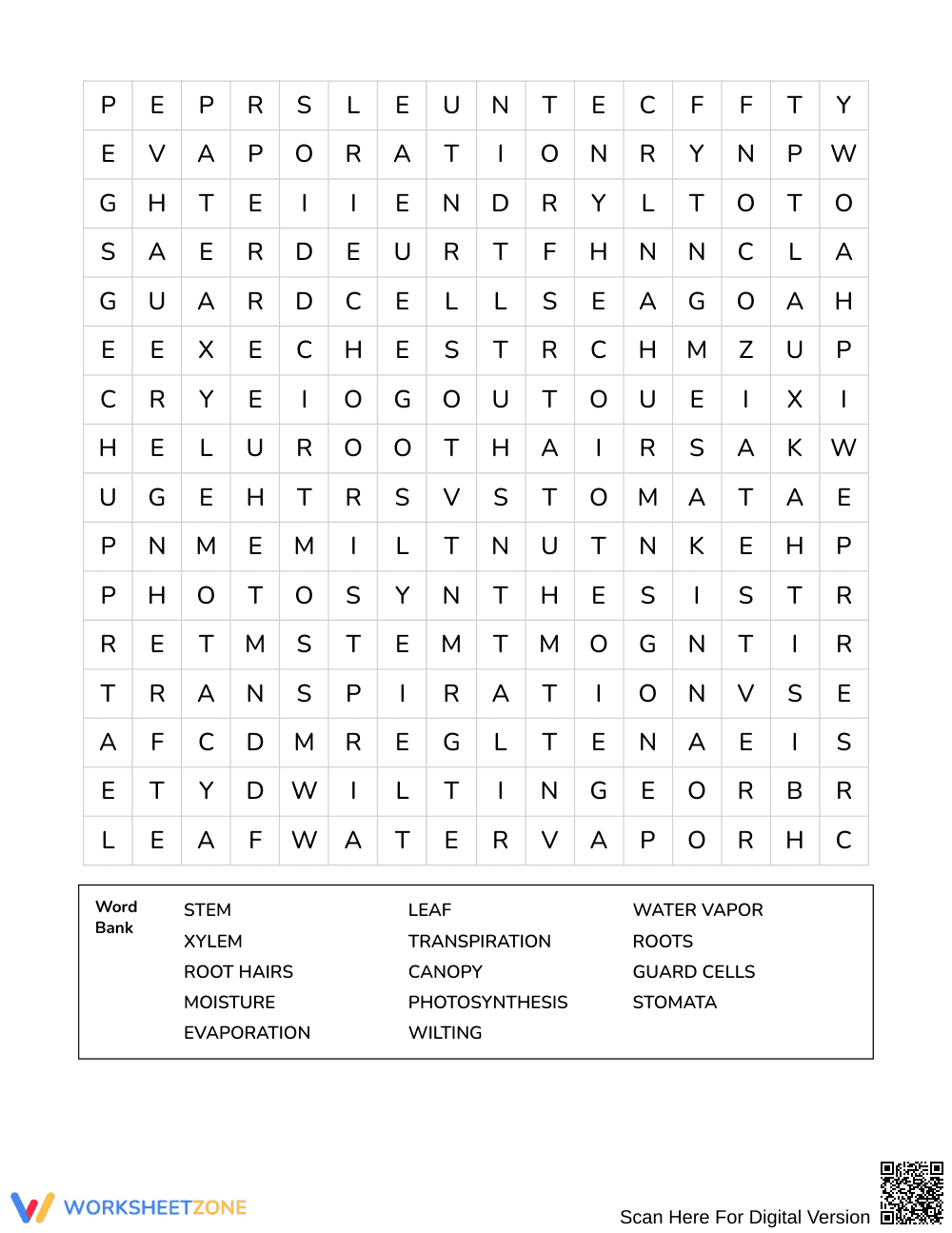
This science word search helps Grades 4–5 students master essential plant biology and water cycle vocabulary through active clue decoding. Learners read definitions to identify 14 key terms—such as transpiration, stomata, and xylem—before searching for each hidden word, strengthening academic recall and understanding of how plants move moisture into the atmosphere.
At a Glance
- Grade: Grades 4–5 · Subject: Science (Earth and Life Science)
- Standard: Not standards-assessed — vocabulary enrichment
- Skill Focus: Transpiration, water cycle connections, and plant anatomy
- Format: 3 pages · 14 words · Full answer key included · Printable PDF
- Best For: Vocabulary review, science stations, or early finishers
- Time: 20–30 minutes
What's Inside
This 3-page printable science activity features a clue-driven word search alongside a complete 3-page answer key. Rather than simply scanning for an alphabetical list, students read 14 structured clues that define core botanical and hydrological concepts—such as root hairs, guard cells, and evaporation. Once learners decipher each term from its clue, they reference a shuffled word bank and locate the target vocabulary within the puzzle grid.
Puzzle Structure and Mechanics
The activity features a 16 x 16 letter grid where all 14 vocabulary words are hidden across four specific directions: northeast (NE), east (E), southeast (SE), and south (S). By limiting word paths to forward horizontal, vertical, and diagonal orientations, students remain engaged without frustration from reverse spellings. Learners cross-reference the clue list, shuffled word bank, and puzzle grid, ensuring repeated cognitive engagement with key plant science terms.
Standards Alignment
This resource is designed specifically as vocabulary enrichment and is not formally aligned to a state or national standard. It functions as a supplemental science activity intended to bolster domain-specific terminology before or after direct instruction in the water cycle and plant systems.
How to Use It
Deploy this word search after direct instruction on transpiration to solidify conceptual understanding, or schedule it during science stations as a mid-unit review. As students work, circulate to observe whether they use definition clues to identify words or rely solely on letter matching; learners struggling with terms like stomata or xylem can be prompted to check diagram notes. Expected completion time is 20 to 30 minutes.
Who It's For
This resource is tailored for Grades 4–5 elementary students developing foundational Earth and life science literacy. For multilingual learners or students requiring additional support, teachers can highlight target first letters or provide an illustrated plant diagram anchor chart alongside the worksheet. The puzzle pairs naturally with hands-on celery stalk food-coloring experiments or illustrated plant cross-section diagrams.
Vocabulary acquisition in upper elementary science relies on repeated, contextual exposure to technical terms, as highlighted by Fisher & Frey (2014) in their research on purposeful academic language development. When Grades 4–5 students explore transpiration and plant systems, decoding domain-specific words through definition clues bridges concrete observations with abstract hydrological cycles. This word search provides structured vocabulary enrichment outside formal standards testing, requiring learners to connect definitions of stomata, xylem, and guard cells directly to their written labels. Engaging with terminology through low-stakes puzzle mechanics reinforces orthographic mapping and helps students retain specialized science vocabulary. As Fisher & Frey (2014) observe, integrating intentional vocabulary practice before or after core instructional units ensures that learners build the lexical precision required for higher-order inquiry, explaining natural phenomena, and reading informational science texts effectively throughout their elementary academic careers.


