

































Essential Tracing Motifs Worksheet | Grade 11 English III

Paste this activity's link or code into your existing LMS (Google Classroom, Canvas, Teams, Schoology, Moodle, etc.).
Students can open and work on the activity right away, with no student login required.
You'll still be able to track student progress and results from your teacher account.
This Grade 11 literary analysis worksheet guides students to track how recurring symbols transform across textual stages to generate complex allegorical themes. Working through an original allegorical narrative, learners analyze physical motifs, evaluate institutional control, and substantiate thematic arguments aligned to high school reading standards.
At a Glance
- Grade: 11 · Subject: English III
- Standard:
RL.11-12.2— Analyze how two or more themes interact over a text- Skill Focus: Trace Motifs Across Stages
- Format: 6 pages · 10 problems · Answer key included · PDF
- Best For: Allegorical analysis and close reading units
- Time: 45–60 minutes
What's Inside
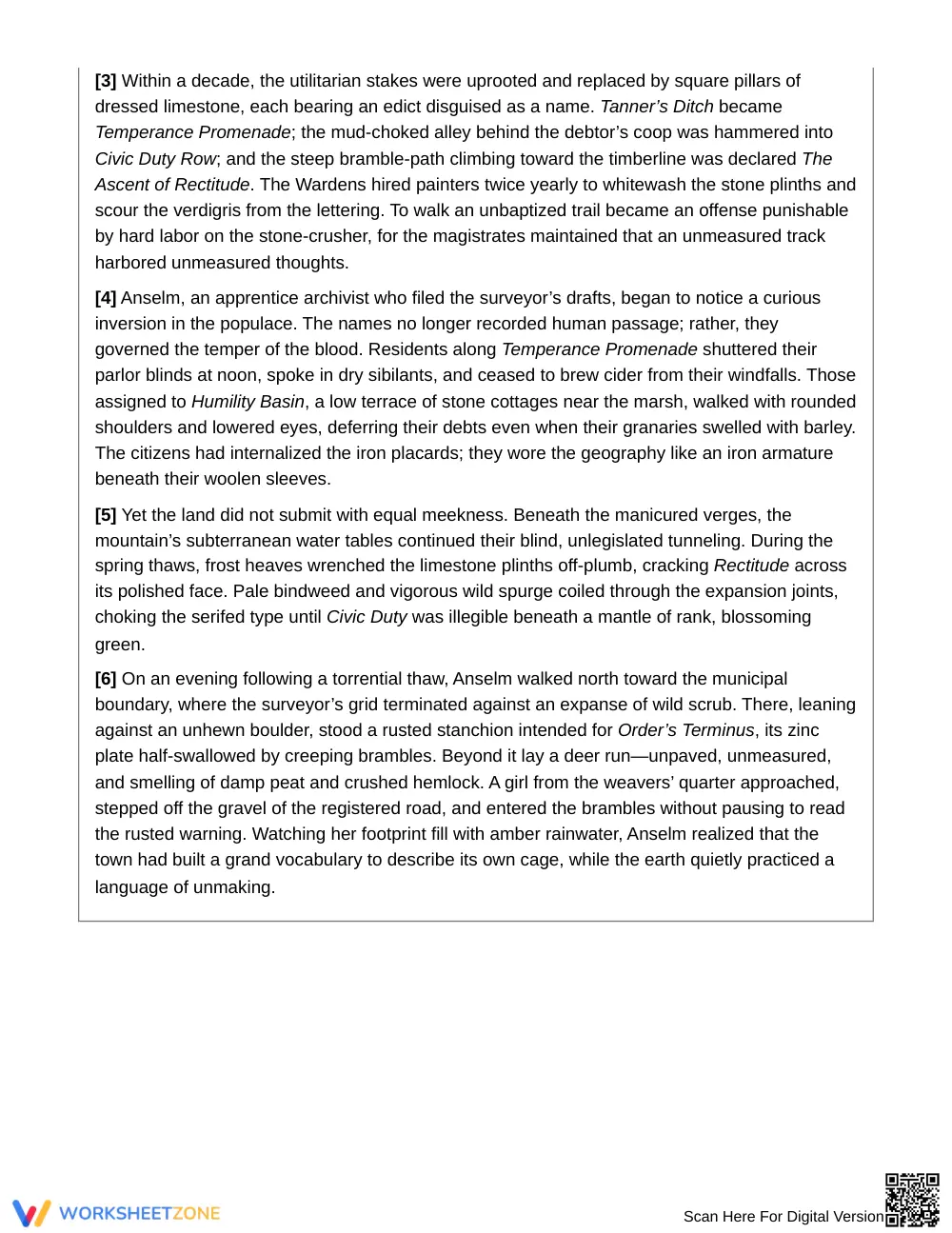
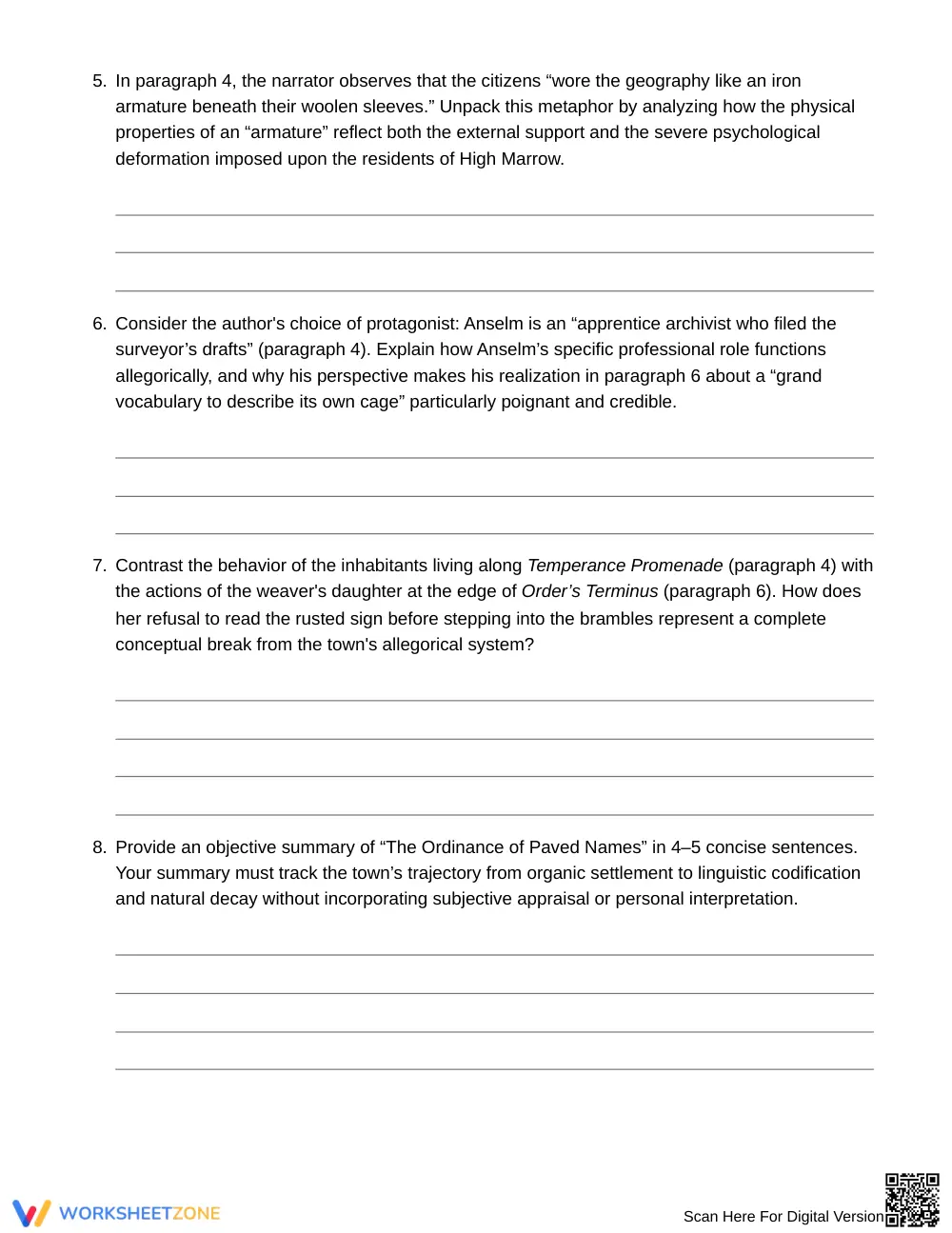
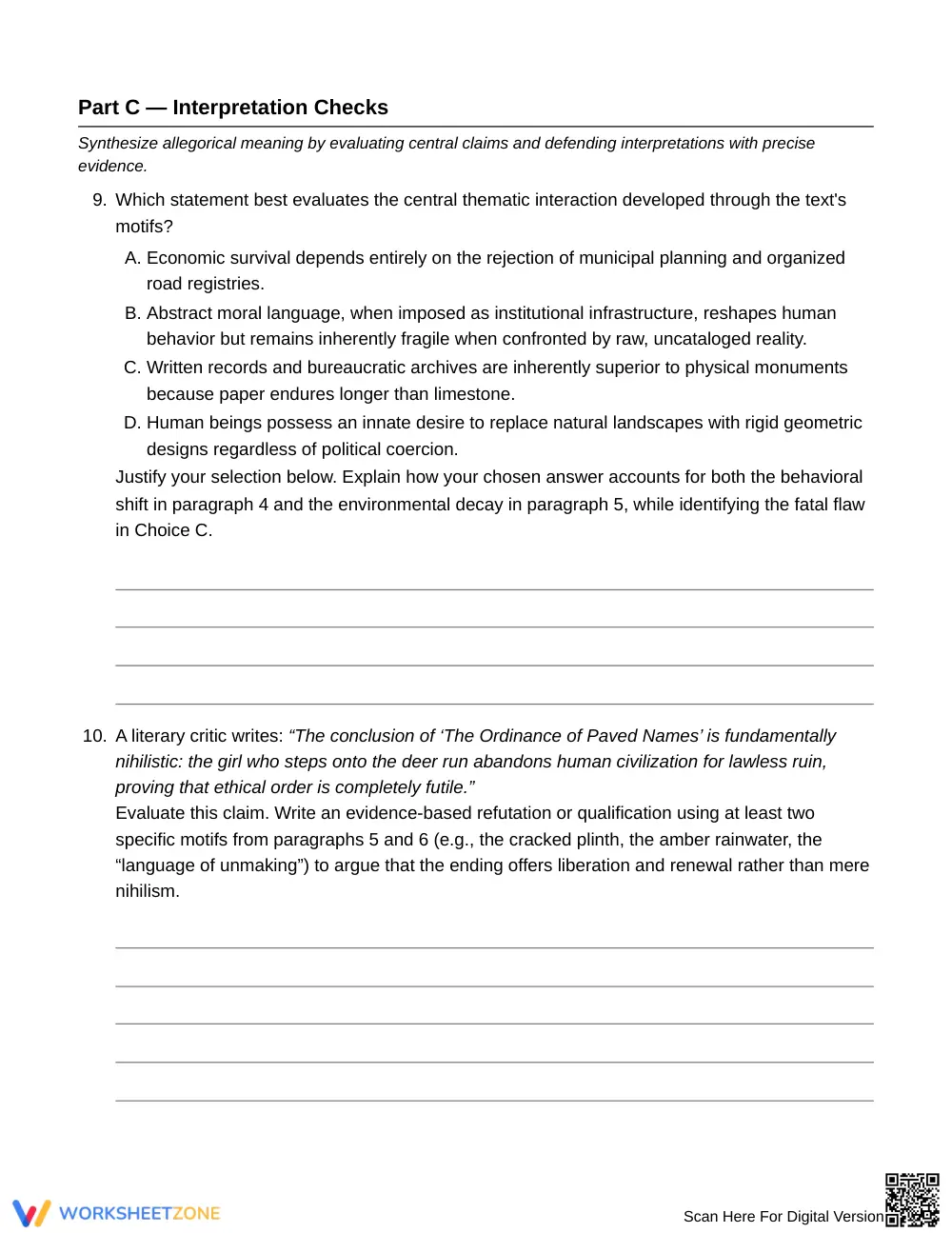
The resource centers on an original allegorical story, "The Ordinance of Paved Names," across 6 pages. It provides a three-stage motif concept guide, a two-row modeled annotation chart, 3 scaffolded evidence links, 5 analytical questions, and 2 interpretive synthesis checks, accompanied by a 4-page answer key with model explanations for all 10 tasks.
Skill Progression
- Guided practice: A modeled annotation chart examines limestone and whitewash motifs across two narrative stages, demonstrating how physical details establish theme.
- Supported practice: Part A provides 3 scaffolded tasks prompting students to trace street marker materials, naming conventions, and natural counter-motifs.
- Independent practice: Parts B and C present 7 analytical tasks evaluating thematic tension, complex metaphors, objective summary, and critical interpretation.
This sequence follows a gradual-release model, transitioning students from scaffolded annotation to rigorous literary synthesis.
Standards Alignment
This worksheet aligns with `RL.11-12.2`: Determine two or more themes or central ideas of a text and analyze their development over the course of the text, including how they interact and build on one another to produce a complex account. Students also practice `RL.11-12.1` by citing thorough evidence. Both standard codes can be copied directly into lesson plans, IEP goals, or district curriculum mapping tools.
How to Use It
Use this worksheet after direct instruction on allegory or as an assessment following a dystopian novel study. Formatively check Part A to ensure students distinguish literal objects from symbolic meanings before they attempt independent analysis in Part B. Expected completion time is 45 to 60 minutes.
Who It's For
Designed for Grade 11 English III and honors literature students, this worksheet offers structured scaffolding for developing analysts and rigorous text analysis for advanced learners. Pair this printable with an introductory lesson on allegorical frameworks or dystopian world-building.
Teaching students to trace motifs across textual stages to analyze interacting themes directly aligns with standard RL.11-12.2 by demanding rigorous, evidence-based literary analysis. According to Fisher & Frey (2014), gradual release of responsibility frameworks significantly strengthen secondary students' analytical writing by establishing explicit cognitive models before requiring independent textual interpretation. In this resource, students engage with ten sequential prompts that dismantle the evolution of concrete symbols within an allegorical text, charting the friction between institutional language and natural dissolution. By progressing from structured annotation scaffolds to nuanced thematic evaluation, learners examine how authors construct layered ideological arguments through physical imagery. This deliberate instructional progression prevents superficial plot summary and fosters the interpretive stamina necessary for college-level textual inquiry, ensuring high school students systematically substantiate complex thematic claims using verifiable narrative evidence across demanding literature coursework.


