


























Views
Downloads



Essential Trace Causes & Effects Worksheet | Grade 6 ELA
Paste this activity's link or code into your existing LMS (Google Classroom, Canvas, Teams, Schoology, Moodle, etc.).
Students can open and work on the activity right away, with no student login required.
You'll still be able to track student progress and results from your teacher account.
This informational text structure worksheet equips Grade 6 students to analyze causal relationships and evaluate how an author organizes sequential cause-and-effect chains within expository writing. Students examine a structured informational passage, identify signal words, complete multi-step causal links, and explain how paragraph placement contributes to overall text development and author purpose.
At a Glance
- Grade: 6 · Subject: ELA
- Standard:
RI.6.5— Analyze how a particular sentence, paragraph, or section fits into the overall text structure- Skill Focus: Trace Causes and Effects
- Format: 5 pages · 10 problems · Answer key included · PDF
- Best For: Direct instruction follow-up and text structure skill practice
- Time: 25–35 minutes
What's Inside
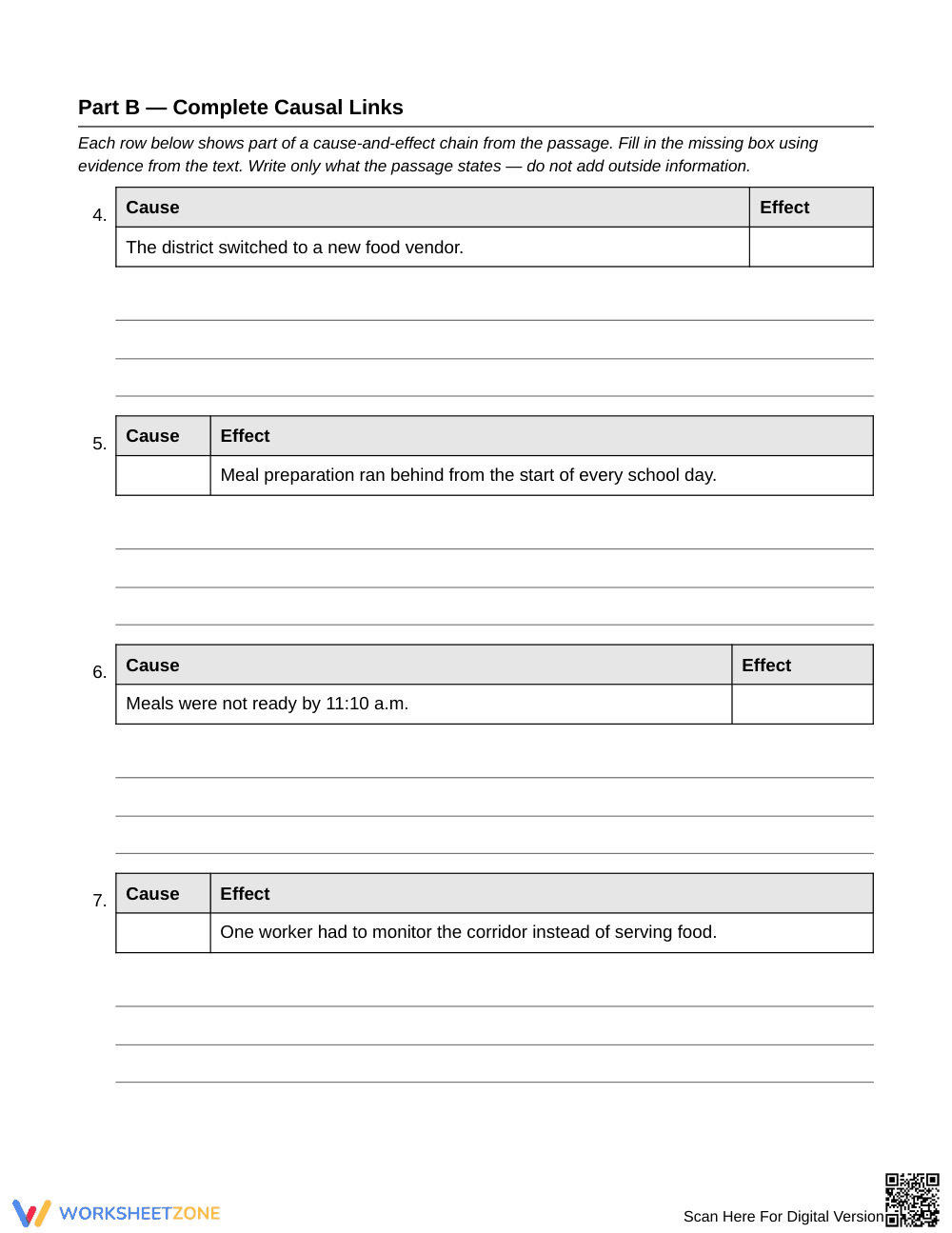
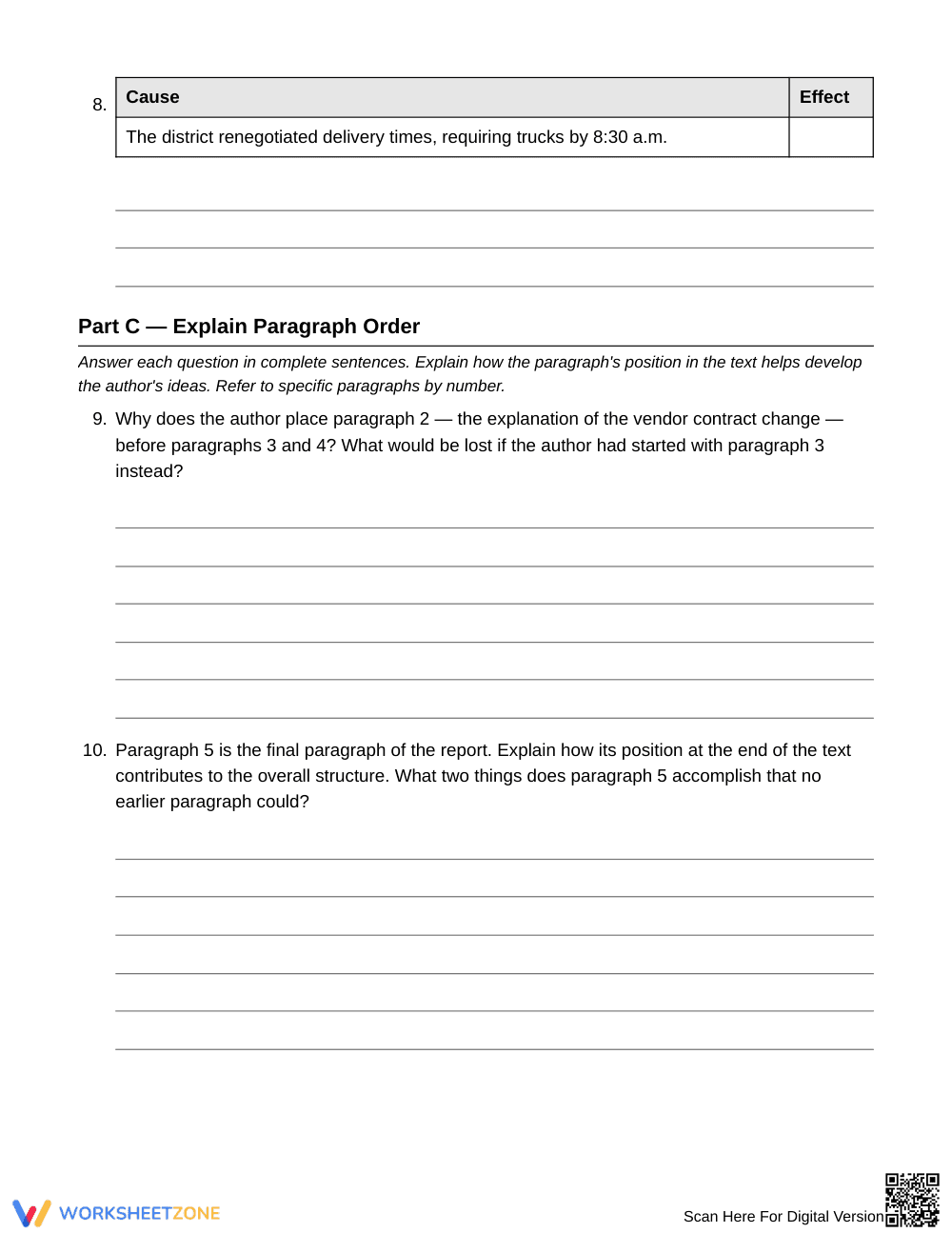
This 5-page printable resource features a complete instructional model, an original five-paragraph informational passage titled "The Lunch-Line Report," and 10 targeted analysis tasks divided into three distinct sections. The opening page provides explicit definitions of causal organization, a reference table of common cause and effect signal words, and an annotated worked example. Parts A through C feature text-dependent short-answer questions, a multi-stage graphic organizer chain, and paragraph-function analysis prompts, followed by a comprehensive 3-page answer key.
Skill Progression
- Guided practice (Part A — 3 tasks): Students locate explicitly stated root causes and cascading effects within specific paragraphs, using signal word prompts to verify each relationship.
- Supported practice (Part B — 5 tasks): Students fill in missing cause-and-effect components across an interconnected five-step chain using graphic organizer boxes and text evidence.
- Independent practice (Part C — 2 tasks): Students evaluate structural organization by explaining how paragraph order develops the author's central ideas and resolution.
This sequence mirrors the gradual-release framework (I Do, We Do, You Do), transitioning students from cue-supported identification to independent structural synthesis.
Standards Alignment
Primary alignment is to RI.6.5: Analyze how a particular sentence, paragraph, chapter, or section fits into the overall structure of a text and contributes to the development of the ideas. Supporting alignment includes RI.6.1 for citing textual evidence to support analysis. Both standard codes can be copied directly into lesson plans, IEP goals, or district curriculum mapping tools.
How to Use It
Assign this resource immediately after direct instruction on text structures or during an informational reading unit. For formative assessment, observe whether students confuse simple chronological sequence with true causal relationships during Part B. The complete 10-task worksheet requires approximately 25 to 35 minutes of instructional time.
Who It's For
This worksheet serves general Grade 6 ELA classrooms, reading intervention groups, and English language learners needing explicit causal signal scaffolds. Pair this practice with an informational text structure anchor chart or a mentor text analysis lesson.
Structured instruction in text structure directly enhances informational reading comprehension and analytical skill for middle school learners. According to Fisher & Frey (2014), explicit modeling combined with graphic organizers and structured cause-and-effect tracing significantly strengthens students' ability to comprehend complex non-fiction texts. When Grade 6 readers learn to identify signal words and trace interconnected causal chains across sequential paragraphs, they move beyond basic recall to analyze how individual sentences and sections build an author's overarching purpose. This worksheet operationalizes standard RI.6.5 by providing scaffolded practice in causal organization, moving students systematically from identifying explicit causal pairs to evaluating paragraph placement and overall text structure. Grounded in research-backed gradual-release principles, this targeted resource ensures that students build transferable analytical reading habits that reliably support reading proficiency across diverse informational content areas and complex non-fiction texts.


