

































Essential Three-Dimensional Nets Worksheet | Grade 6 Math

Paste this activity's link or code into your existing LMS (Google Classroom, Canvas, Teams, Schoology, Moodle, etc.).
Students can open and work on the activity right away, with no student login required.
You'll still be able to track student progress and results from your teacher account.
This comprehensive Grade 6 geometry worksheet helps students master spatial visualization and surface area using two-dimensional nets. Learners identify valid folding patterns, determine opposite faces, and solve multi-step surface area calculations with rectangular prisms, triangular prisms, and square pyramids for thorough geometric mastery.
At a Glance
- Grade: 6 · Subject: Math
- Standard:
6.G.A.4— Represent three-dimensional figures using nets to find total surface area- Skill Focus: Three-Dimensional Nets and Surface Area
- Format: 6 pages · 16 problems · Answer key included · PDF
- Best For: Geometry skill practice and formative assessment
- Time: 45–60 minutes
This 6-page resource features 16 problems organized in three scaffolded tiers, supported by a 3-page answer key. It includes a reference box with area formulas, detailed 2D net diagrams, a calculation table, and open-response reasoning items.
Skill Progression
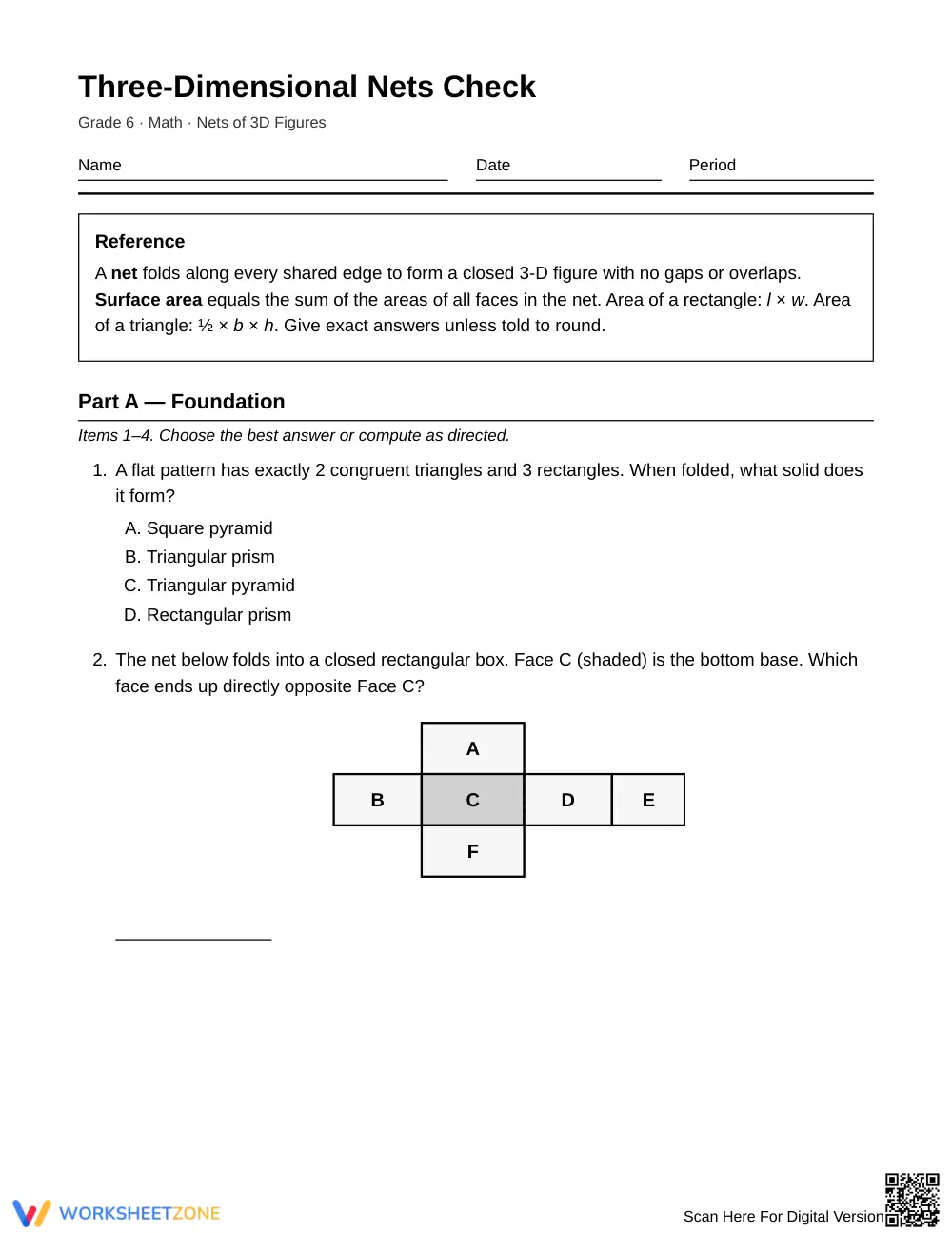
- Guided Practice (Part A, Items 1–4): Foundation items focus on identifying solids, locating opposite faces, eliminating invalid cube nets, and calculating lateral area.
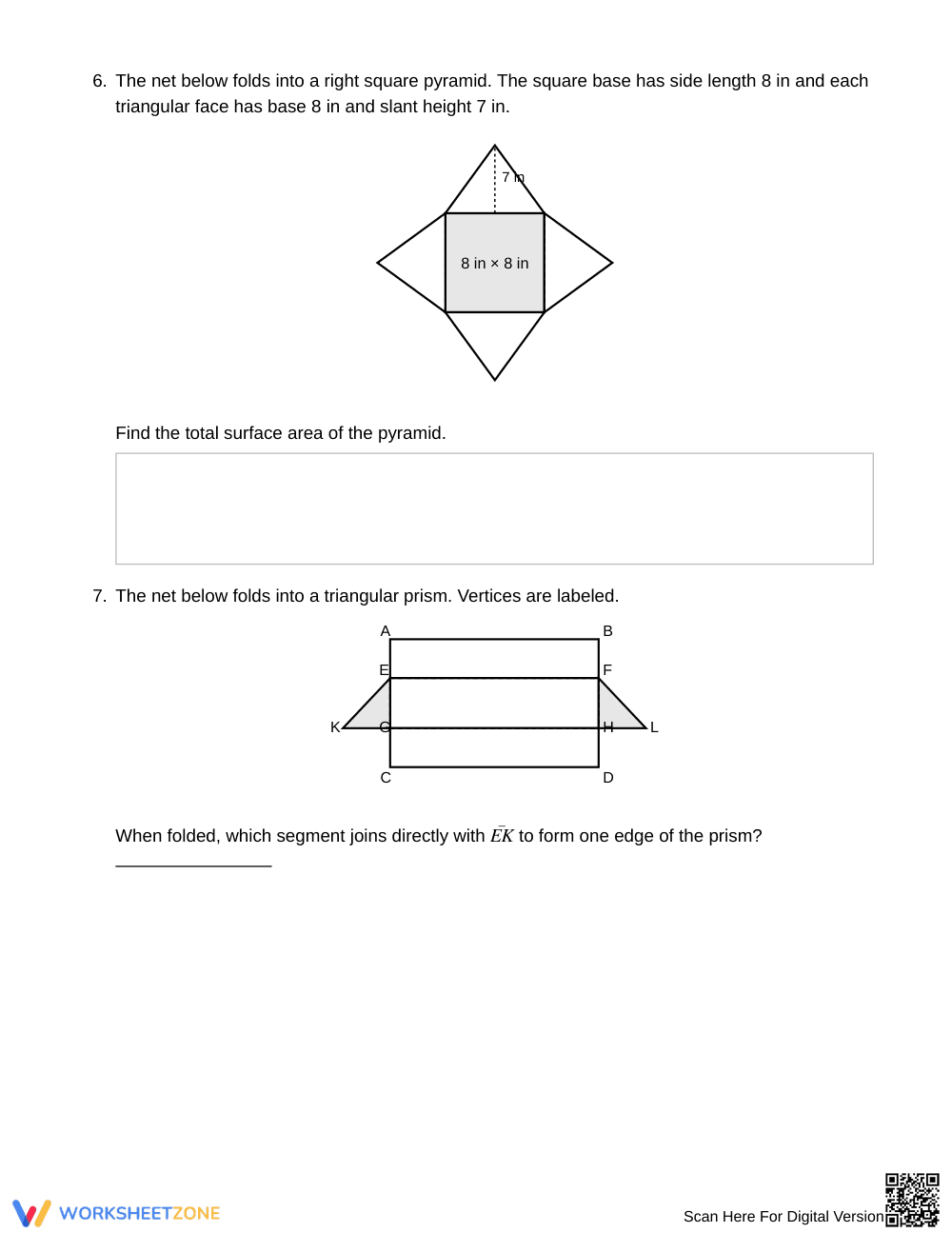
- Supported Practice (Part B, Items 5–12): Core problems require calculating total surface area, matching folded edges, filling dimension tables, and diagnosing net errors.
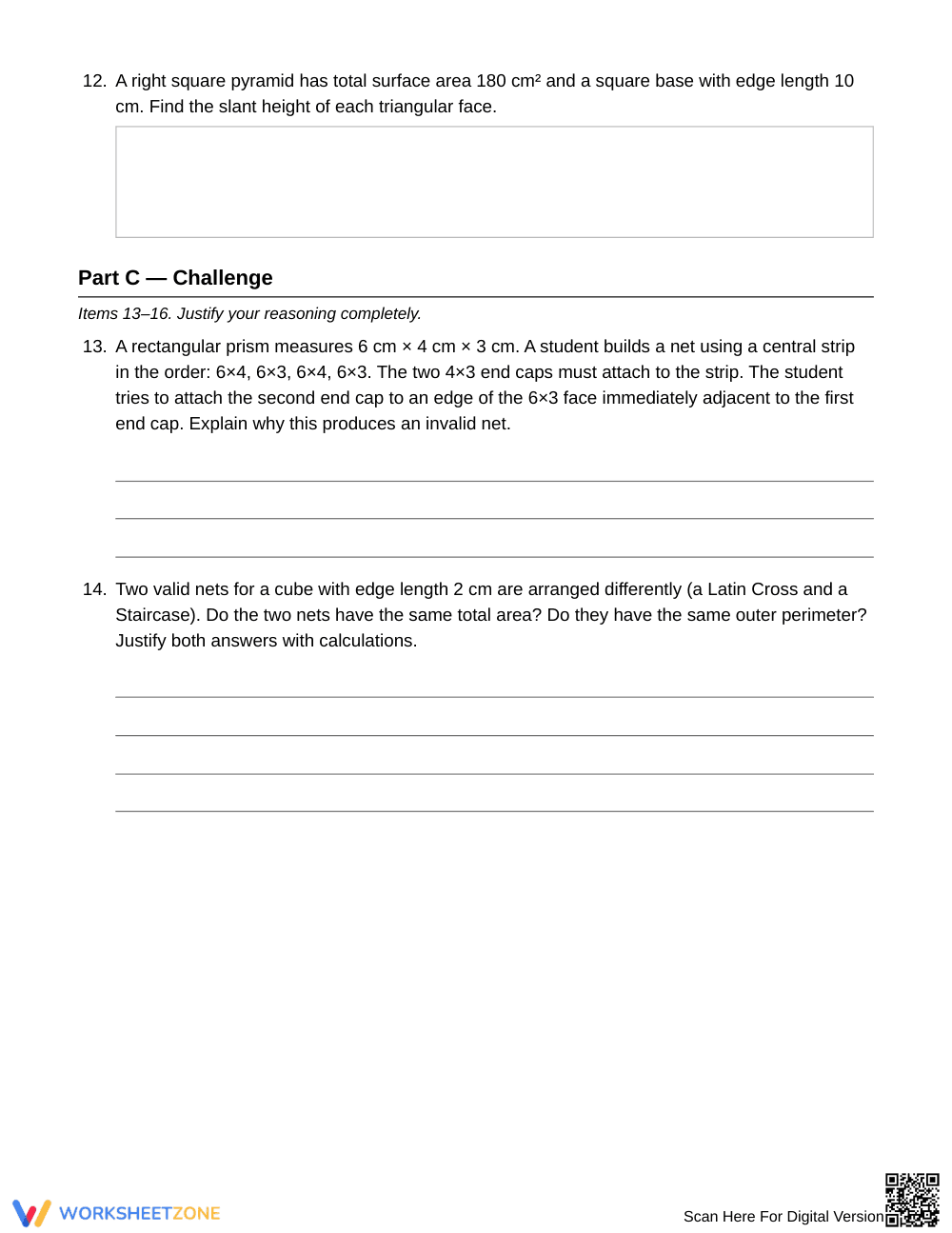
- Independent Practice (Part C, Items 13–16): Challenge tasks prompt learners to evaluate end-cap placements, compare net perimeters, and calculate packaging waste percentages.
This sequence follows a gradual-release framework, progressing from visual identification to complex mathematical modeling.
Standards Alignment
This worksheet aligns directly to 6.G.A.4: Represent three-dimensional figures using nets made up of rectangles and triangles, and use the nets to find surface area. It also supports 6.EE.A.2 through formula evaluation. Both standard codes can be copied directly into lesson plans, IEP goals, or district curriculum mapping tools.
How to Use It
Use this worksheet after introducing nets or as a mid-unit review. During practice, check whether students match corresponding edge lengths on prisms rather than miscalculating rectangular face areas. Expected completion time is 45–60 minutes.
Who It's For
This worksheet serves Grade 6 math classrooms, supporting both on-level practice and targeted intervention. Pair this resource with physical folding paper net manipulatives to reinforce spatial reasoning before students transition to abstract calculations.
According to research by Fisher & Frey (2014) on the gradual release of responsibility, structured transitions from foundational spatial recognition to independent geometric synthesis significantly deepen conceptual mastery in middle school mathematics. This Grade 6 worksheet operationalizes standard 6.G.A.4 by guiding students through the process of representing three-dimensional figures using two-dimensional nets and calculating total surface area across 16 scaffolded problems. Learners begin by evaluating basic folding nets and lateral face areas, progress into multi-step prism and pyramid surface area computations, and culminate in rigorous edge-matching justifications and real-world packaging optimization. By systematically linking flat net layouts to 3D spatial properties, the resource addresses persistent student misconceptions regarding face alignment and edge congruence. The structured 6-page format delivers targeted formative assessment data that enables educators to verify individual mastery of geometric measurement and spatial modeling standards efficiently.


