


























Views
Downloads


Essential Text Reorganization Worksheet | Grade 7 ELA
Paste this activity's link or code into your existing LMS (Google Classroom, Canvas, Teams, Schoology, Moodle, etc.).
Students can open and work on the activity right away, with no student login required.
You'll still be able to track student progress and results from your teacher account.
This Grade 7 informational text worksheet equips students to analyze text structure and reorganize information for new audiences. Working with an authentic community program passage, learners identify operational constraints, extract practical steps for specific scenarios, and justify structural revisions to tailor key content for distinct readers.
At a Glance
- Grade: 7 · Subject: ELA
- Standard:
RI.7.5— Analyze how a text's structure shapes and clarifies its main ideas- Skill Focus: Reorganizing Information for a Different Reader
- Format: 5 pages · 10 problems · Answer key included · PDF
- Best For: Nonfiction text structure practice and analysis
- Time: 45–60 minutes
What's Inside
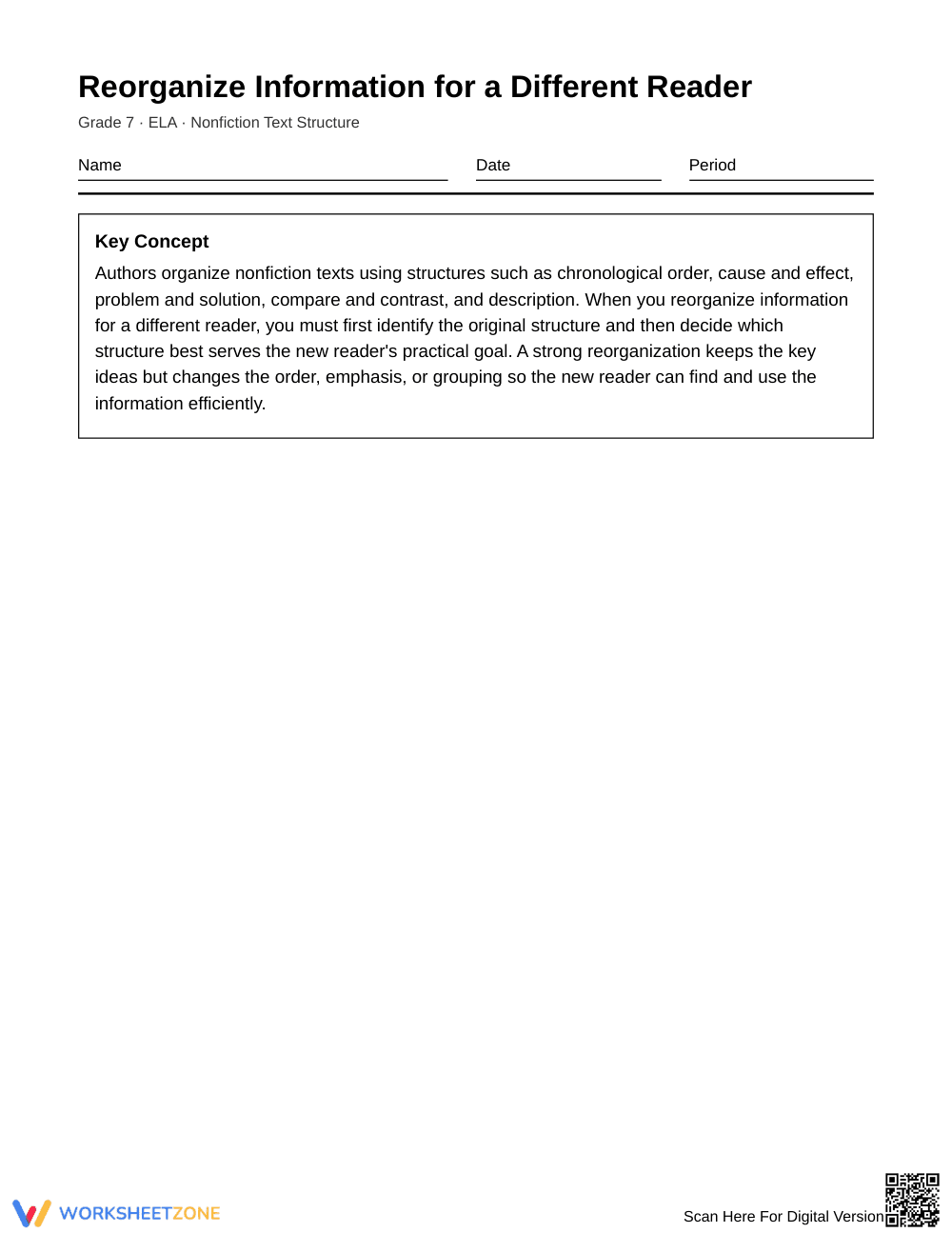
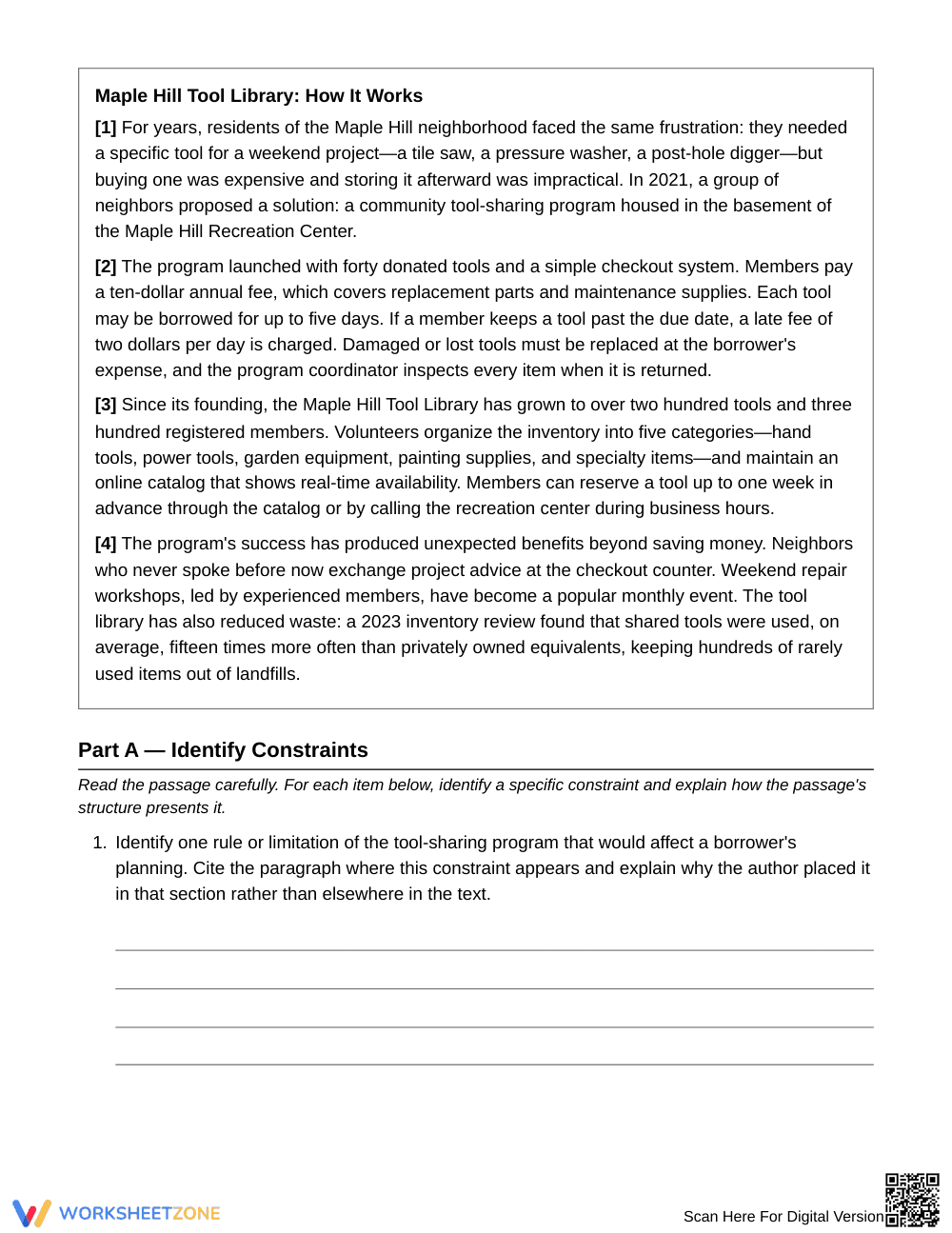
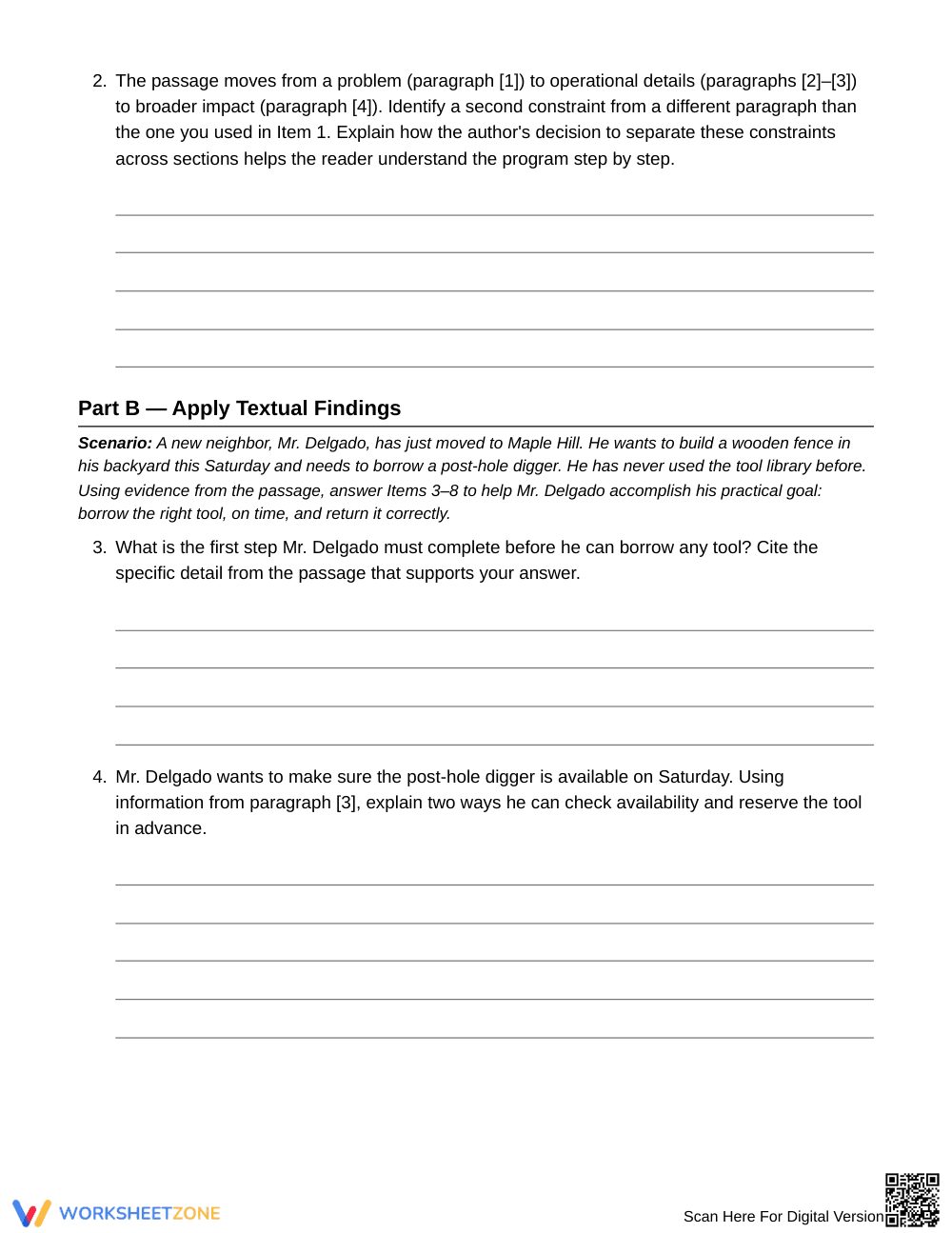
The 5-page printable packet centers on an informational article about a neighborhood tool library. It opens with an anchoring Key Concept box defining five major nonfiction structures. Students complete 10 text-dependent tasks arranged across three structured sections, supported by realistic scenarios. A 4-page answer key provides model responses and textual rationales for every item.
Skill Progression
- Guided Practice (Items 1–2): Students analyze structural constraints, identifying how the author distributes rules across problem-and-solution paragraphs.
- Supported Practice (Items 3–8): Working through a new-borrower scenario, learners extract procedural steps, calculate deadlines, and compare organizational formats.
- Independent Practice (Items 9–10): Students synthesize evidence across paragraphs to justify structural reordering for a municipal funding proposal.
This sequence mirrors the gradual-release framework, guiding learners from structural analysis to independent rhetorical adaptation.
Standards Alignment
The primary standard is RI.7.5: Analyze the structure an author uses to organize a text, including how major sections contribute to the whole. Supporting standard RI.7.1 requires students to cite textual evidence to support structural analyses. Both standard codes can be copied directly into lesson plans, IEP goals, or district curriculum mapping tools.
How to Use It
Deploy this worksheet after direct instruction on text structures for partner practice or independent evaluation. During the activity, check whether students accurately locate operational rules in Part A before reorganizing content in Part B. Most middle school classes will complete the 10 tasks within 45 to 60 minutes.
Who It's For
This resource supports Grade 7 ELA classes, reading intervention groups, and multilingual learners analyzing informational text. Clear headings and paragraph numbering guide students who need focused search targets. Pair this packet with an anchor chart on text structures or an introductory lesson on author's purpose.
According to Fisher & Frey (2014), purposeful text-dependent questioning scaffolds middle school readers from basic factual recall to sophisticated structural analysis. This worksheet operationalizes Common Core standard RI.7.5 by requiring Grade 7 students to examine how an informational text organizes operational details, program constraints, and community outcomes. By practicing the essential skill of reorganizing information for a different reader, students move beyond passive reading to evaluate how structural choices influence clarity and practical utility. Learners identify policy constraints across 4 distinct paragraphs, convert descriptive explanations into actionable procedural steps, and defend organizational adjustments for specialized audiences such as municipal councils. Grounded in a deliberate gradual-release instructional design, the 10 structured tasks guide middle school learners to see that authorial structure directly governs informational access, audience engagement, and overall message effectiveness across diverse real-world reading scenarios.


