




























Views
Downloads




Essential Strategic Placement Worksheet | Grade 8 ELA

Paste this activity's link or code into your existing LMS (Google Classroom, Canvas, Teams, Schoology, Moodle, etc.).
Students can open and work on the activity right away, with no student login required.
You'll still be able to track student progress and results from your teacher account.
This rigorous Grade 8 reading comprehension worksheet helps students analyze how authors structure informational text to develop central ideas. Working with an original civic infrastructure passage, learners evaluate paragraph architecture, defend sentence placement, and analyze how structural shifts refine complex arguments across a complete four-paragraph text.
At a Glance
- Grade: 8 · Subject: ELA
- Standard:
RI.8.5— Analyze how a particular sentence or paragraph contributes to developing ideas- Skill Focus: Defend a Strategic Placement
- Format: 5 pages · 8 problems · Answer key included · PDF
- Best For: Close reading and analytical writing practice
- Time: 45–50 minutes
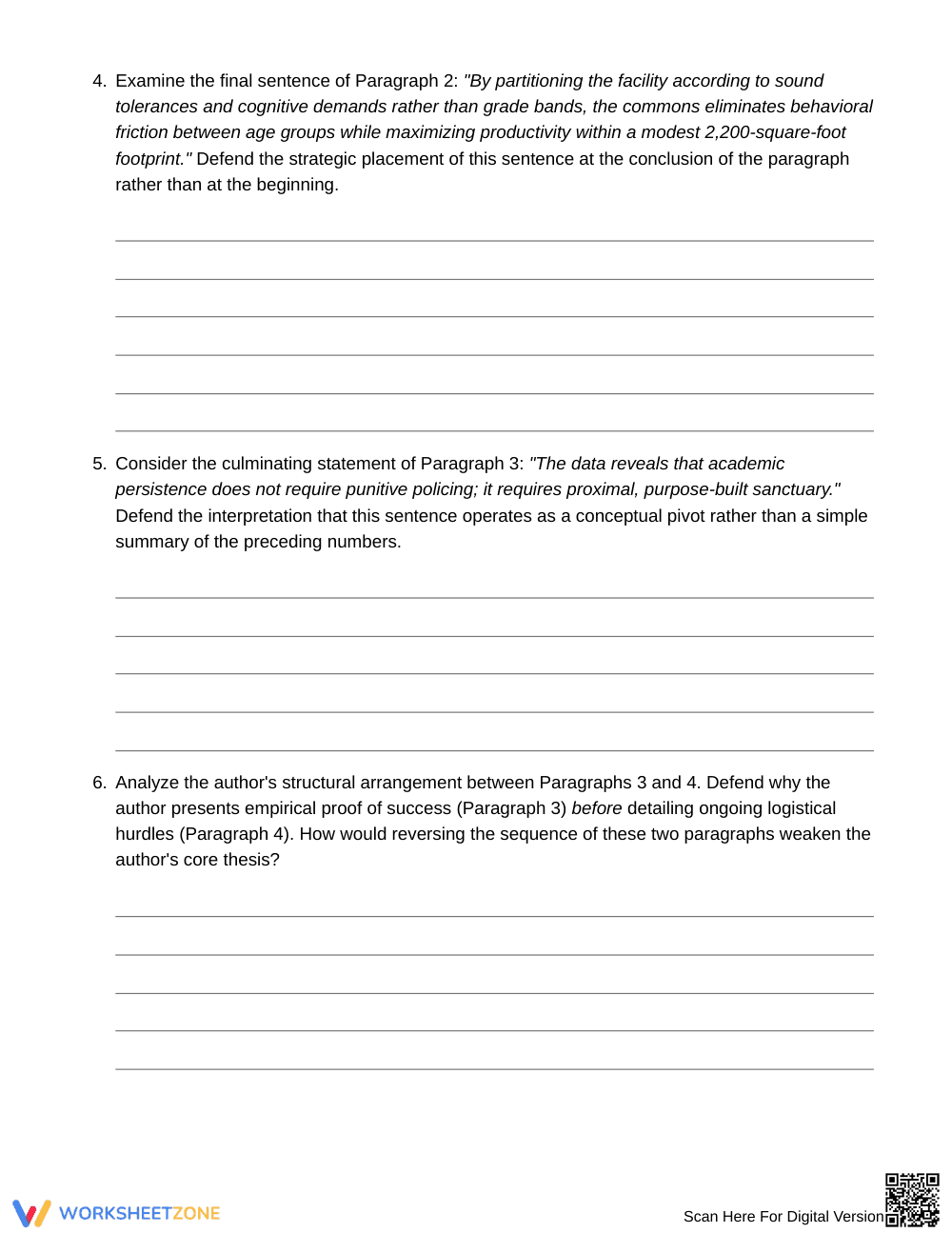
This 5-page resource features an informational text, “Civic Infrastructure and the Spatial Commons,” with 8 text-dependent questions across three analytical parts. It includes a reasoning reminder on paragraph architecture and a comprehensive 3-page teacher answer key with sample defenses.
Skill Progression
- Guided practice (Part A — 2 tasks): Students locate explicit evidence and identify foundational claims, using structural cues to understand how specific data points substantiate claims.
- Supported practice (Part B — 4 tasks): Learners defend why specific sentences and paragraphs are placed in exact sequences to refine key concepts, examine transitional pivots, and evaluate logical flow.
- Independent practice (Part C — 2 tasks): Students evaluate competing interpretations and counterarguments, constructing rigorous text-based defenses to justify paragraph-level architectural choices.
This structure follows the gradual release of responsibility model, guiding students from foundational evidence identification to sophisticated structural justification.
Standards Alignment
This resource aligns to RI.8.5: “Analyze in detail the structure of a specific paragraph in a text, including the role of particular sentences in developing and refining a key concept.” It also supports RI.8.1 for textual evidence. Both standard codes can be copied directly into lesson plans, IEP goals, or district curriculum mapping tools.
How to Use It
Deploy this worksheet during an informational text structure unit after direct instruction on sentence functions. For formative assessment, observe whether students explain why relocating a sentence weakens an argument instead of merely summarizing content. It works effectively as a 45-minute paired analysis or an independent mastery check.
Who It’s For
This activity serves Grade 8 ELA classrooms, advanced Grade 7 readers, and high school intervention groups needing practice with analytical defense. It pairs naturally with informational mentor texts or an anchor chart highlighting structural roles like premises, evidence, pivots, and refutations.
According to research on informational literacy by Fisher & Frey (2014), middle school students demonstrate significantly higher comprehension and retention when explicitly prompted to analyze text architecture rather than simply extracting factual recall details. Mastering standard RI.8.5 requires learners to evaluate how authors use sentence positioning and structural transitions to build cohesive logical arguments. This instructional resource operationalizes that research through 8 targeted analytical tasks, requiring eighth-grade students to defend strategic placement and assess how specific sentences refine core claims within an authentic civic infrastructure text. By progressing from evidence location to defending architectural arrangements and refuting counterarguments, students internalize the communicative function of syntax and sequence. Teachers can utilize the detailed 3-page answer key to evaluate student mastery of organizational analysis and ensure alignment with grade-level rigor expectations.


