































Essential Standing Waves Worksheet | Grade 12 Physics

Paste this activity's link or code into your existing LMS (Google Classroom, Canvas, Teams, Schoology, Moodle, etc.).
Students can open and work on the activity right away, with no student login required.
You'll still be able to track student progress and results from your teacher account.
This Grade 12 physics worksheet equips students to evaluate standing-wave scenarios in mechanical and acoustic systems. Learners analyze boundary conditions, calculate harmonic resonance modes, and evaluate scientific claims using governing wave equations. Through structured quantitative analysis, students connect boundary constraints directly to observable standing wave patterns.
At a Glance
- Grade: 12 · Subject: Physics (Wave Mechanics & Acoustic Systems)
- Standard: Advanced Wave Mechanics — Analyze standing wave harmonics, boundary reflections, and resonance in physical systems
- Skill Focus: Evaluate a Standing-Wave Scenario
- Format: 4 student pages · 10 structured problems · Detailed answer key included · PDF
- Best For: Advanced high school physics exam preparation
- Time: 45–60 minutes
What's Inside
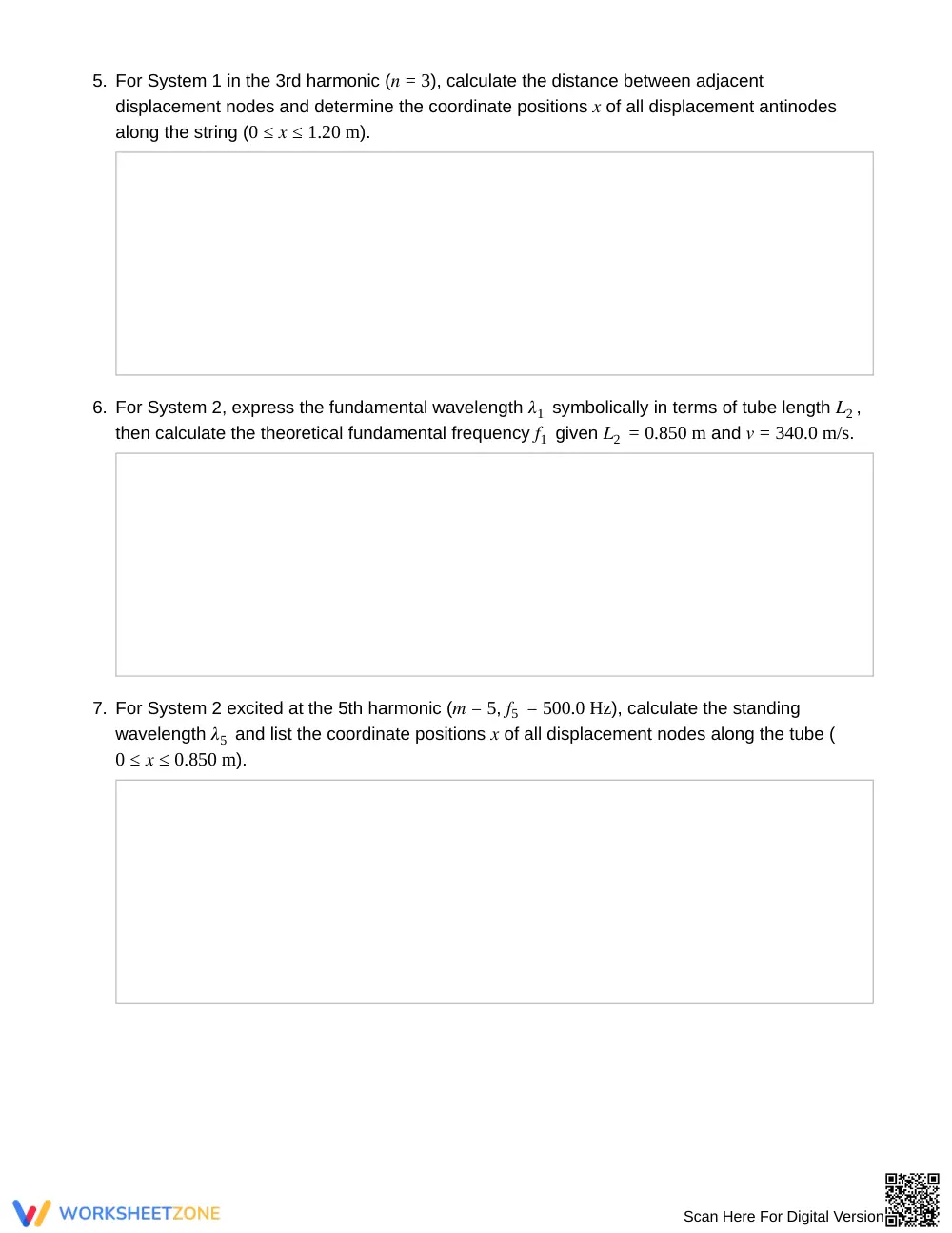
This 4-page worksheet includes governing equation reference tables for string and acoustic systems, followed by 10 multi-step problems. Students analyze synthetic data for clamped strings and resonance tubes, calculate spatial node-antinode coordinates, and critique experimental claims. A 3-page teacher answer key provides full mathematical working and unit tracking.
Skill Progression
- Guided practice (Part A, Items 1–2): Students analyze boundary constraints and wave reflections, identifying phase shifts and explaining harmonic series differences.
- Supported practice (Part B, Items 3–8): Learners perform quantitative derivations to find wave speed, modal frequencies, and spatial node coordinates across changing string tensions.
- Independent practice (Part C, Items 9–10): Students evaluate student arguments regarding wave amplitude, propagation speed, and acoustic end-corrections.
This scaffolded progression applies a gradual-release model to transition students from core concepts to autonomous evaluation.
Standards Alignment
This worksheet addresses secondary physics wave standards by having students evaluate mathematical standing wave models, boundary phase inversions, and harmonic resonance frequencies. Supporting standards emphasize analyzing physical sources of experimental error in resonance tubes. Both standard codes can be copied directly into lesson plans, IEP goals, or district curriculum mapping tools.
How to Use It
Use this resource after direct instruction on wave interference and boundary reflections. In class, students can complete Parts A and B in collaborative pairs before independently tackling Part C as a formal assessment. Alternatively, assign the entire packet as an intensive 45–60 minute test-prep review. For formative assessment, check Item 9 to confirm whether students distinguish wave speed from driver amplitude.
Who It's For
This worksheet is tailored for Grade 12 physics and AP Physics students investigating resonant mechanics. Teachers can support developing learners by referencing the provided formula bank while challenging advanced students to derive boundary node conditions from scratch. Pair this assignment with a hands-on vibrating string lab or acoustic resonance demonstration.
This Grade 12 physics worksheet provides structured practice to evaluate a standing-wave scenario across fixed strings and open-closed acoustic resonance tubes. Aligned to secondary physics standards for wave mechanics, the 10-problem instructional resource guides students through boundary condition analysis, modal frequency derivations, and scientific claim verification. Grounded in the gradual-release pedagogy established by Fisher & Frey (2014), the structured sequence advances from explicit physical boundary constraints to autonomous evaluation of synthetic experimental anomalies. By requiring learners to distinguish between driver amplitude effects and medium-dependent wave propagation speeds, the worksheet strengthens conceptual reasoning alongside quantitative problem-solving. Educators can utilize the comprehensive four-page problem set and three-page answer key to evaluate student mastery of resonant frequencies, node locations, and wave superposition principles. This focused practice solidifies core analytical competencies essential for post-secondary physics success.


