


























Views
Downloads



Essential Speech Delivery Worksheet | Grade 11 English III
Paste this activity's link or code into your existing LMS (Google Classroom, Canvas, Teams, Schoology, Moodle, etc.).
Students can open and work on the activity right away, with no student login required.
You'll still be able to track student progress and results from your teacher account.
This Grade 11 rhetorical analysis worksheet trains students to connect delivery cues, argumentative structure, and persuasive meaning. High school learners analyze how vocal tempo, volume shifts, and pauses reinforce claims, weigh competing civic premises, and evaluate how speakers build compelling arguments for distinct municipal audiences.
At a Glance
- Grade: 11 · Subject: English III
- Standard:
SL.11-12.3— Evaluate a speaker's point of view, reasoning, evidence, and rhetorical delivery cues- Skill Focus: Connect Delivery Cues, Structure, and Meaning
- Format: 6 pages · 12 analytical problems · Complete answer key · PDF
- Best For: Advanced rhetorical analysis and civic discourse units
- Time: 45–60 minutes
What's Inside
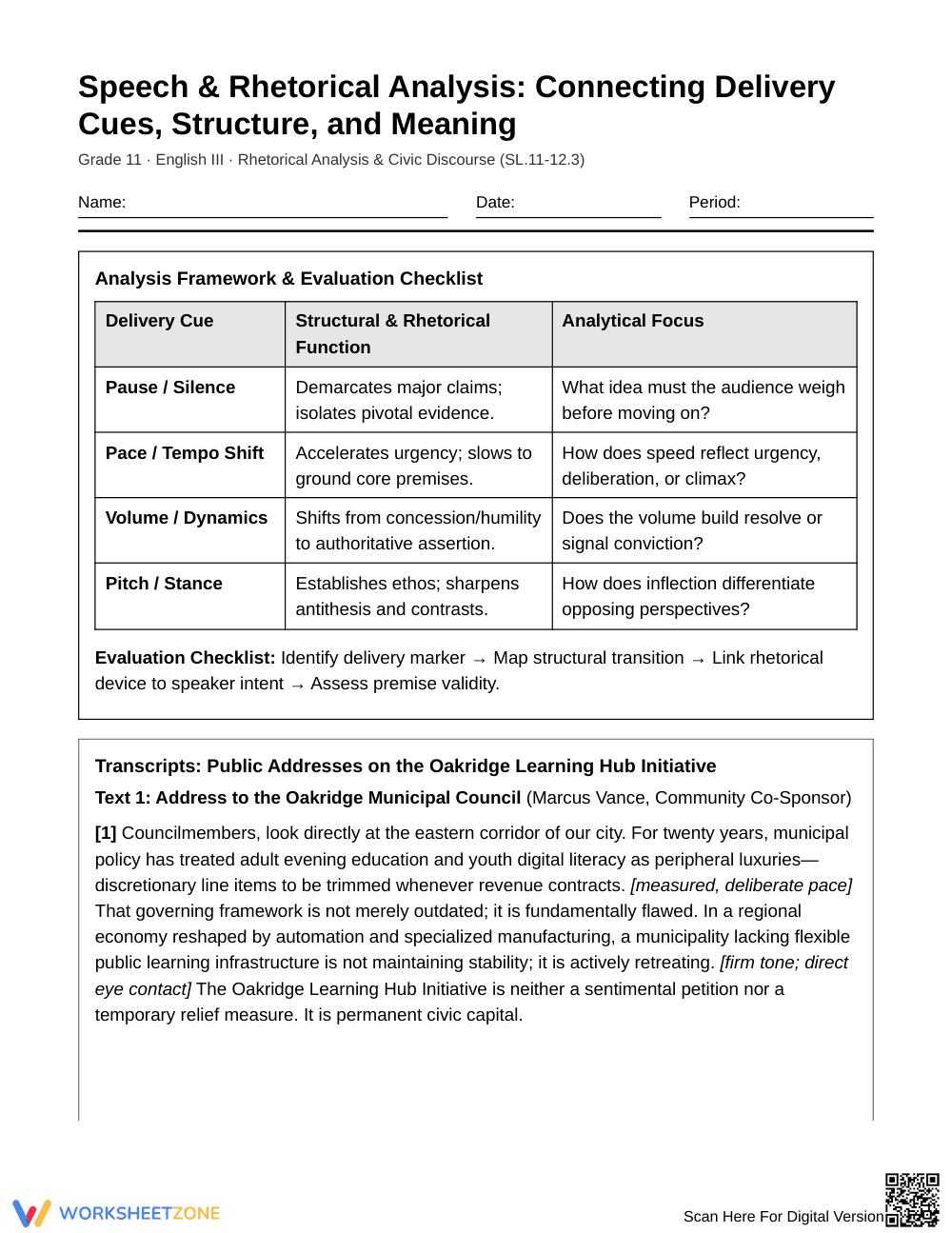
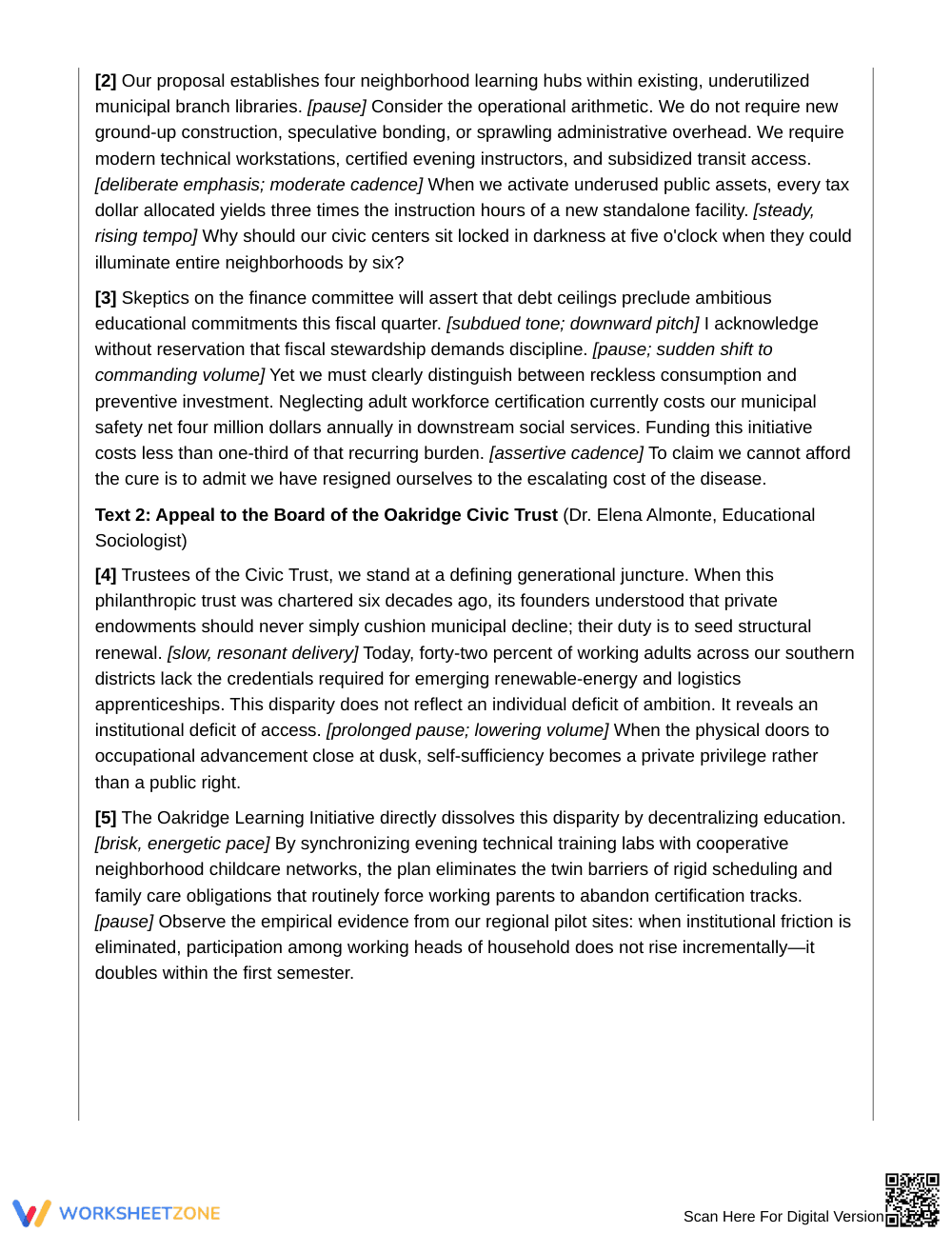
This 6-page printable packet includes two municipal speech transcripts, a delivery framework, and 12 analytical tasks. Students analyze speeches by Marcus Vance and Dr. Elena Almonte using text-dependent questions and synthesis prompts. A 3-page answer key provides complete model responses.
Skill Progression
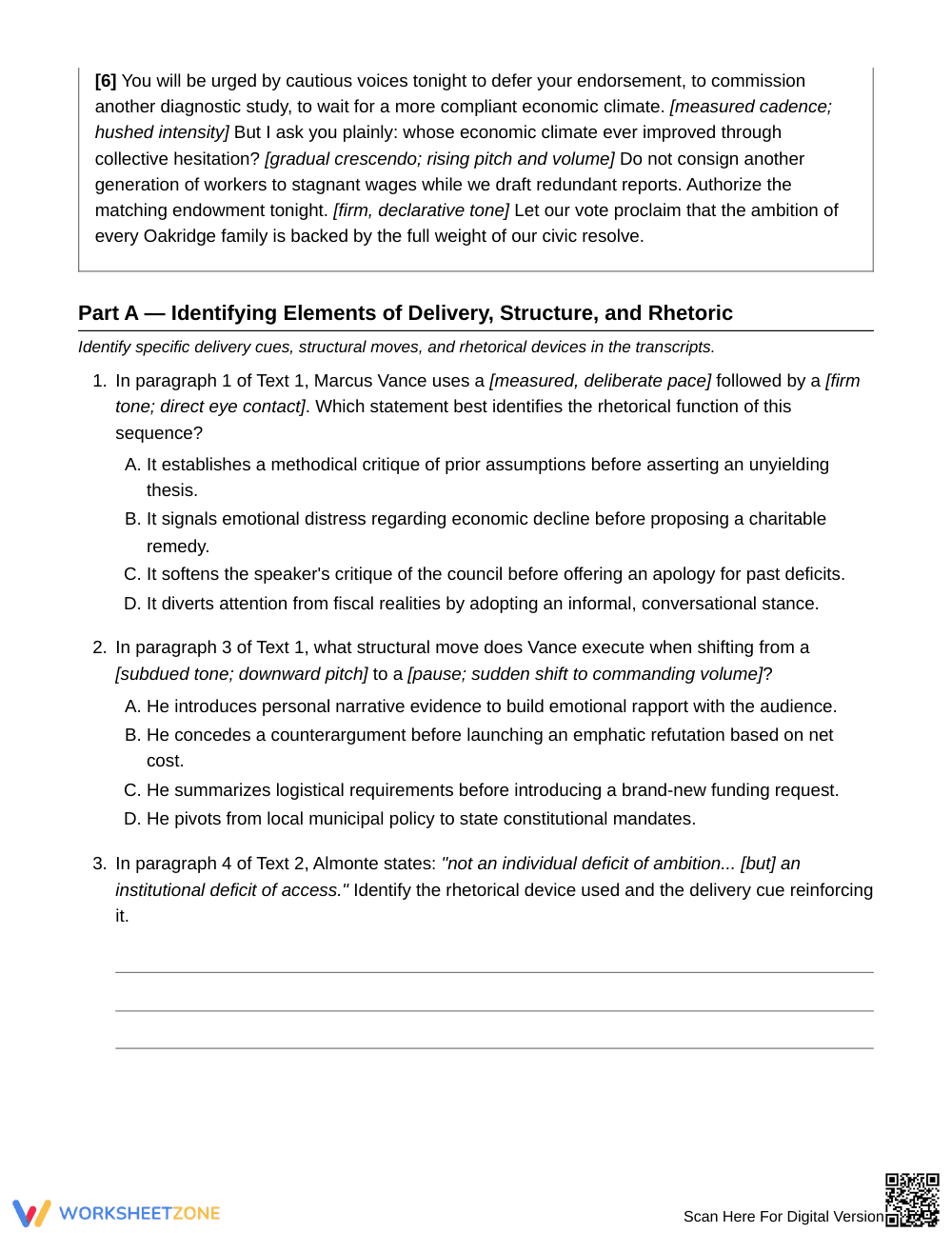
- Guided practice (Tasks 1–3): Multiple-choice and short-identification questions isolate delivery cues like Vance's deliberate cadence or Almonte's antithesis.
- Supported practice (Tasks 4–9): Paired-text analysis tasks prompt students to connect volume, tempo, and pauses to persuasive claims and ethos.
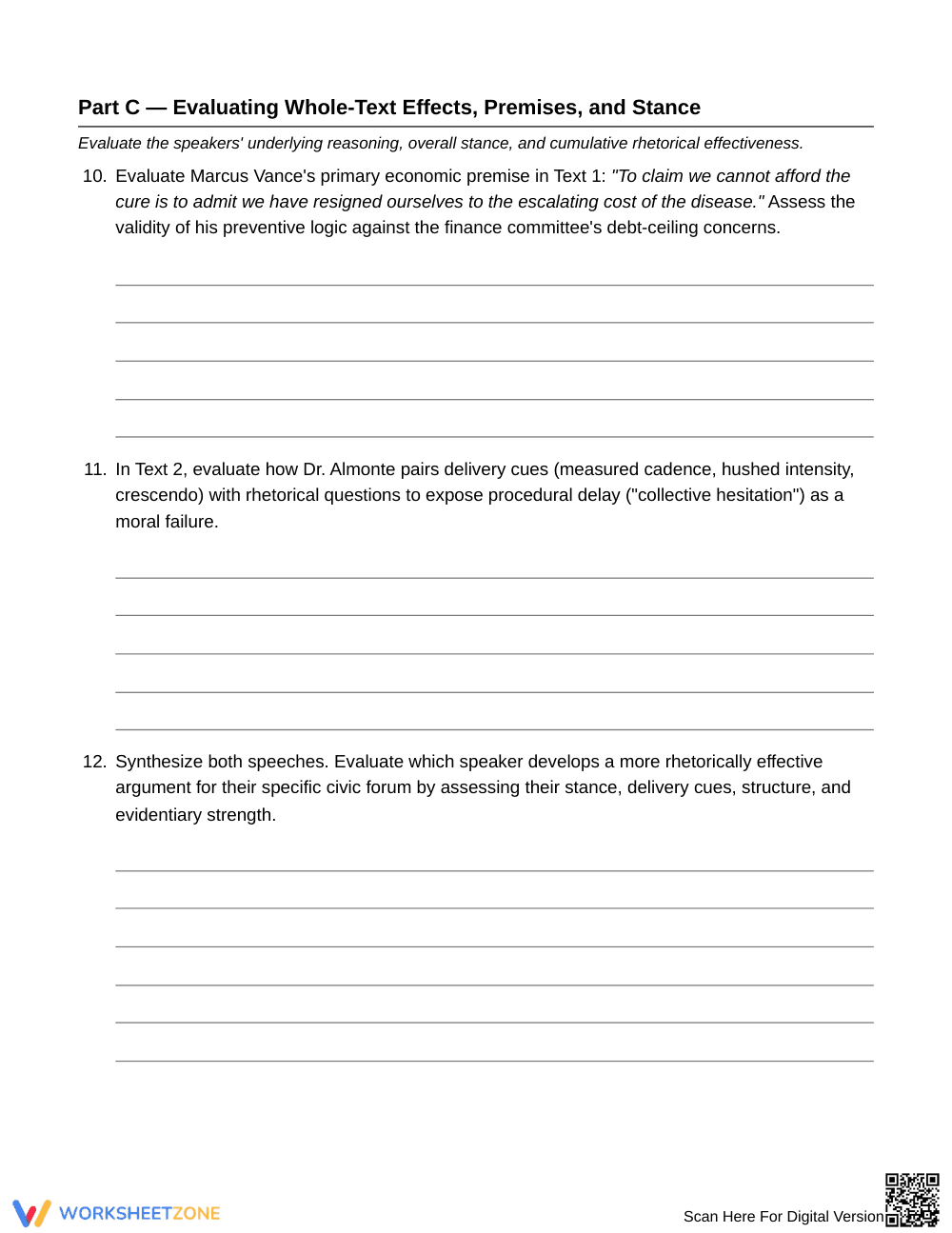
- Independent practice (Tasks 10–12): Extended prompts require students to evaluate civic premises, assess speaker validity, and synthesize both speeches.
This gradual-release structure moves students from isolated cue identification to comprehensive rhetorical critique.
Standards Alignment
This resource aligns to `SL.11-12.3`: Evaluate a speaker's point of view, reasoning, and use of evidence and rhetoric, assessing the stance, premises, links among ideas, word choice, points of emphasis, and tone used. It also supports `RI.11-12.5` by analyzing text structure and claim development. Both standard codes can be copied directly into lesson plans, IEP goals, or district curriculum mapping tools.
How to Use It
Use this worksheet after direct instruction on rhetorical devices. Have students read transcripts aloud in pairs to hear delivery markers before completing the 45-to-60-minute task set. Formatively check Part A responses to verify students understand how Vance's downward pitch signals concession before letting them tackle the independent synthesis.
Who It's For
Designed for Grade 11 English III and AP Language students analyzing civic discourse. The embedded delivery reference chart supports developing readers without diluting rigorous text complexity. Pair this packet with recorded public debates or an anchor chart on classical argumentation.
According to Fisher & Frey (2014), structured close reading of complex texts through guided cognitive progressions significantly accelerates secondary students' ability to synthesize oral argumentation and textual evidence. This Grade 11 English III instructional resource directly operationalizes standard SL.11-12.3 by training high school learners to evaluate a speaker's point of view, reasoning, evidence, and rhetorical delivery cues. By providing authentic civic transcripts equipped with explicit bracketed delivery markers, the worksheet successfully bridges auditory oratorical delivery, structural textual analysis, and civic literacy. Students move systematically from identifying vocal tempo, volume dynamics, and pauses to interrogating foundational premises and municipal policy claims across 12 rigorous analytical tasks. The included 3-page answer key details evidence-based evaluation criteria, equipping educators to measure analytical writing and oral discourse comprehension efficiently while supporting standards-aligned secondary literacy instruction. This targeted design ensures upper-level English students master the essential critical thinking skills needed for college-level rhetorical evaluation.


