




























Views
Downloads



Essential Specific Heat Worksheet | Grade 11 Chemistry

Paste this activity's link or code into your existing LMS (Google Classroom, Canvas, Teams, Schoology, Moodle, etc.).
Students can open and work on the activity right away, with no student login required.
You'll still be able to track student progress and results from your teacher account.
This Grade 11 thermochemistry worksheet trains students to estimate an unknown specific heat capacity while evaluating physical assumptions. Across six quantitative problems, learners apply the First Law of Thermodynamics, account for non-zero calorimeter heat capacities, analyze systematic transfer errors, and evaluate competing models to calculate accurate thermal properties.
At a Glance
- Grade: 11 · Subject: Chemistry
- Standard: Calculate thermal energy transfer and specific heat capacity using calorimetry models
- Skill Focus: Estimate an Unknown Specific Heat with Explicit Assumptions
- Format: 5 pages · 6 problems · Answer key included · PDF
- Best For: Post-lab calorimetry analysis and practice
- Time: 45–60 minutes
What's Inside
This 5-page student packet includes a core thermodynamic reference box covering signed heat flow ($q=mc\Delta T$) and isolated system boundaries ($\sum q_k = 0$). Students solve problems using structured data tables and error-analysis equations, supported by a 2-page step-by-step answer key displaying complete algebraic derivations and sign conventions.
Skill Progression
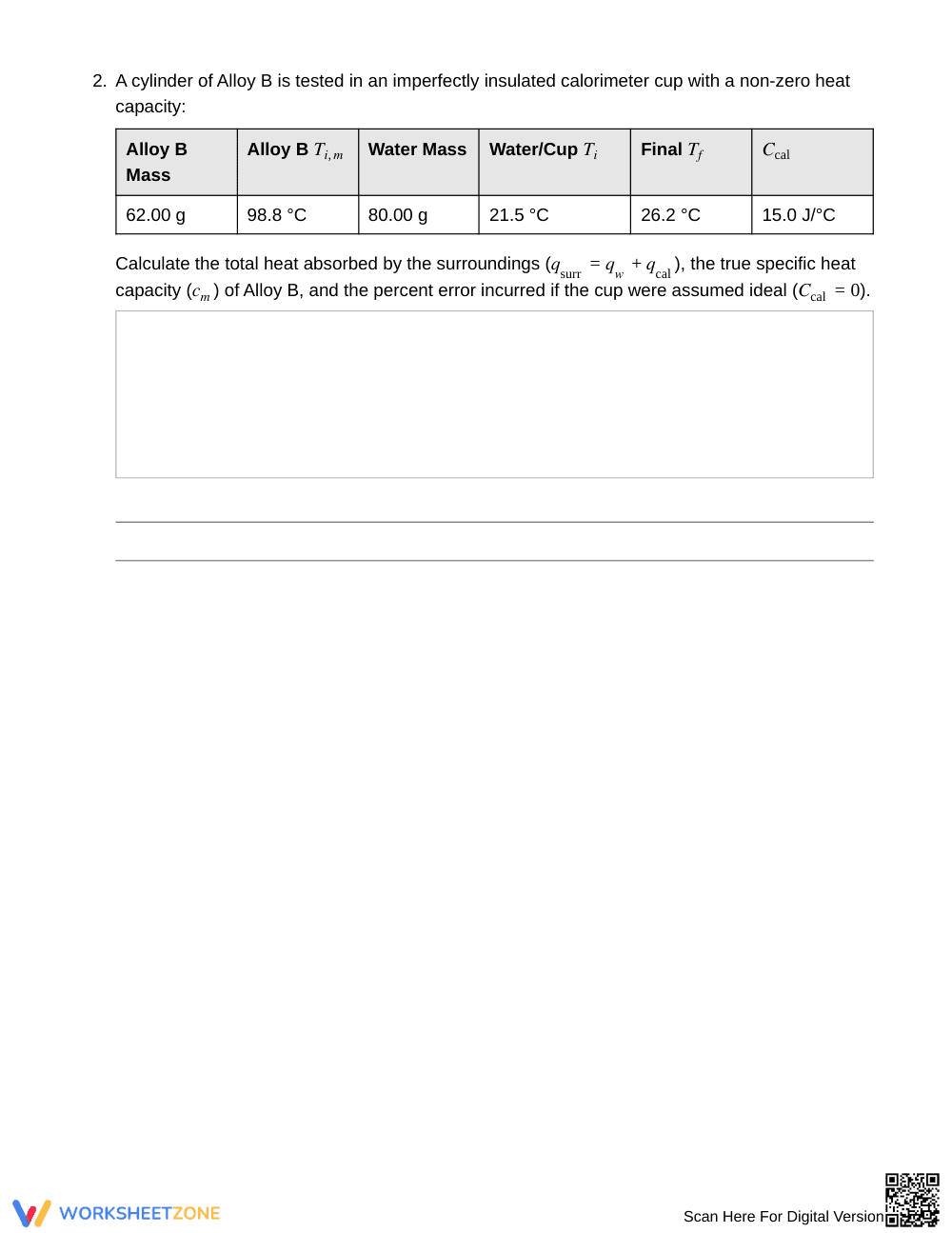
- Guided Practice (Part A — 2 problems): Students calculate signed heat flow and alloy specific heat under ideal conditions before factoring in calorimeter cup heat capacity ($C_{cal}$).
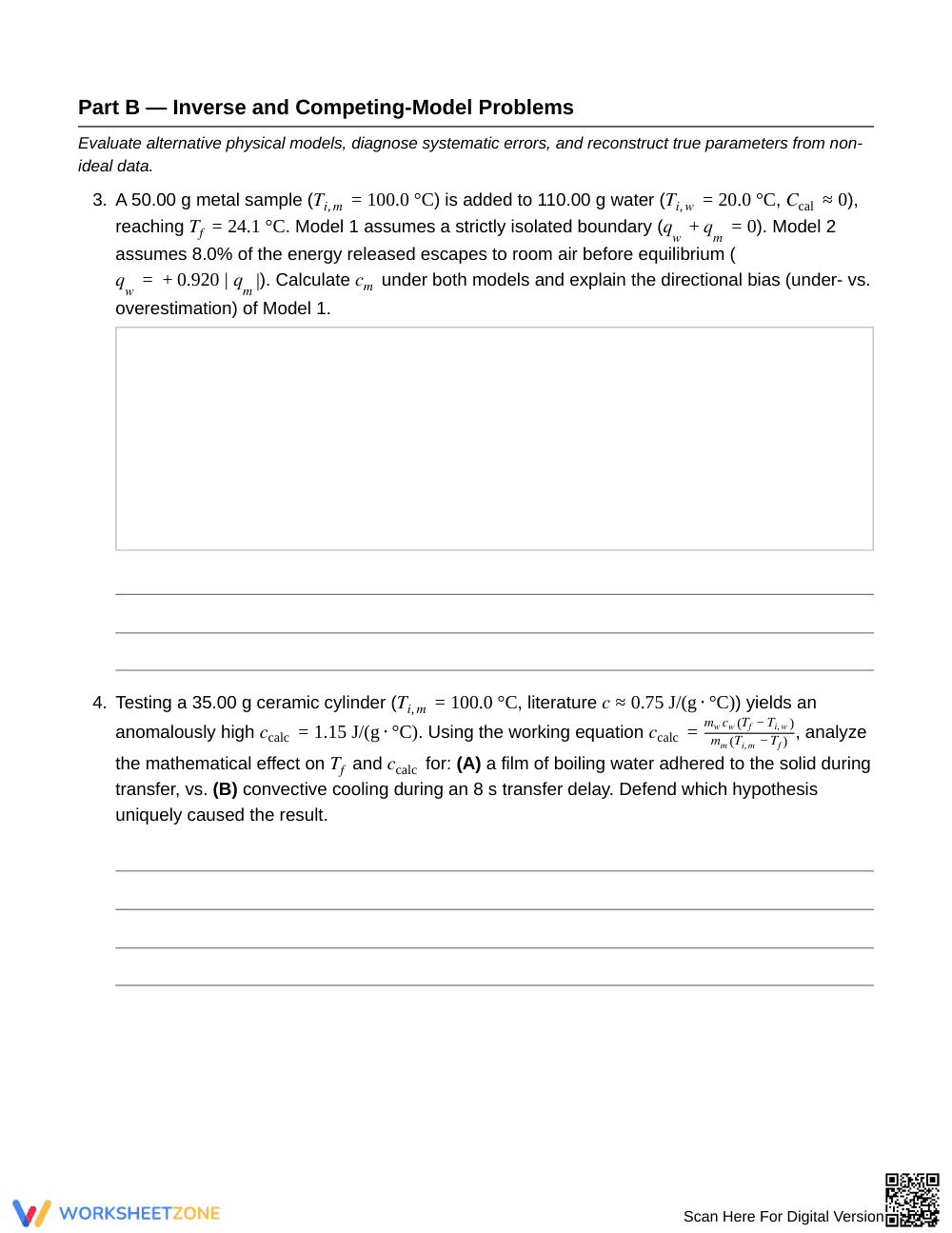
- Supported Practice (Part B — 3 problems): Students evaluate competing thermal loss models, diagnose transfer delay errors, and resolve three-component balances with water carryover.
- Independent Practice (Part C — 1 problem): Students evaluate high-temperature quenching protocols and defend thermodynamic assumptions.
This sequence implements an I Do, We Do, You Do gradual-release model from guided calculation to experimental defense.
Standards Alignment
This resource aligns with high school chemistry standards on thermal energy transfer, conservation of energy, and mathematical modeling in calorimetry. Students evaluate thermodynamic boundary conditions and calculate heat exchange. Both standard codes can be copied directly into lesson plans, IEP goals, or district curriculum mapping tools.
How to Use It
Assign this worksheet after direct instruction on calorimetry or as post-lab analytical practice. Formatively assess whether students maintain correct negative signs for exothermic metal cooling ($\Delta T < 0$) and positive signs for endothermic water warming. Expected completion time is 45 to 60 minutes.
Who It's For
This worksheet serves Grade 11 Chemistry and Honors Chemistry students developing quantitative thermochemistry skills. Scaffolded equations support learners needing structure, while error modeling challenges advanced students. Pair this activity with a metal calorimetry laboratory investigation or a lesson on energy conservation.
According to research by Fisher & Frey (2014) on disciplinary literacy and mathematical modeling in secondary science, structured problem sets requiring learners to defend boundary assumptions significantly improve conceptual retention and analytical accuracy. This Grade 11 chemistry resource targets the core skill of estimating unknown specific heat capacities by systematically challenging students to contrast ideal isolated systems with realistic non-ideal calorimetry environments. Rather than applying formulas mechanically, learners track extensive versus intensive variables, account for calorimeter heat capacities, and quantify systematic error from water mass carryover across 6 multi-step problems. By integrating explicit physical modeling with quantitative calculations and experimental protocol design, this resource bridges theoretical thermodynamics and practical laboratory analysis, ensuring secondary science students achieve durable mastery of thermal energy conservation principles.


