

































Essential Sound Wave Quantity Worksheet | Grade 12 Physics

Paste this activity's link or code into your existing LMS (Google Classroom, Canvas, Teams, Schoology, Moodle, etc.).
Students can open and work on the activity right away, with no student login required.
You'll still be able to track student progress and results from your teacher account.
Master sound-wave mechanics with this comprehensive Grade 12 physics worksheet. Students calculate acoustic wave quantities including wave speed, decibel levels, harmonic resonance in open and closed pipes, beat frequencies, and Doppler shifts. This resource builds rigorous problem-solving fluency across multi-step mathematical acoustics.
At a Glance
- Grade: 12 · Subject: Physics
- Standard: Advanced Wave Mechanics — Calculate acoustic wave quantities, resonance modes, and Doppler shifts
- Skill Focus: Calculate a Sound-Wave Quantity
- Format: 5 pages · 10 problems · Answer key included · PDF
- Best For: High school advanced physics wave practice
- Time: 45–60 minutes
What's Inside
This 5-page worksheet includes a governing equation reference box, two worked example calculations, and 10 problems divided into scaffolded foundational calculations, independent multi-step applications, and theoretical reasoning prompts. A 2-page answer key provides complete step-by-step mathematical solutions.
Skill Progression
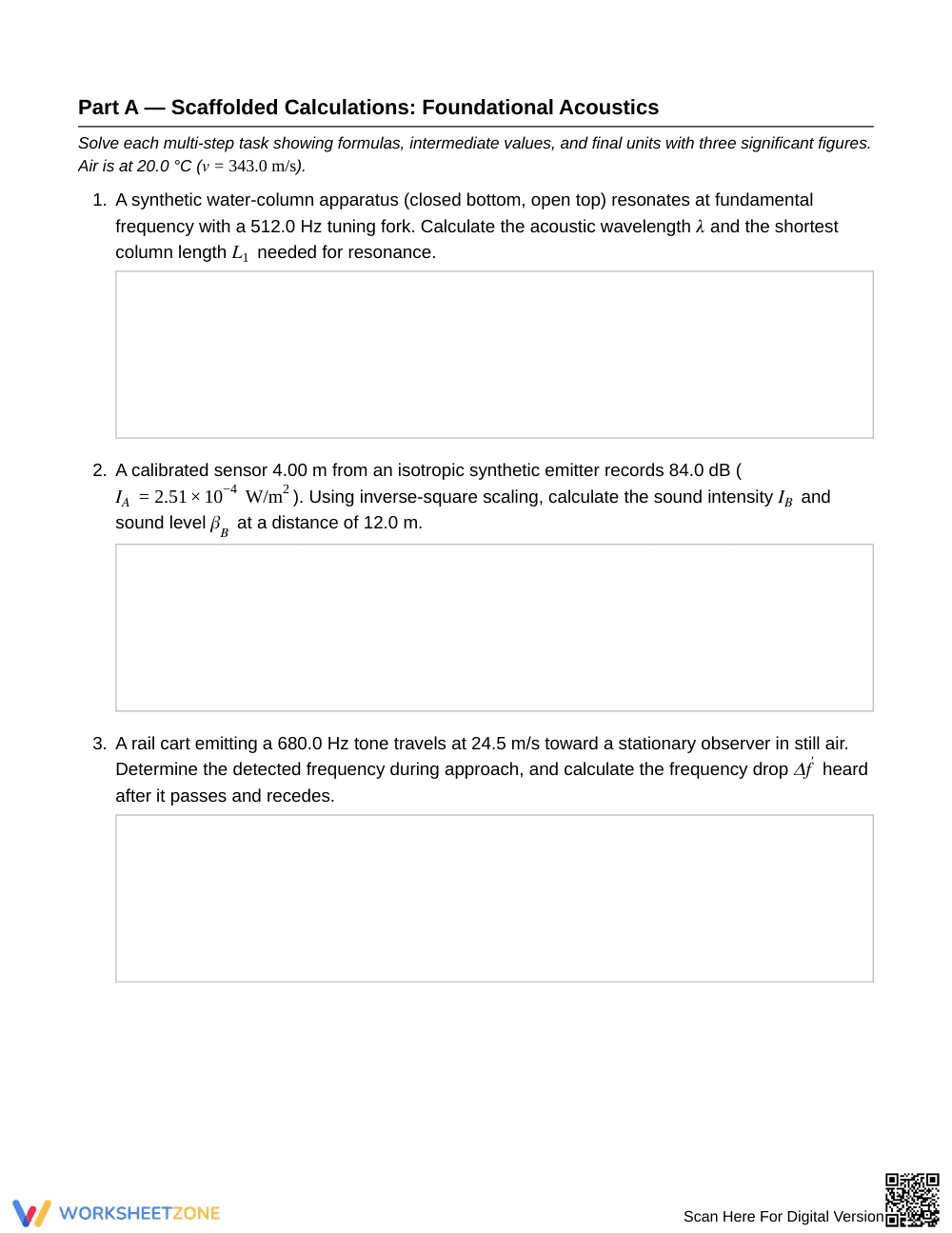
- Guided practice: Students review modeled cases solving resonance and intensity before tackling 3 scaffolded problems on wavelength, decibel scaling, and Doppler shifts.
- Supported practice: Students solve 5 multi-step application problems on matched harmonics, two-source superposition, moving observers, beat frequencies, and temperature-dependent wave speeds.
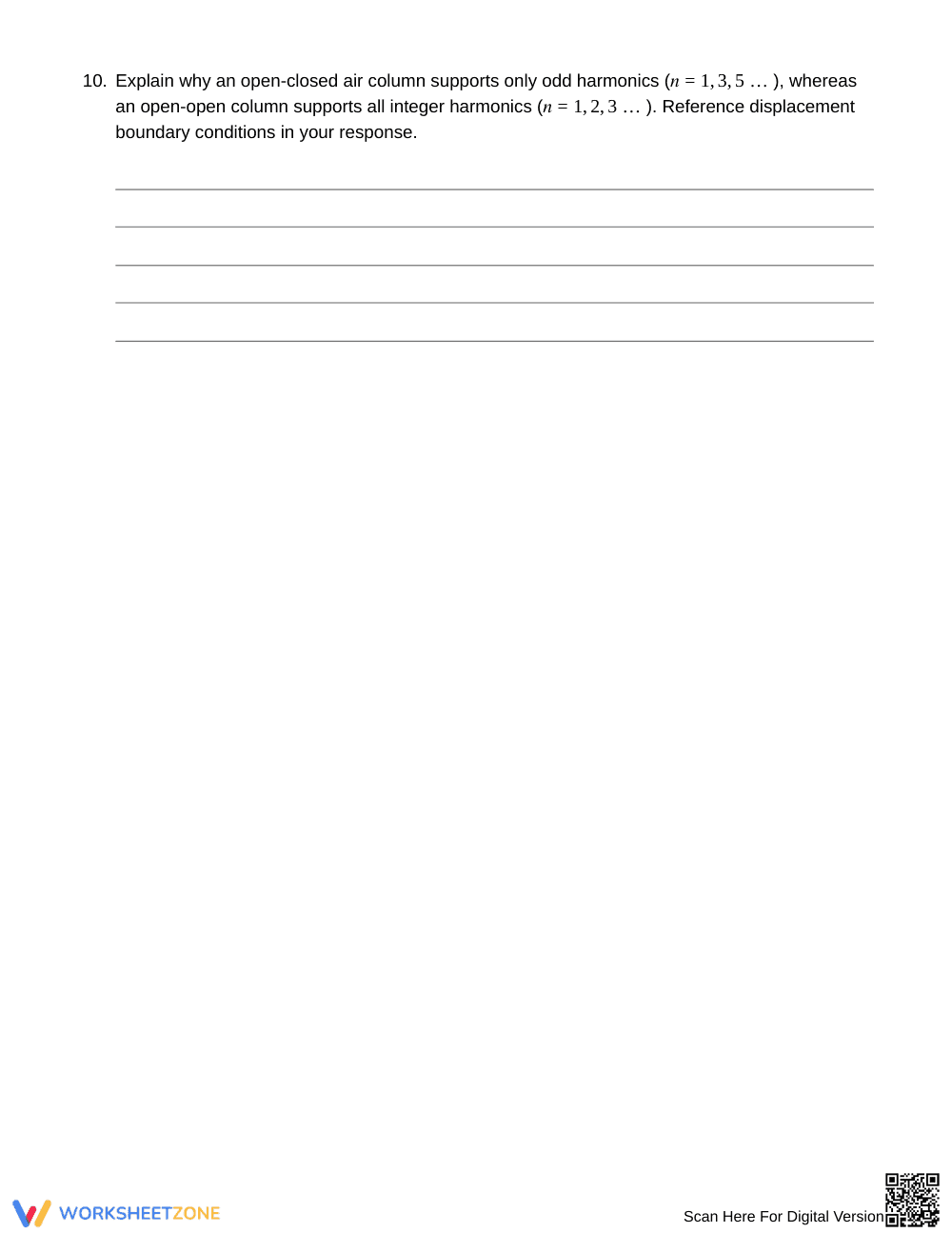
- Independent practice: Students write 2 theoretical explanations analyzing logarithmic decibel scaling and standing wave boundary conditions.
This sequence applies the gradual release model (I Do, We Do, You Do) to build autonomous problem-solving.
Standards Alignment
This resource aligns with high school wave mechanics standards, requiring students to calculate mathematical relationships among frequency, wavelength, speed, sound intensity, resonance modes, and Doppler motion. Standard descriptions can be copied directly into lesson plans, IEP goals, or district curriculum mapping tools.
How to Use It
Assign this worksheet during your sound unit following instruction on standing waves and the Doppler effect. Have students complete Part A in pairs before tackling Parts B and C independently within 45 to 60 minutes. Check Part B problem 2 to confirm students add physical acoustic intensities rather than raw decibel values.
Who It's For
This worksheet is designed for Grade 12 physics, AP Physics, and introductory college physics students. Scaffolding supports developing learners through worked examples, while advanced problems challenge honors students. Pair this set with an acoustic resonance laboratory investigation.
According to research by Fisher & Frey (2014), structured instructional progressions that move systematically from modeled foundational examples through supported problem sets to autonomous application substantially improve student quantitative mastery in advanced STEM coursework. This Grade 12 physics resource directly implements that pedagogical framework to help learners calculate complex sound-wave quantities, including inverse-square intensity attenuation, decibel sound levels, harmonic pipe resonance, beat frequencies, Doppler velocity shifts, and temperature-dependent wave speeds. Featuring an explicit reference box with acoustic constants, two fully annotated worked examples, and ten multi-tiered problem sets, this 5-page instructional worksheet builds mathematical calculation fluency while reinforcing conceptual wave physics. The resource delivers robust formative assessment data for high school physics instructors seeking to evaluate student analytical reasoning, equation manipulation, and conceptual understanding of acoustic boundary conditions prior to comprehensive summative evaluations.


