































Essential Solar System Word Search | Grades 7–8 Science

Paste this activity's link or code into your existing LMS (Google Classroom, Canvas, Teams, Schoology, Moodle, etc.).
Students can open and work on the activity right away, with no student login required.
You'll still be able to track student progress and results from your teacher account.
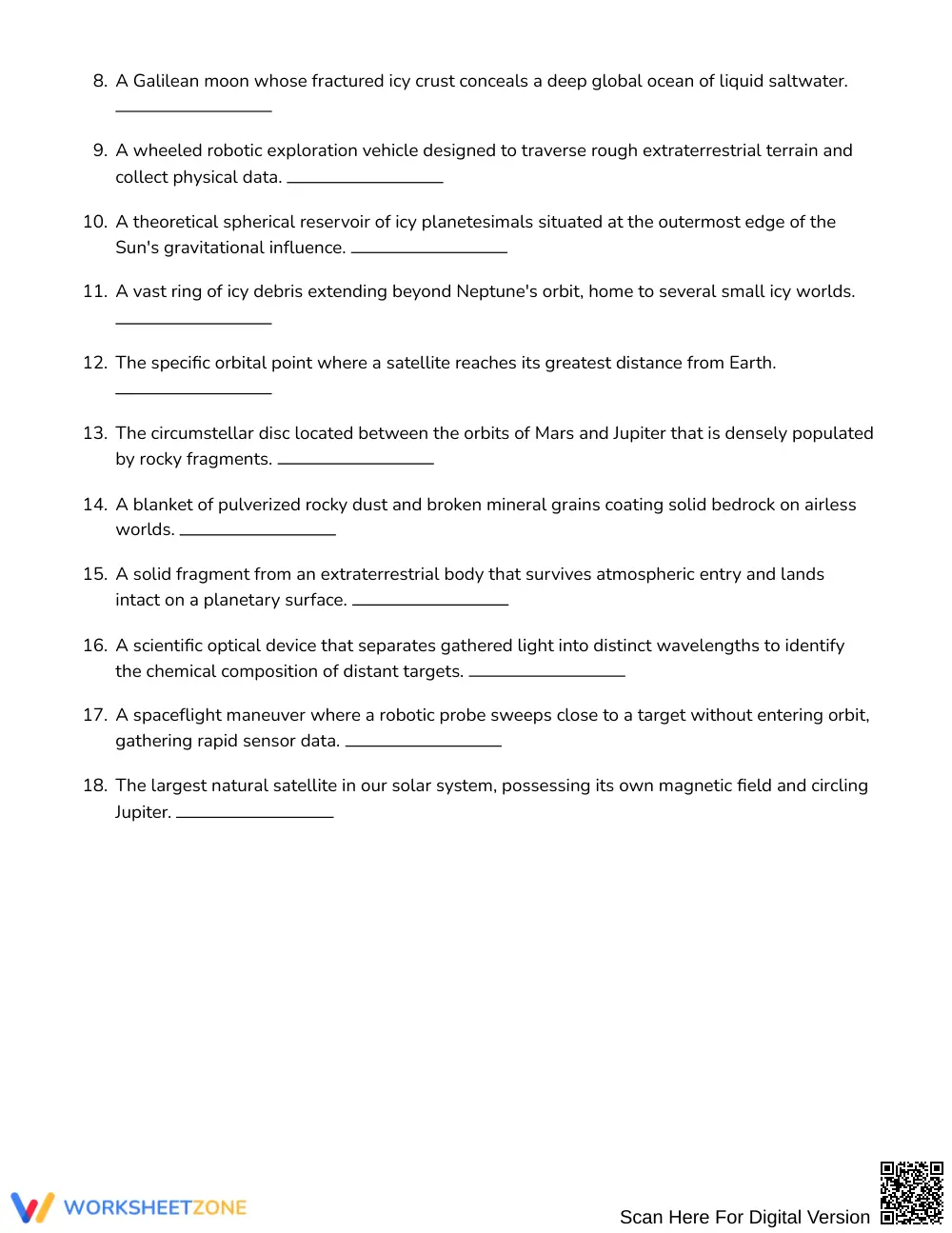
This Grades 7–8 science word search reinforces foundational astronomy vocabulary through clue-based retrieval practice. Students review key celestial bodies, orbital mechanics, and space exploration concepts by matching definitions to scientific terminology before locating each hidden term. It provides an engaging, low-stakes method to consolidate vocabulary mastery across a comprehensive solar system unit.
At a Glance
- Grade: Grades 7–8 · Subject: Science
- Standard: Not standards-assessed — vocabulary enrichment
- Skill Focus: Solar-system bodies and exploration review
- Format: 3 pages · 18 words · Answer key included · PDF
- Best For: Unit vocabulary review and station work
- Time: 20–30 minutes
What's Inside
The activity spans 3 printable pages featuring an 18-word puzzle accompanied by content-rich clues. Rather than presenting a simple list of terms, the resource supplies rigorous scientific descriptions that require students to deduce the correct terminology first. A comprehensive 4-page answer key displays exact grid coordinates and word placements for immediate verification.
Puzzle Mechanics
This puzzle utilizes a dense 20 x 20 letter grid designed to challenge middle school students. The 18 target vocabulary terms are hidden across all eight compass directions: north, northeast, east, southeast, south, southwest, west, and northwest. Students read descriptive definitions, identify the corresponding terms within a shuffled word bank, and track the spatial orientation of each word across the letter matrix.
Standards Alignment
This word search serves as a vocabulary enrichment resource and cumulative review activity rather than an assessment of a specific state or national performance expectation. It reinforces domain-specific terminology across middle school earth and space science curricula, strengthening scientific literacy and content comprehension without formal standards benchmarking.
How to Use It
Deploy this puzzle directly after completing direct instruction on solar system exploration and planetary bodies. It works well as an independent consolidation station or as a collaborative partner challenge during review week. During completion, circulate to observe whether students use the contextual clues to identify terms before hunting in the grid. Most students will finish the complete 18-word search within 20 to 30 minutes.
Who It's For
This activity is tailored for general education and introductory astronomy students in Grades 7–8. It offers accessible terminology reinforcement for English language learners through clear definitions and paired word-bank scaffolding. Pair this word search alongside an illustrated solar system reference chart or introductory textbook chapter for optimal retention.
Contextualized vocabulary retrieval plays a vital role in middle school science comprehension. According to Fisher & Frey (2014), intentional word exposure through structured literacy tasks strengthens domain-specific acquisition and aids long-term memory consolidation in adolescent learners. By challenging students to connect descriptive clues—such as orbital characteristics, robotic mission types, and satellite features—to specific astronomical terms, this activity promotes active cognitive processing rather than passive letter scanning. Students practice identifying technical vocabulary including regolith, apogee, tidal locking, and spectrometer within authentic scientific contexts. Incorporating structured puzzle formats into science review provides low-anxiety academic engagement while reinforcing orthographic memory and conceptual definitions across the curriculum. Middle school learners benefit significantly when academic terminology is reviewed systematically across multiple instructional touches, establishing a durable linguistic framework that supports subsequent reading comprehension, laboratory investigation, and complex scientific discourse in secondary science courses.


