




























Essential Shared Facts Worksheet | Grade 7 ELA
Paste this activity's link or code into your existing LMS (Google Classroom, Canvas, Teams, Schoology, Moodle, etc.).
Students can open and work on the activity right away, with no student login required.
You'll still be able to track student progress and results from your teacher account.
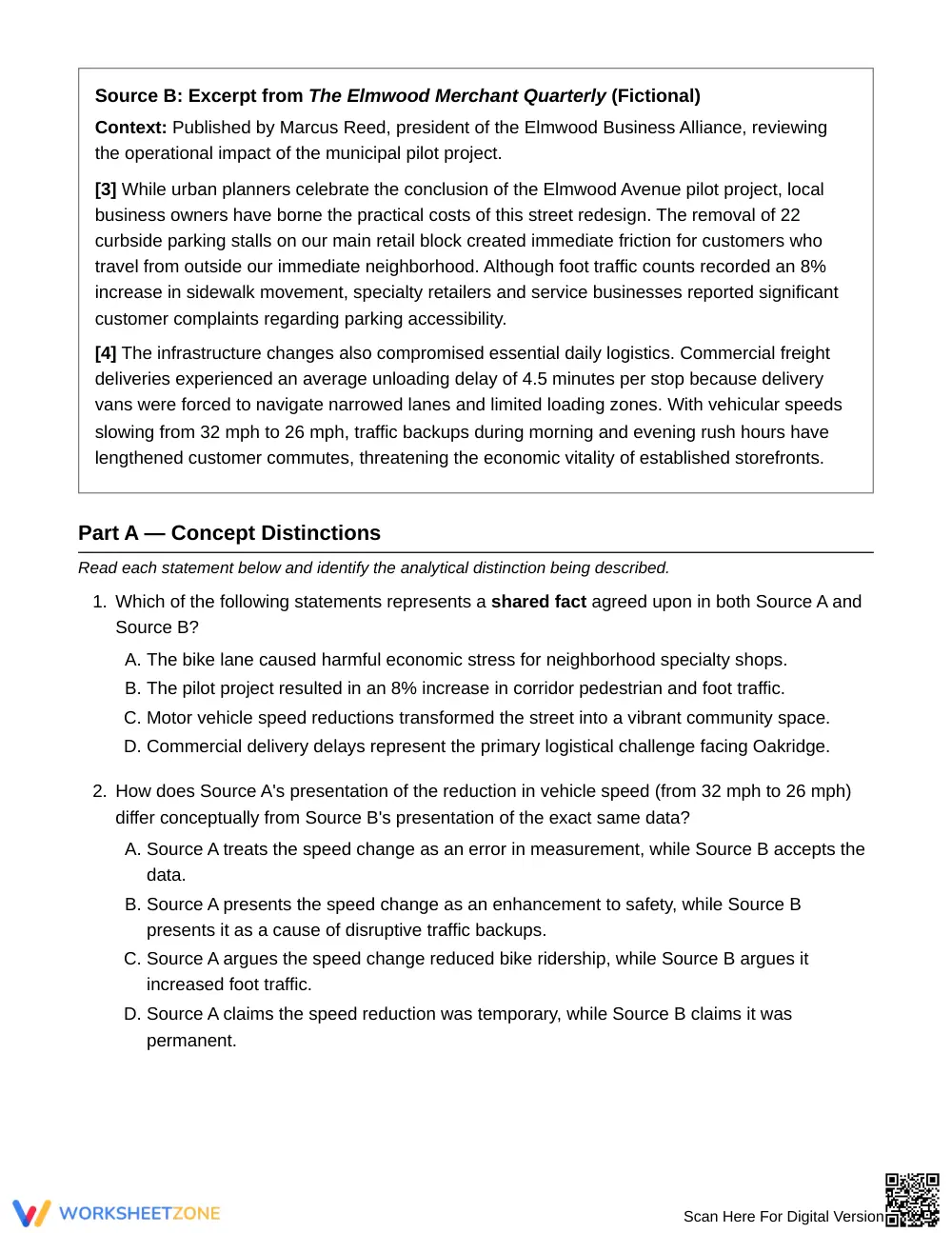
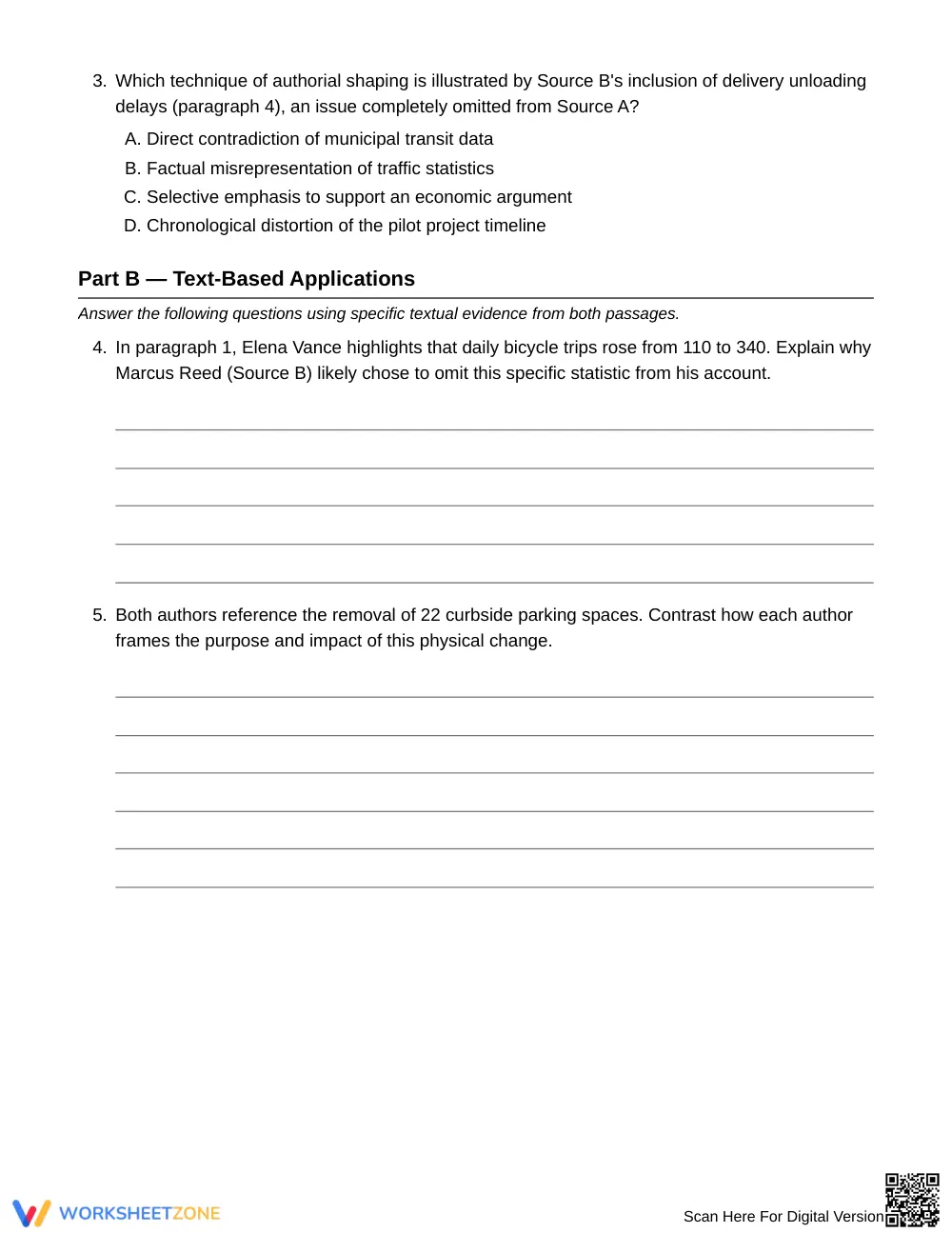
This Grade 7 reading informational text worksheet develops critical analytical skills by training middle schoolers to contrast two accounts of the same event. Students examine how different authors select, emphasize, and interpret identical factual data regarding an urban street redesign to shape opposing arguments and sway civic audiences.
At a Glance
- Grade: 7 · Subject: ELA
- Standard:
RI.7.9— Compare how two authors shape presentations of the same topic using evidence- Skill Focus: Shared Facts and Different Emphases
- Format: 5 pages · 10 problems · Answer key included · PDF
- Best For: Informational text paired analysis practice
- Time: 35–45 minutes
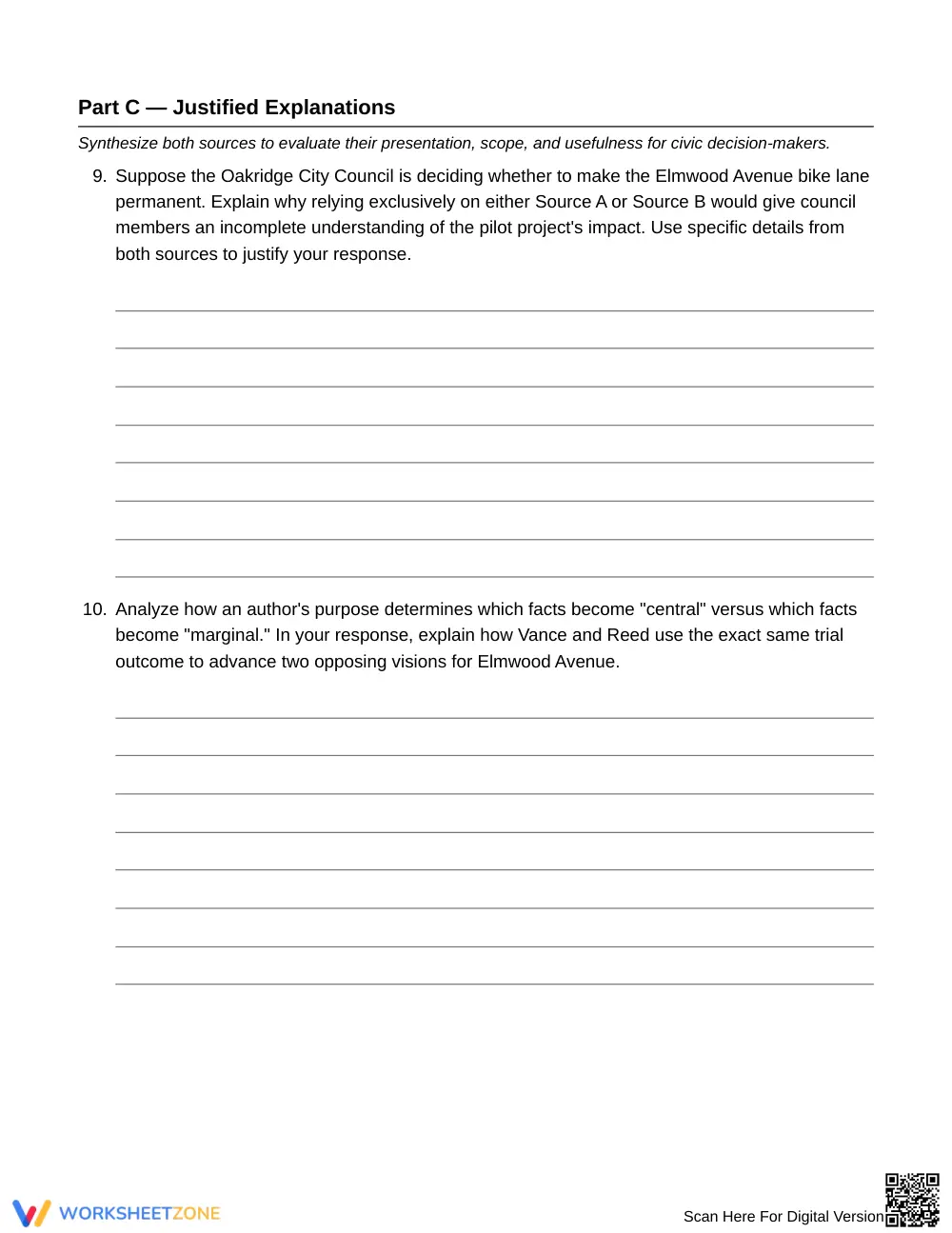
This 5-page resource presents paired nonfiction excerpts about a municipal transit pilot alongside 10 targeted analytical questions and a complete 3-page answer key. The worksheet opens with a core concept box defining facts, selective emphasis, and interpretation before moving into multiple-choice discrimination, a synthesis comparison table, and short-answer evaluations.
Skill Progression
- Guided practice (Questions 1–3): Students identify baseline shared data and distinguish between factual claims, selective omissions, and subjective framing across 3 multiple-choice items.
- Supported practice (Questions 4–8): Students complete a comparison table and write 4 short answers examining how author perspective and omitted details influence reader interpretation.
- Independent practice (Questions 9–10): Students synthesize both texts in 2 extended responses, explaining how author purpose dictates evidence hierarchy for civic decision-makers.
This structured sequence follows the gradual release of responsibility model, transitioning learners from conceptual recognition to rigorous textual synthesis.
Standards Alignment
This activity targets primary standard RI.7.9: "Compare and contrast how two or more authors writing about the same topic shape their presentations of key information by emphasizing different evidence or advancing different interpretations of facts." It also reinforces RI.7.1 by requiring textual evidence for every claim. Both standard codes can be copied directly into lesson plans, IEP goals, or district curriculum mapping tools.
How to Use It
Deploy this worksheet during the guided practice phase following direct instruction on rhetorical perspective, or assign it as a paired-text assessment. For formative assessment, check whether students recognize the 8% foot traffic increase as neutral shared evidence before evaluating each author's spin. Expected completion time is 35 to 45 minutes.
Who It's For
This activity is designed for Grade 7 general education English language arts classrooms, advanced Grade 6 readers, or high school intervention groups needing structured practice with paired nonfiction. Support emerging readers by highlighting data points in both passages prior to class, and pair the lesson with an anchor chart comparing objective facts against authorial spin.
Mastering standard RI.7.9 requires middle school readers to move beyond literal comprehension and examine how authors manipulate emphasis to construct contrasting arguments from identical data. According to Fisher & Frey (2014), close reading of complex paired texts fosters analytical independence when students systematically interrogate authorial perspective, structural emphasis, and intentional omission. This 10-task worksheet builds essential evaluative capacity by guiding Grade 7 students through a comparative study of two transit reports. Learners examine how identical metrics—such as speed reductions and foot traffic gains—are reframed to advance opposing stakeholder priorities. By completing these comparative tasks, students develop the critical reasoning and media literacy skills necessary to evaluate complex civic and informational texts across secondary coursework.


