


























Views
Downloads




Essential Rhetorical Defense Worksheet | Grade 10 English II
Paste this activity's link or code into your existing LMS (Google Classroom, Canvas, Teams, Schoology, Moodle, etc.).
Students can open and work on the activity right away, with no student login required.
You'll still be able to track student progress and results from your teacher account.
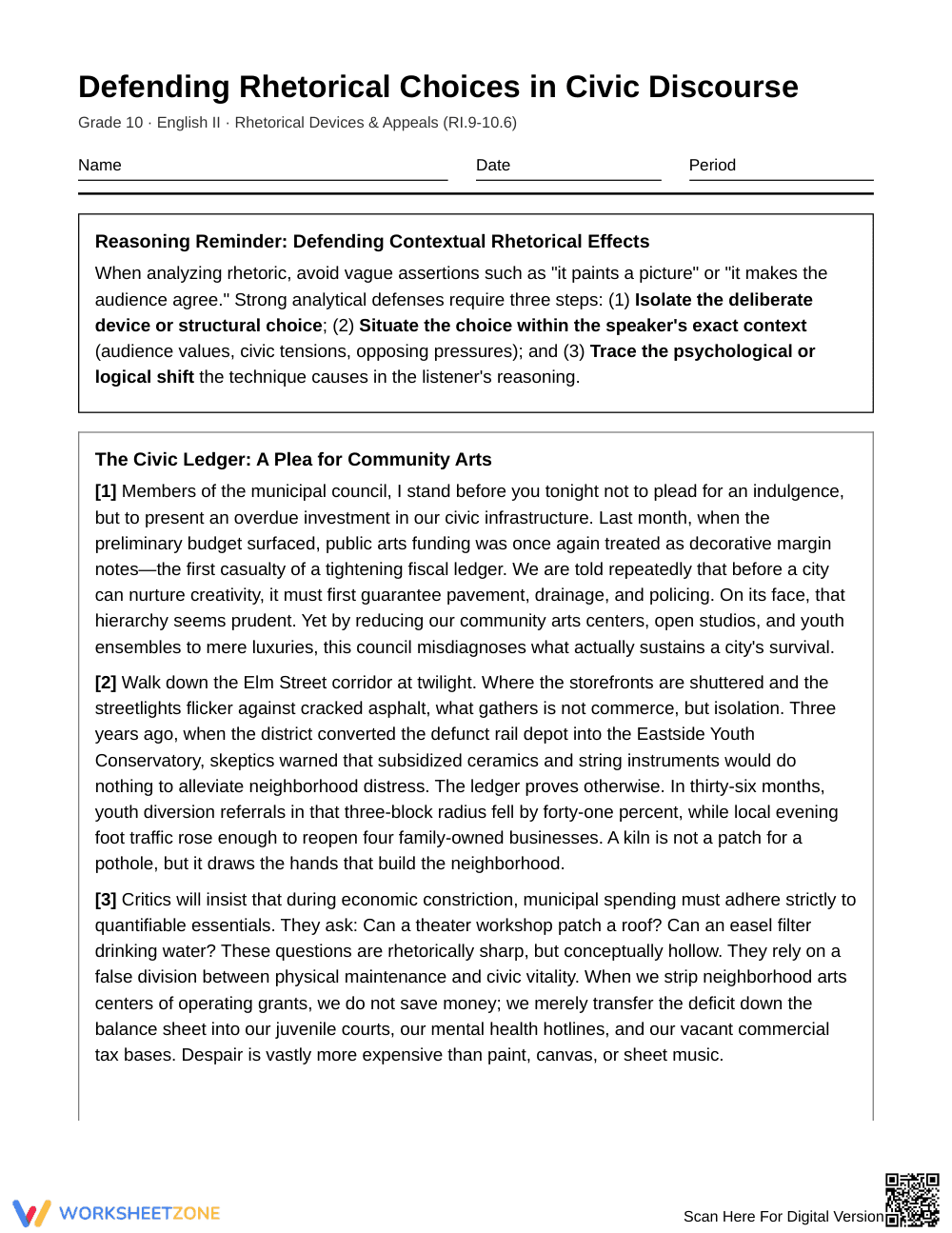
This Grade 10 English II worksheet guides students to defend how deliberate rhetorical choices achieve specific effects in civic discourse. Analyzing a municipal budget speech, learners move beyond naming devices to evaluate how speakers navigate audience values and advance persuasive arguments.
At a Glance
- Grade: 10 · Subject: English II
- Standard:
RI.9-10.6— Determine point of view and analyze how rhetoric advances it- Skill Focus: Defending Contextual Rhetorical Effects
- Format: 6 pages · 8 problems · Answer key included · PDF
- Best For: Rhetorical analysis and civic debate units
- Time: 40–50 minutes
What's Inside
This 6-page resource features an authentic speech, "The Civic Ledger," alongside 8 analytical prompts. It includes a "Reasoning Reminder" reference protocol and a complete 3-page answer key with exemplar defenses.
Skill Progression
- Guided practice (Part A, 2 tasks): Students identify empirical data and contrastive details that establish the speaker's foundation.
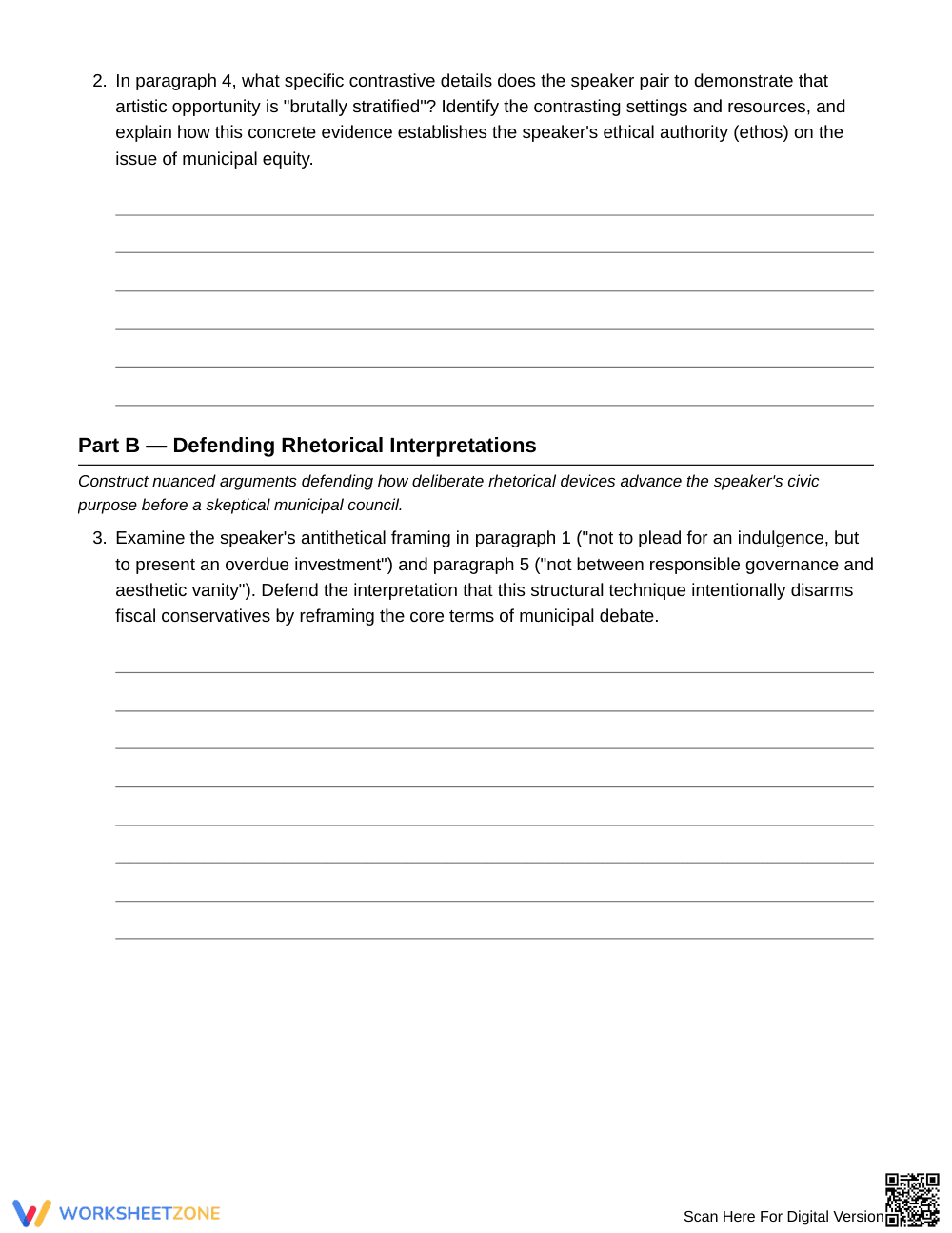
- Supported practice (Part B, 4 tasks): Learners construct contextual arguments defending how antithesis, economic jargon, and concession persuade listeners.
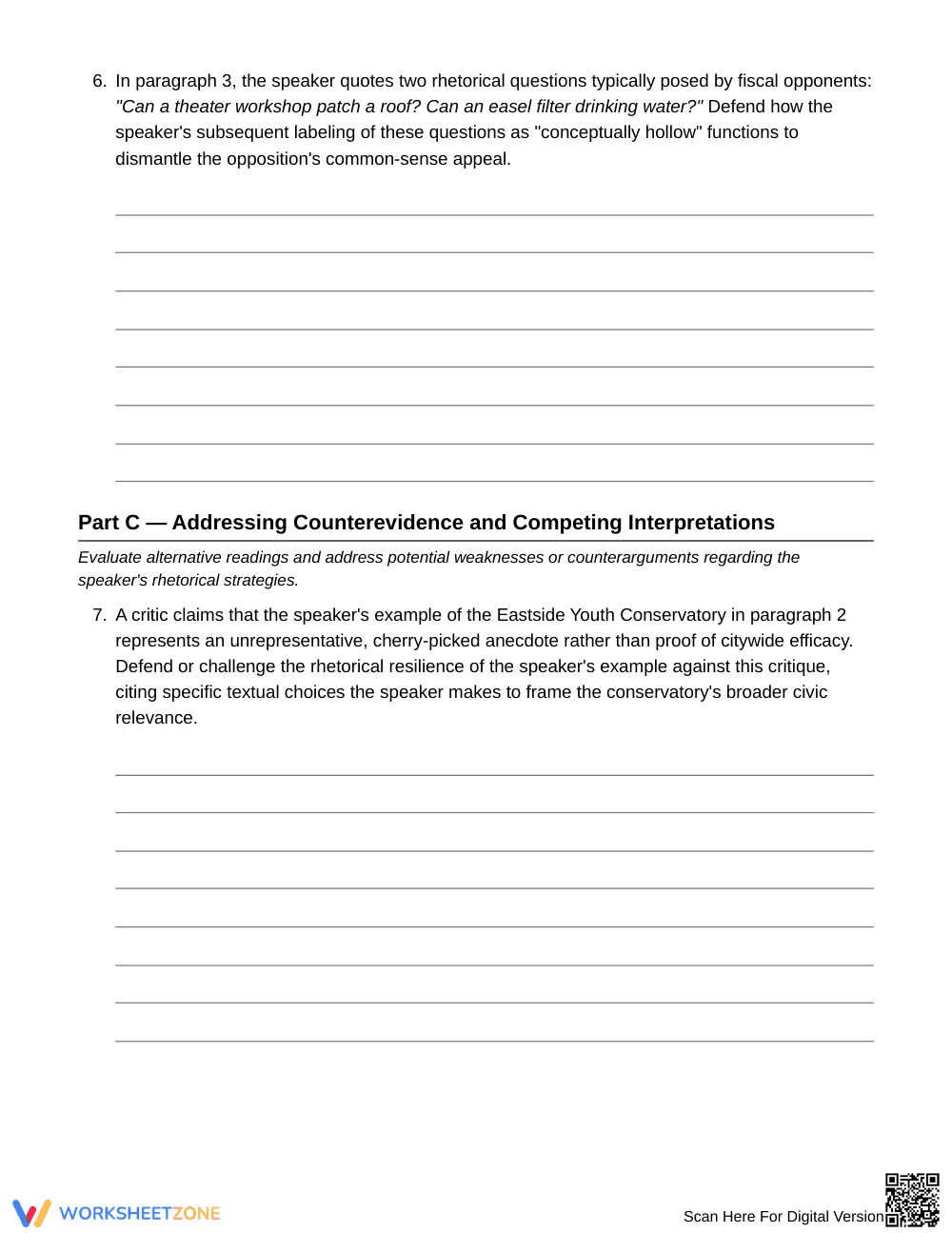
- Independent practice (Part C, 2 tasks): Students evaluate counterevidence and defend interpretations against competing critiques.
This structure ensures a steady gradual release toward analytical mastery.
Standards Alignment
Aligned with RI.9-10.6, this worksheet asks students to determine an author's purpose and analyze rhetorical strategies. It also supports RI.9-10.1 through rigorous textual evidence requirements. Both standard codes can be copied directly into lesson plans, IEP goals, or district curriculum mapping tools.
How to Use It
Use this activity during rhetorical analysis units or prior to essay drafting. For formative assessment, review Part B to verify that students explain audience dynamics rather than offering vague device definitions. Completion takes approximately 40 to 50 minutes.
Who It's For
Ideal for Grade 10 English II, honors, and Pre-AP classes. Pair with direct instruction on rhetorical appeals or argumentative writing guides.
According to research by Fisher & Frey (2014), secondary students develop advanced analytical writing skills when instruction explicitly scaffolds the progression from textual evidence identification to contextual argumentation. This Grade 10 English II worksheet applies that framework by aligning 8 targeted tasks with standard RI.9-10.6, which calls on learners to determine an author's purpose and analyze how deliberate rhetorical techniques advance that viewpoint. Grounded in a realistic municipal budget debate text, the resource guides students through isolating devices, evaluating audience constraints, and explaining shifts in listener reasoning. In addition, the comprehensive 3-page answer key provides teachers with clear benchmark responses for accurate, consistent formative assessment across diverse classrooms. By moving learners beyond basic device labeling to defensible analytical writing, this 6-page instructional material establishes essential high school literacy and critical reasoning competencies.


