




























Views
Downloads




Essential Representative Detail Worksheet | Grade 7 ELA

Paste this activity's link or code into your existing LMS (Google Classroom, Canvas, Teams, Schoology, Moodle, etc.).
Students can open and work on the activity right away, with no student login required.
You'll still be able to track student progress and results from your teacher account.
This Grade 7 reading informational text worksheet helps students master central idea development and objective summary writing through rigorous textual analysis. By evaluating evidence from an authentic school broadcast scenario, learners practice distinguishing representative details from isolated facts, defending analytical claims, and crafting balanced, unbiased summaries.
At a Glance
- Grade: 7 · Subject: ELA
- Standard:
RI.7.2— Determine central ideas, analyze their development, and write an objective summary- Skill Focus: Defending Representative Details & Objective Summaries
- Format: 5 pages · 8 problems · Answer key included · PDF
- Best For: Informational text analysis and close reading
- Time: 40–50 minutes
What's Inside
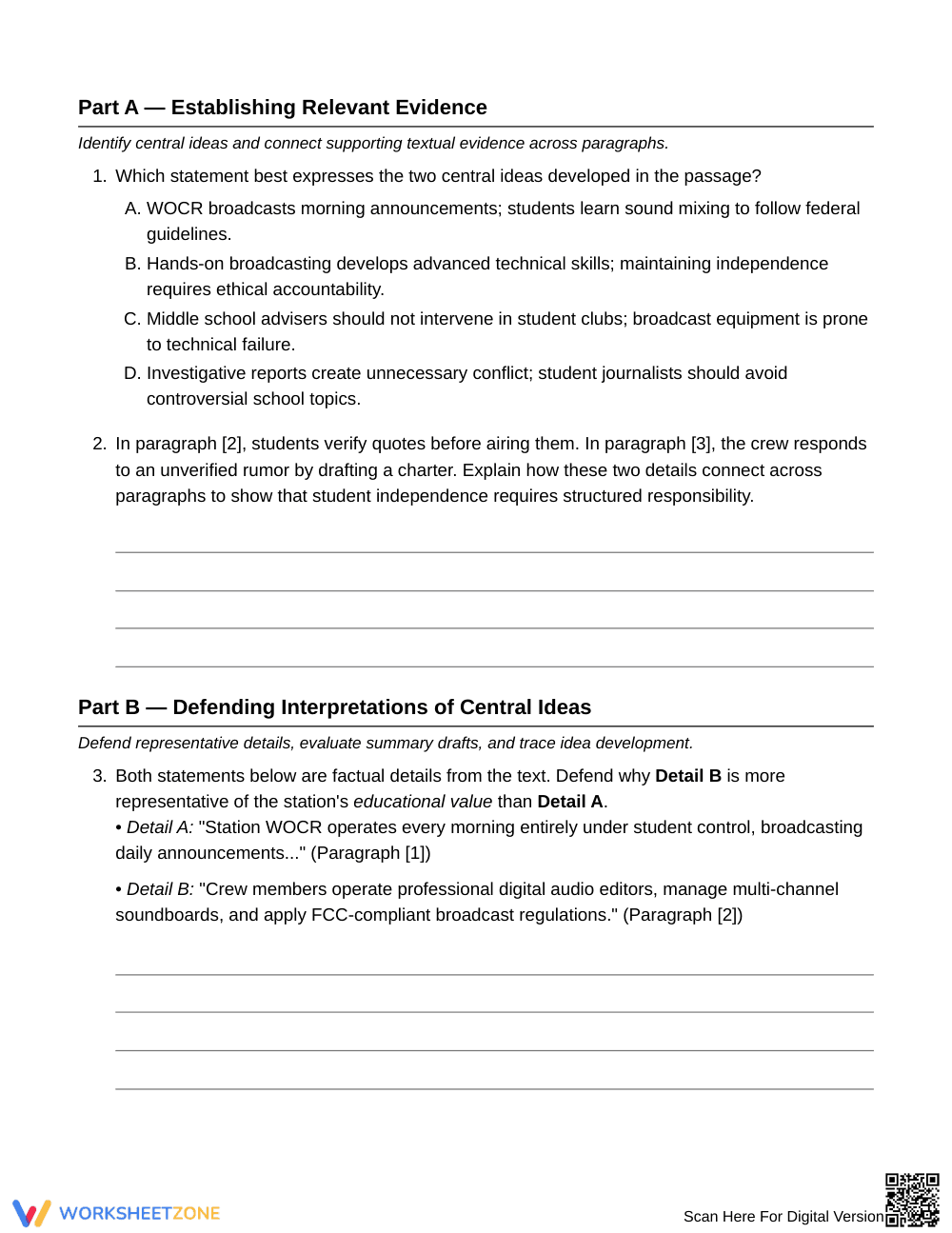
The 5-page printable resource centers on "On the Air at Room 114," an engaging informational article about a student-operated middle school radio station. It includes foundational reasoning reminders, 8 structured analytical prompts across three scaffolded sections, dedicated student response areas, and a comprehensive 2-page answer key with model explanations.
Skill Progression
- Guided Practice (Part A, 2 tasks): Students identify dual central ideas across paragraphs and connect supporting evidence, establishing how student autonomy requires structured institutional responsibility.
- Supported Practice (Part B, 4 tasks): Learners defend why specific details represent the text better than others, critique summary drafts for bias, trace idea progression, and draft a 3-sentence objective summary.
- Independent Practice (Part C, 2 tasks): Students evaluate counterevidence, refute flawed claims regarding adult oversight, and explain why single-event details produce incomplete text summaries.
This structured sequence reflects the gradual release of responsibility model, moving students from basic identification to critical evaluation and written synthesis.
Standards Alignment
This resource aligns directly with RI.7.2: "Determine two or more central ideas in a text and analyze their development over the course of the text; provide an objective summary of the text." It also supports RI.7.1 by requiring textual evidence to defend analytical choices. Both standard codes can be copied directly into lesson plans, IEP goals, or district curriculum mapping tools.
How to Use It
Use this worksheet after direct instruction on central ideas as a core close-reading activity, or assign it during structured small-group intervention. When facilitating Part B, check whether students can articulate why Detail B demonstrates deeper educational value than Detail A, observing whether they identify conceptual scope versus factual accuracy. Expect completion within 40 to 50 minutes.
Who It's For
Designed for seventh-grade English language arts classrooms, this printable is ideal for general education, co-taught classes, and targeted reading intervention. Sentence stems can support multilingual learners, while Part C provides rigorous critical thinking for advanced readers. Pair this activity with an anchor chart on objective summary criteria or a mini-lesson on distinguishing central ideas from minor supporting details.
Mastering central idea analysis and objective summarization under CCSS.ELA-LITERACY.RI.7.2 requires middle school students to move beyond surface-level recall toward rigorous, evaluative textual synthesis. As highlighted by Fisher & Frey (2014) in their foundational research on text-dependent questioning and close reading systems, secondary reading comprehension improves significantly when adolescent learners must defend why specific textual evidence best supports an overarching concept rather than merely identifying isolated facts. This 5-page informational text resource provides 8 structured analytical tasks that guide Grade 7 students through evaluating competing details, analyzing idea progression across paragraphs, distinguishing neutral reporting from subjective bias, and formulating concise objective summaries. By requiring explicit evidence-based justification and the systematic refutation of incomplete claims, this instructional tool develops critical thinking habits essential for standardized assessments and lifelong non-fiction literacy.


