





























Essential Report Structure Worksheet | Grade 9 English I
Paste this activity's link or code into your existing LMS (Google Classroom, Canvas, Teams, Schoology, Moodle, etc.).
Students can open and work on the activity right away, with no student login required.
You'll still be able to track student progress and results from your teacher account.
This Grade 9 informational text worksheet trains students to trace the structural logic of complex technical reports. Students examine how an author builds an evidence-based civil assessment from empirical diagnosis through causal refinement, engineered solutions, and counterarguments to reach a defensible policy conclusion.
At a Glance
- Grade: 9 · Subject: English I
- Standard:
RI.9-10.5— Analyze how an author structures an argument to develop claims- Skill Focus: Trace a Report’s Organizational Logic
- Format: 6 pages · 10 problems · Answer key included · PDF
- Best For: Informational text structure analysis practice
- Time: 45–60 minutes
What's Inside
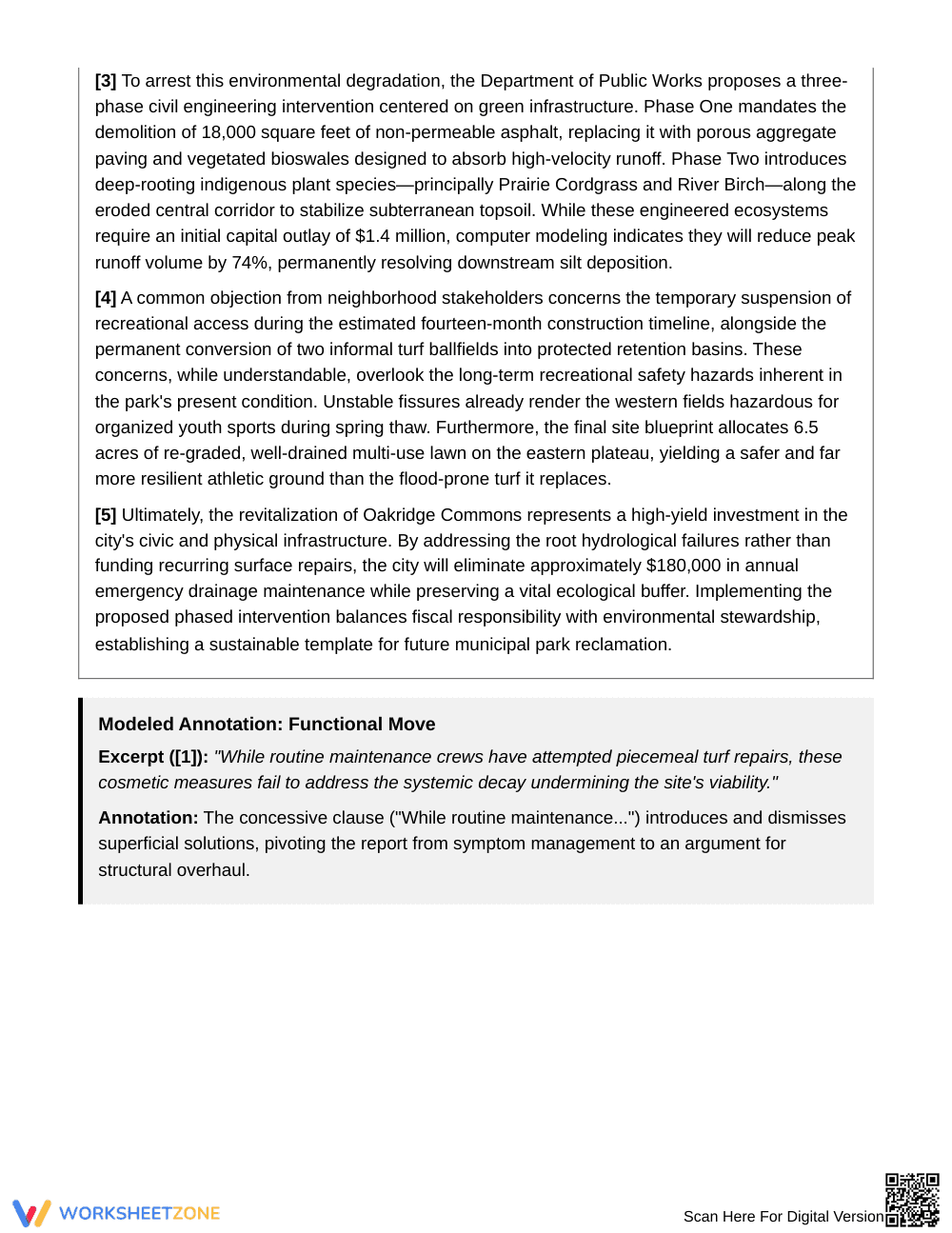
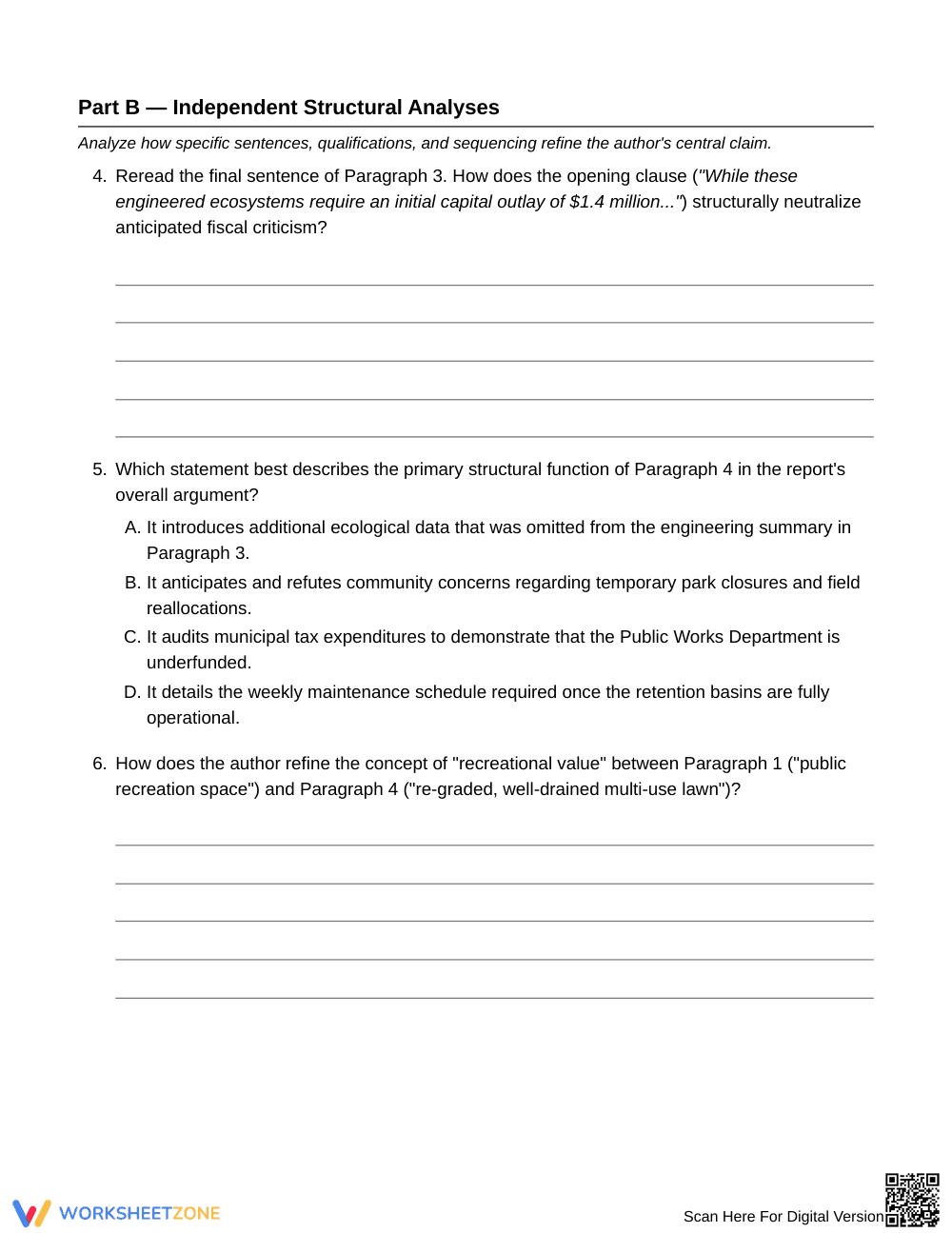
The resource includes a multi-paragraph civic report on municipal park revitalization, an analytical framework defining four structural moves, and a modeled annotation demonstrating functional analysis. It provides 10 analytical tasks distributed across three rigorous sections, concluding with a comprehensive 3-page explanatory answer key.
Skill Progression
- Guided practice (Part A, 3 problems): Students reference an explicit conceptual framework to connect diagnostic evidence with technical solutions using structured analytical prompts.
- Supported practice (Part B, 5 problems): Learners independently evaluate sentence-level qualifications, thesis tracking, and the structural placement of fiscal data.
- Independent practice (Part C, 2 problems): Students complete a comprehensive structural flow matrix and evaluate macro-level rhetorical cohesion without external scaffolds.
This sequence follows a gradual-release instructional model that transitions learners from guided excerpt analysis to autonomous macro-structural synthesis.
Standards Alignment
This worksheet directly targets RI.9-10.5: Analyze in detail how an author's ideas or claims are developed and refined by particular sentences, paragraphs, or larger portions of a text. Both standard codes can be copied directly into lesson plans, IEP goals, or district curriculum mapping tools.
How to Use It
Implement this activity during close-reading instruction after introducing structural text patterns. It functions effectively as a mid-unit formative assessment or paired partner activity. During work time, observe whether students identify functional rhetorical moves rather than merely summarizing topical facts. The activity requires 45 to 60 minutes for complete completion and review.
Who It's For
Designed for Grade 9 English I general education students, this worksheet offers robust analytical depth for advanced readers while supporting emerging analysts through explicit architectural frameworks. Pair this resource with direct lessons on technical writing or informational text analysis anchor charts.
According to Fisher & Frey (2014), explicit instruction in text architecture significantly strengthens high school readers' ability to comprehend technical prose and evaluate complex claims. This Grade 9 informational text resource develops targeted proficiency in tracing organizational logic under standard RI.9-10.5. Students deconstruct an authentic civil engineering report by examining how an author moves from empirical problem diagnosis to causal refinement, structural intervention, civic objection rebuttal, and policy summation. By engaging with 10 structured analysis tasks across three scaffolded sections, learners systematically evaluate how specific paragraphs and transition clauses establish rhetorical coherence. The integrated structural framework and modeled functional annotation support students in moving beyond passive reading toward active macro-structural analysis. This rigorous progression ensures students acquire transferable analytical tools for interpreting complex informational texts across academic disciplines.


