




























Views
Downloads



Essential Redshift Worksheet | Grade 12 Earth/Space Science

Paste this activity's link or code into your existing LMS (Google Classroom, Canvas, Teams, Schoology, Moodle, etc.).
Students can open and work on the activity right away, with no student login required.
You'll still be able to track student progress and results from your teacher account.
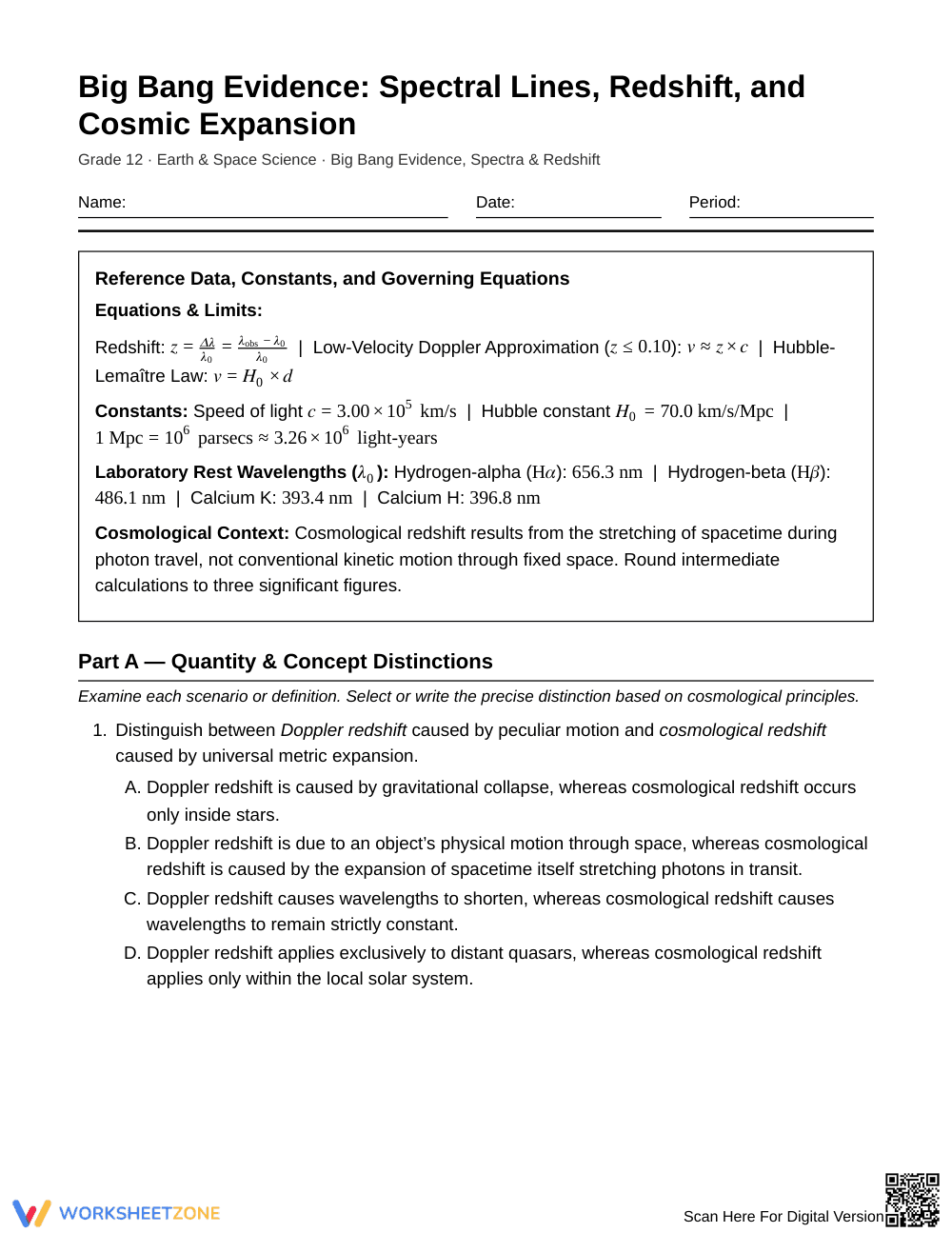
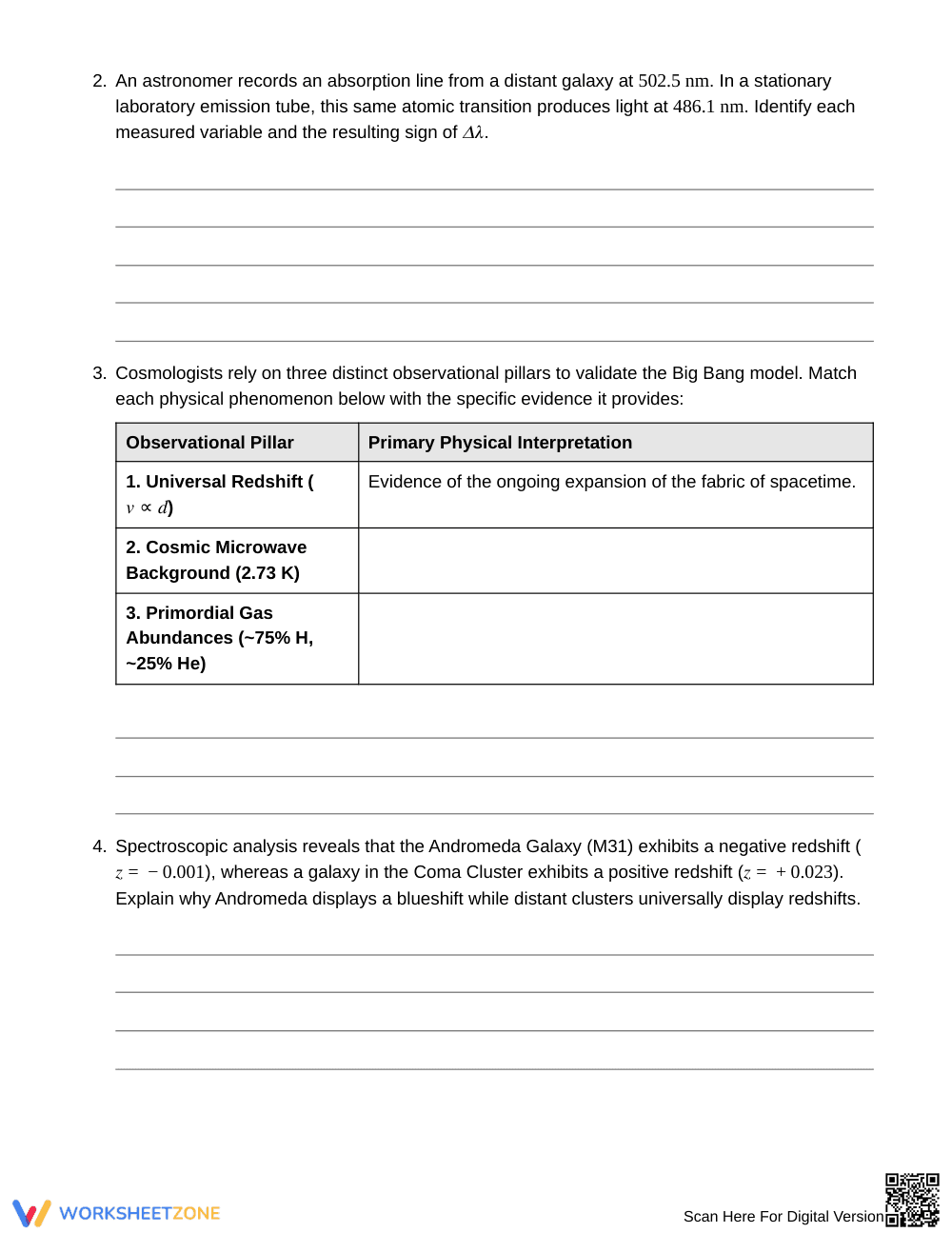
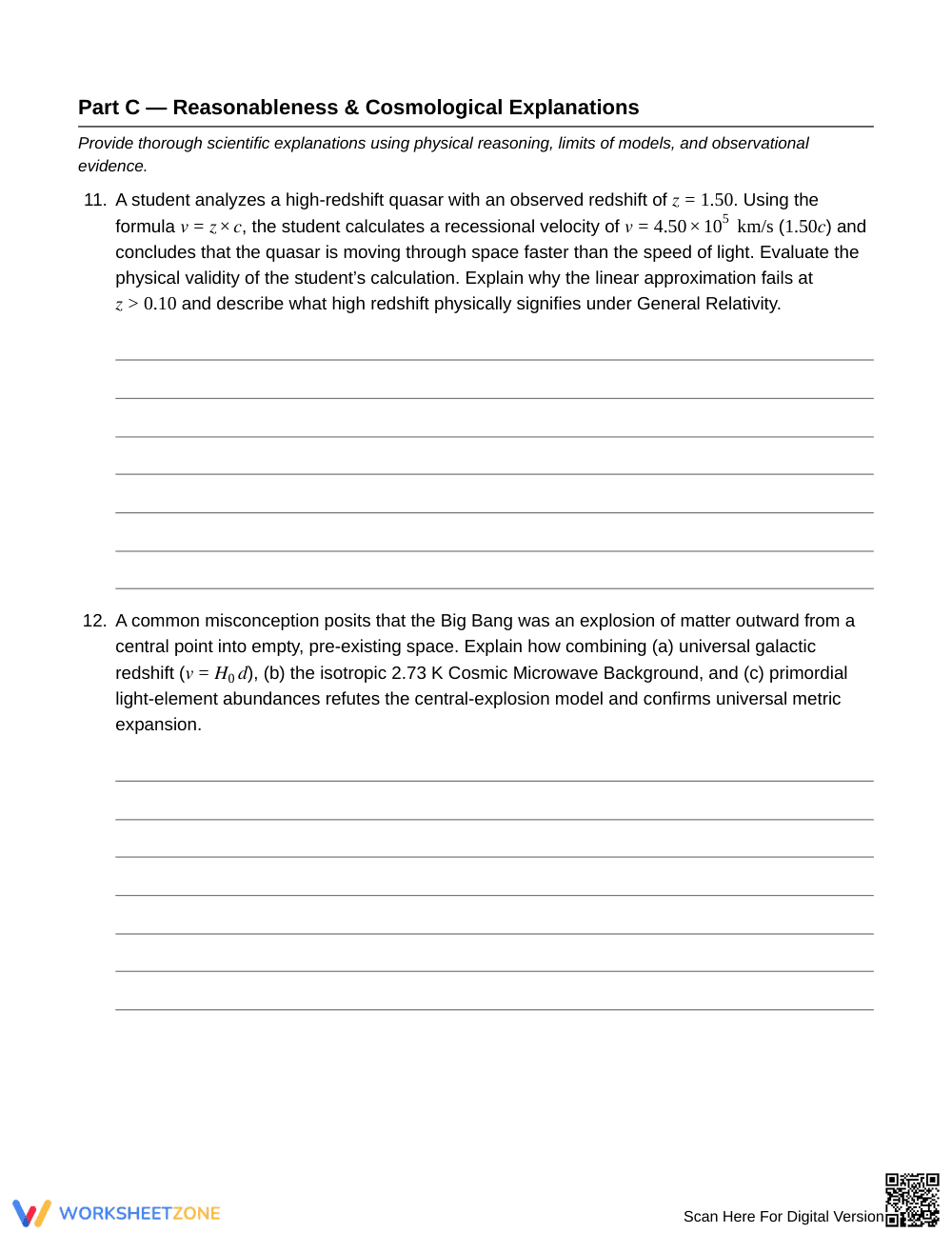
This Grade 12 Earth and Space Science worksheet builds advanced competency in calculating cosmological redshift, recessional velocities, and cosmic expansion. Students analyze laboratory rest wavelengths alongside synthetic astronomical spectra to evaluate Hubble-Lemaître law relationships, calculate galactic distances, and evaluate theoretical boundaries of low-velocity Doppler approximations across twelve analytical problems.
At a Glance
- Grade: 12 · Subject: Earth & Space Science
- Standard: Analyze spectroscopic data to evaluate recessional velocities and evidence for metric space expansion
- Skill Focus: Spectral Lines, Redshift, and Expansion
- Format: 5 pages · 12 problems · Answer key included · PDF
- Best For: Quantitative astrophysics and cosmology unit mastery
- Time: 45–60 minutes
The 5-page student activity provides 12 computational and conceptual tasks across three sections, supported by a reference header with constants, rest wavelengths, and governing equations. Students work with optical absorption spectra and standard-candle distance calibrations. A complete 3-page answer key provides step-by-step mathematical substitutions, unit tracking, and detailed explanations for qualitative items.
Skill Progression
- Guided practice: Tasks 1–4 establish conceptual distinctions between Doppler and cosmological redshift, guide variable identification, and match observational pillars to cosmological evidence.
- Supported practice: Tasks 5–10 guide multi-step calculations linking spectral shifts to recessional velocity and Hubble-Lemaître distances using calibration benchmarks.
- Independent practice: Tasks 11–12 require unassisted synthesis to critique linear model breakdowns at relativistic speeds and refute central-explosion misconceptions.
This structured progression follows the gradual-release model (I Do, We Do, You Do) to transition students from foundational definitions to complex astrophysical modeling.
Standards Alignment
This resource aligns with high school Earth and Space Science performance expectations addressing the origin and evolution of the universe. Students construct explanations of the Big Bang model based on light spectra and galactic motion. This alignment can be copied directly into lesson plans, IEP goals, or district curriculum mapping tools.
How to Use It
Deploy this resource during the core analytical phase of a cosmology unit or as a summative review following lectures on universal expansion. When facilitating guided practice, observe whether students confuse Doppler motion with metric expansion in Part A before solving Part B. Expected completion time is 45 to 60 minutes in a standard block period.
Who It's For
Designed for Grade 12 Earth and Space Science or Astronomy students mastering quantitative cosmology. Teachers can differentiate by providing pre-calculated velocity steps for learners needing math support or assigning Part C as an honors extension. Pair this printable with an optical galaxy spectra laboratory or cosmic microwave background simulation.
According to Fisher & Frey (2014), purposeful instructional design relies on guided cognitive transitions that anchor conceptual foundations before demanding quantitative execution. This Grade 12 Earth and Space Science worksheet exemplifies this pedagogical architecture by structuring practice around calculating cosmological redshift, determining recessional velocities, and interpreting spectroscopic evidence for cosmic metric expansion. By moving systematically from qualitative spectral line identification to multi-step Hubble-Lemaître law applications, the resource ensures students master mathematical modeling prior to evaluating theoretical boundaries. Students examine observational benchmarks, calculate galactic distances, and critique relativistic velocity approximations using explicit scaffolding. Research confirms that structured problem progression paired with comprehensive answer keys improves secondary physics comprehension and self-regulated error analysis. Consequently, this classroom-tested resource equips twelfth-grade science educators with an empirically validated tool for advancing astronomical literacy and rigorous evidence-based reasoning.


