




























Essential Reconciling Sources Worksheet | Grade 7 ELA
Paste this activity's link or code into your existing LMS (Google Classroom, Canvas, Teams, Schoology, Moodle, etc.).
Students can open and work on the activity right away, with no student login required.
You'll still be able to track student progress and results from your teacher account.
This Grade 7 informational text worksheet equips middle school readers to analyze two conflicting non-fiction viewpoints without oversimplifying the facts. By comparing paired perspectives on a municipal bike lane project, students learn to identify agreed baseline evidence, detect selective emphasis, and synthesize balanced arguments across 8 targeted analytical tasks.
At a Glance
- Grade: 7 · Subject: ELA
- Standard:
RI.7.9— Compare and contrast how different authors shape presentations of key information- Skill Focus: Reconciling conflicting non-fiction accounts
- Format: 5 pages · 8 problems · Answer key included · PDF
- Best For: Informational paired text analysis practice
- Time: 40–50 minutes
What's Inside
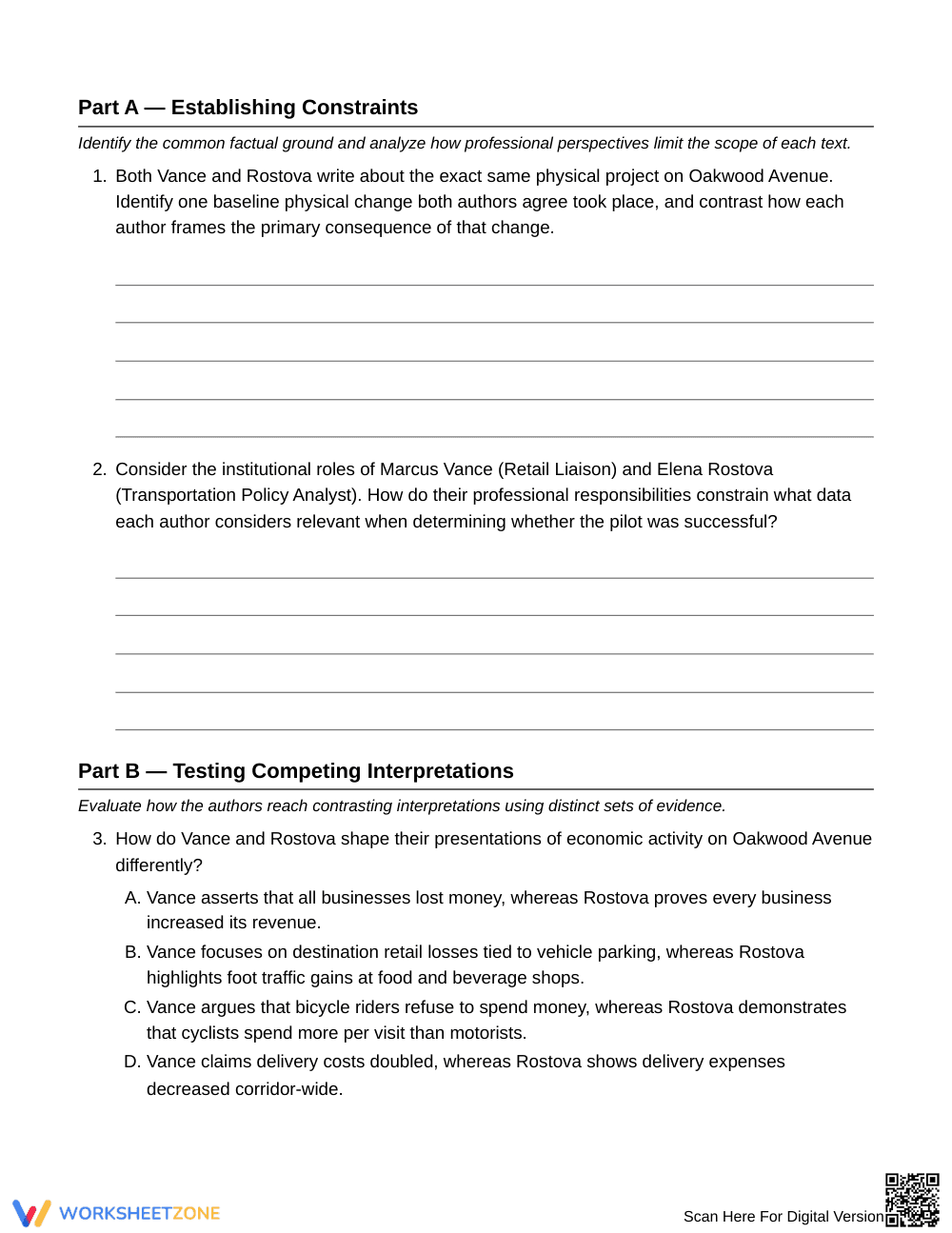
The 5-page printable resource pairs two contrasting stakeholder accounts regarding a shared municipal pilot trial. Across 8 rigorous tasks, students engage with conceptual strategy boxes, multiple-choice items testing evidence interpretation, and short-answer prompts that require textual synthesis. A detailed 3-page answer key provides complete model responses and evaluation criteria.
Skill Progression
- Guided Practice (Tasks 1–2): Students examine explicit institutional roles to define baseline factual agreements and analyze professional perspective constraints.
- Supported Practice (Tasks 3–6): Learners complete four multiple-choice and short-response problems to test how conflicting authors interpret identical metrics differently.
- Independent Practice (Tasks 7–8): Students synthesize findings independently by identifying analytical blind spots and drafting a qualified 3–5 sentence conclusion.
This structure mirrors the gradual release of responsibility model, guiding learners from structural text analysis to independent, nuanced synthesis.
Standards Alignment
This worksheet is aligned to primary standard `RI.7.9`: Compare and contrast how two or more authors write about the same topic by analyzing the several points of view they emphasize or how their presentations shape distinct interpretations. It also supports `RI.7.1` through citation-based analytical writing. Both standard codes can be copied directly into lesson plans, IEP goals, or district curriculum mapping tools.
How to Use It
Use this resource after direct instruction on author bias and perspective in informational texts. During independent work or partner analysis, observe whether students identify underlying numerical agreements before critiquing an author's stance. The full sequence takes 40 to 50 minutes, serving effectively as a mid-unit benchmark or high-rigor paired passage practice.
Who It's For
This resource is designed for seventh-grade English language arts students developing critical literacy and non-fiction comparison skills. It offers structured support for general education learners and targeted practice for advanced readers. Pair this activity with a mini-lesson on rhetorical point of view or a structured classroom debate.
Informational text standards require middle school readers to evaluate complex non-fiction accounts without defaulting to binary true-or-false judgments. Aligned with standard RI.7.9, this worksheet trains seventh-grade students to compare and contrast how different authors shape presentations of key information through selective emphasis and interpretive framing. According to research from Fisher & Frey (2014) on close reading and text-dependent questions, structured progressions that move from identifying shared baseline facts to resolving conflicting claims significantly improve students' ability to synthesize complex arguments. By analyzing dual perspectives on a single municipal initiative across 8 rigorous tasks, learners develop the higher-order critical thinking necessary to evaluate competing claims, inspect authorial perspective constraints, and construct qualified evidentiary conclusions. This instructional design ensures students retain essential analytical rigor when engaging with real-world informational texts across diverse disciplines.


