































Essential Premature Disclosure Worksheet | Grade 7 ELA

Paste this activity's link or code into your existing LMS (Google Classroom, Canvas, Teams, Schoology, Moodle, etc.).
Students can open and work on the activity right away, with no student login required.
You'll still be able to track student progress and results from your teacher account.
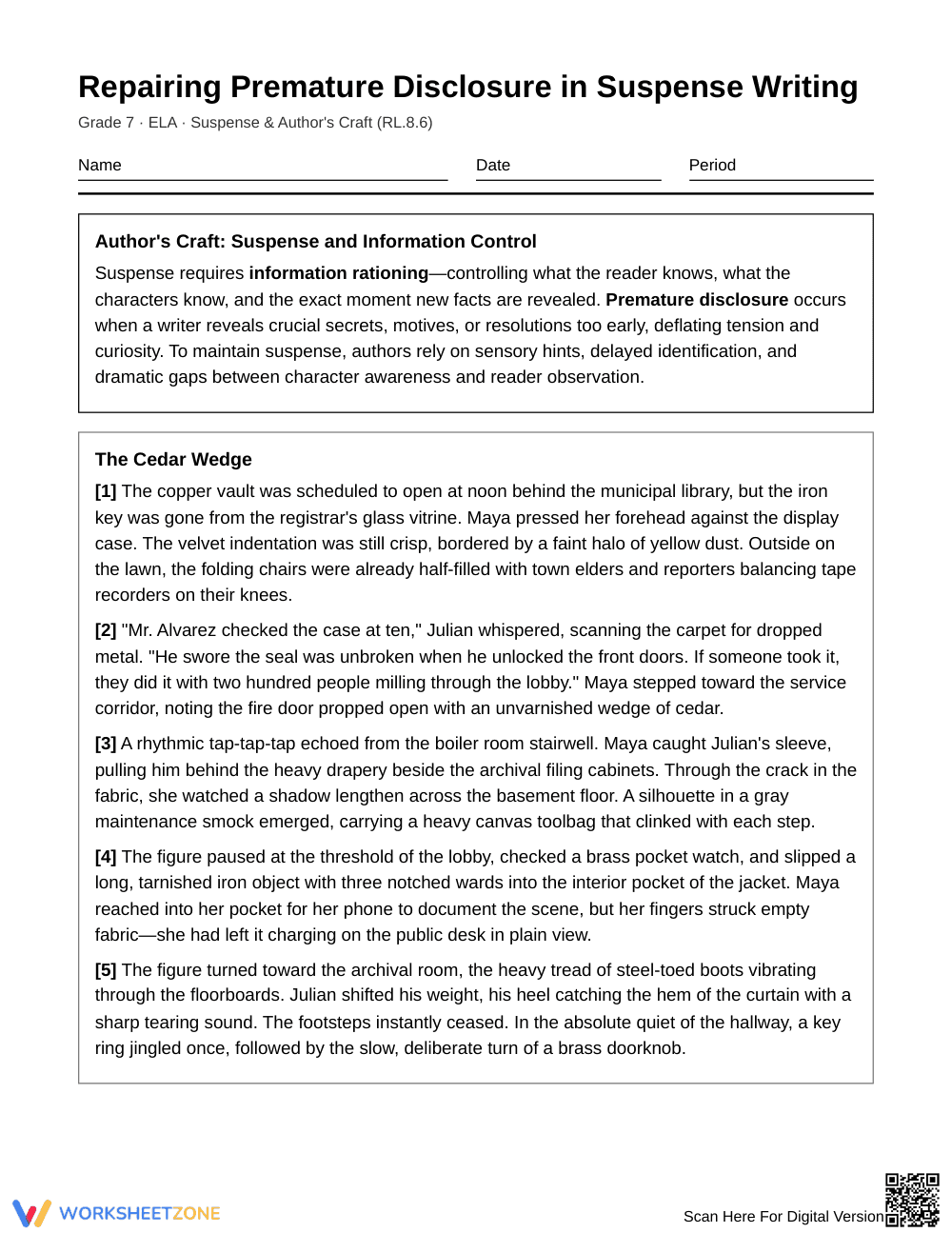
This printable Grade 7 suspense writing worksheet guides middle school students to identify and repair premature disclosure in narrative pacing. By analyzing information rationing in a short mystery excerpt, learners evaluate how withholding explicit facts preserves dramatic tension, transforming weak expository drafts into engaging, high-stakes narrative scenes.
At a Glance
- Grade: 7 · Subject: ELA
- Standard:
RL.8.6— Analyze how differences in character and reader awareness create suspense.- Skill Focus: Repairing Premature Disclosure in Suspense Writing
- Format: 5 pages · 10 problems · Answer key included · PDF
- Best For: Narrative writing revision and reading analysis
- Time: 40–50 minutes
What's Inside
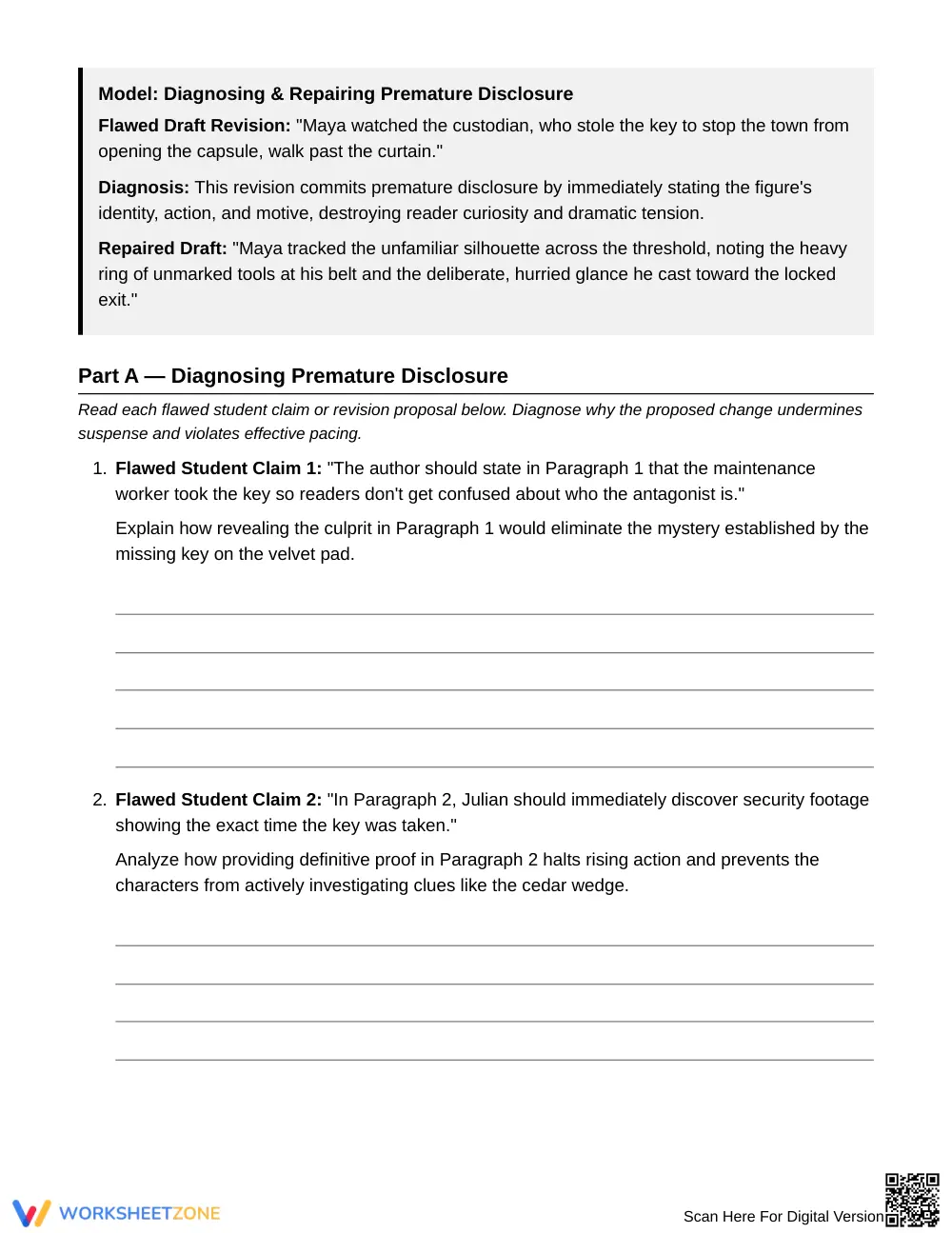
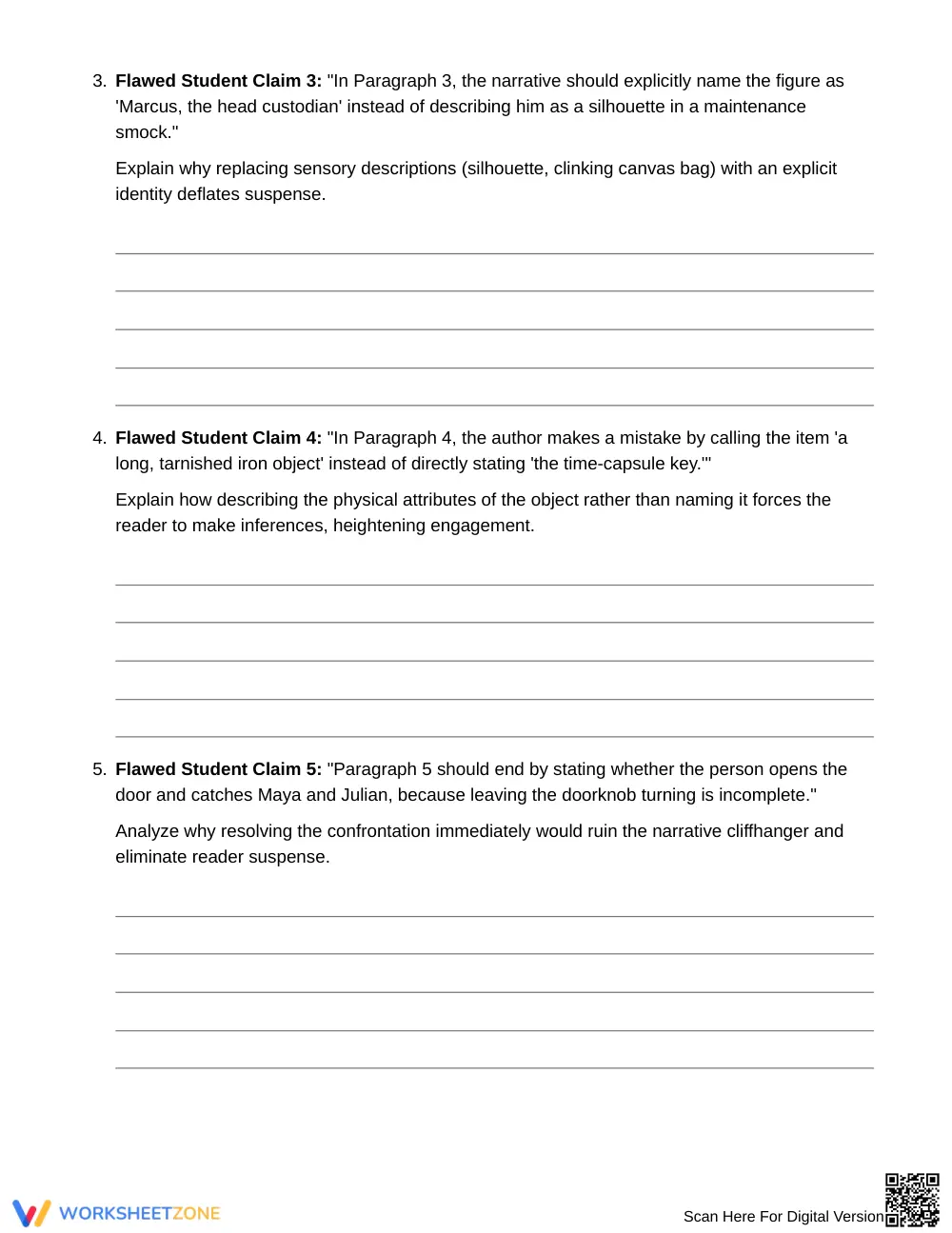
This 5-page instructional resource features a complete original narrative excerpt, "The Cedar Wedge," followed by a modeled diagnosis and 10 targeted analysis and revision exercises. Students analyze flawed student claims to diagnose pacing errors before applying evidence-based writing techniques to rewrite scene elements, enhance sensory pacing, and synthesize information control strategies. A comprehensive 2-page answer key provides sample rewritten passages and complete diagnostic explanations.
Skill Progression
- Guided Practice (Tasks 1–3): Students examine flawed revision proposals, identifying how revealing key details prematurely collapses dramatic tension and character investigation.
- Supported Practice (Tasks 4–7): Learners evaluate subtle narrative choices, rewriting opening lines and character internal monologues using physical clues and sensory pacing.
- Independent Practice (Tasks 8–10): Students craft original controlled-clue descriptions and synthesize how dramatic gaps between reader and character knowledge produce sustained suspense.
This sequence follows the gradual release of responsibility model, moving students from critical evaluation to independent narrative craft.
Standards Alignment
This worksheet directly supports RL.8.6: Analyze how differences in the points of view of the characters and the audience or reader create effects such as suspense or humor. By practicing deliberate information control, students master the precise mechanics authors use to shape reader perspective. Both standard codes can be copied directly into lesson plans, IEP goals, or district curriculum mapping tools.
How to Use It
Use this resource during a narrative writing unit directly following mini-lessons on pacing and dramatic irony. Alternatively, assign it as a targeted peer-review station during creative writing workshops to help students audit their own drafts for spoilers. During independent work, monitor whether students can articulate why sensory clues build more tension than explicit character names. Students typically complete the 10 tasks in 40 to 50 minutes.
Who It's For
This activity is designed for Grade 7 ELA classrooms, advanced Grade 6 writers, and Grade 8 intervention groups mastering narrative point of view. It pairs naturally with anchor charts on suspense techniques or mentor text studies of classic mystery short stories.
According to Fisher & Frey (2014), structured analysis of non-examples followed by guided narrative revision significantly strengthens middle school students' grasp of sophisticated authorial techniques. Common Core standard RL.8.6 requires learners to analyze how differences in character and reader awareness generate narrative suspense. When seventh-grade students explicitly evaluate and diagnose premature disclosure—the pacing error of revealing crucial plot details, motives, or identities too early—they develop essential metacognitive awareness of information rationing. Practicing evidence-based corrections across 10 targeted tasks teaches students to replace expository spoilers with concrete sensory details, delayed character identification, and strategic cliffhangers. This targeted instructional sequence enables emerging writers to understand the deliberate craft decisions that sustain reader curiosity, transforming abstract pacing concepts into practical revision strategies they can independently apply across diverse narrative texts.


