




























Views
Downloads




Essential Plate Boundary Clues Worksheet | Grade 8 Science

Paste this activity's link or code into your existing LMS (Google Classroom, Canvas, Teams, Schoology, Moodle, etc.).
Students can open and work on the activity right away, with no student login required.
You'll still be able to track student progress and results from your teacher account.
This comprehensive science worksheet guides middle school geoscientists to infer tectonic plate boundary types by synthesizing multiple lines of empirical evidence. Students evaluate rock composition, crustal thickness, earthquake focal depths, surface landforms, and thermal data to accurately diagnose convergent, divergent, transform, and collision zones across complex geologic sectors.
At a Glance
- Grade: 8 · Subject: Earth & Space Science
- Standard: Plate Tectonics — Analyze geologic data to determine tectonic plate interactions and boundary types
- Skill Focus: Inferring plate boundaries using multi-clue evidence
- Format: 5 pages · 12 problems · Answer key included · PDF
- Best For: Rigorous mid-unit practice or assessment
- Time: 45–60 minutes
What's Inside
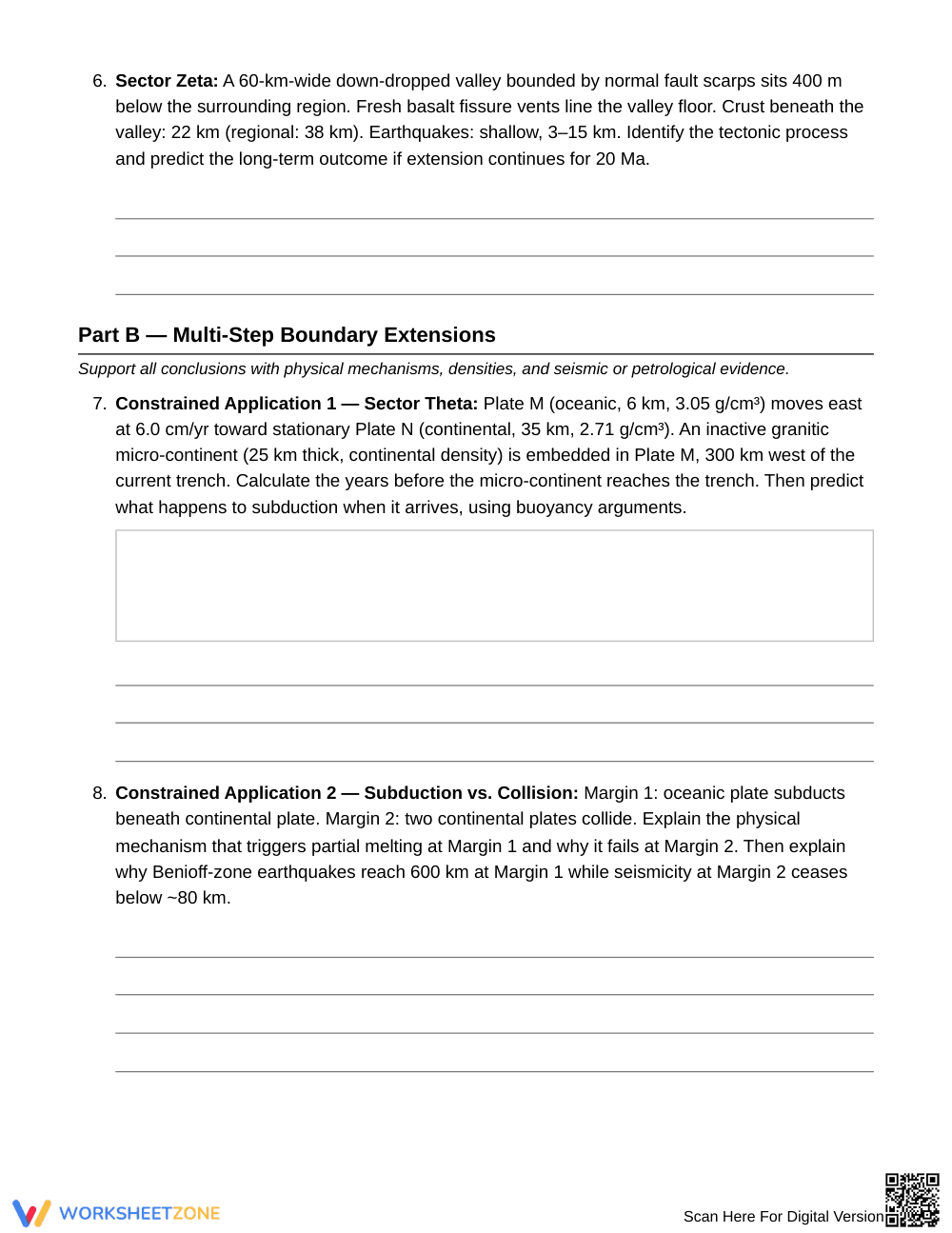
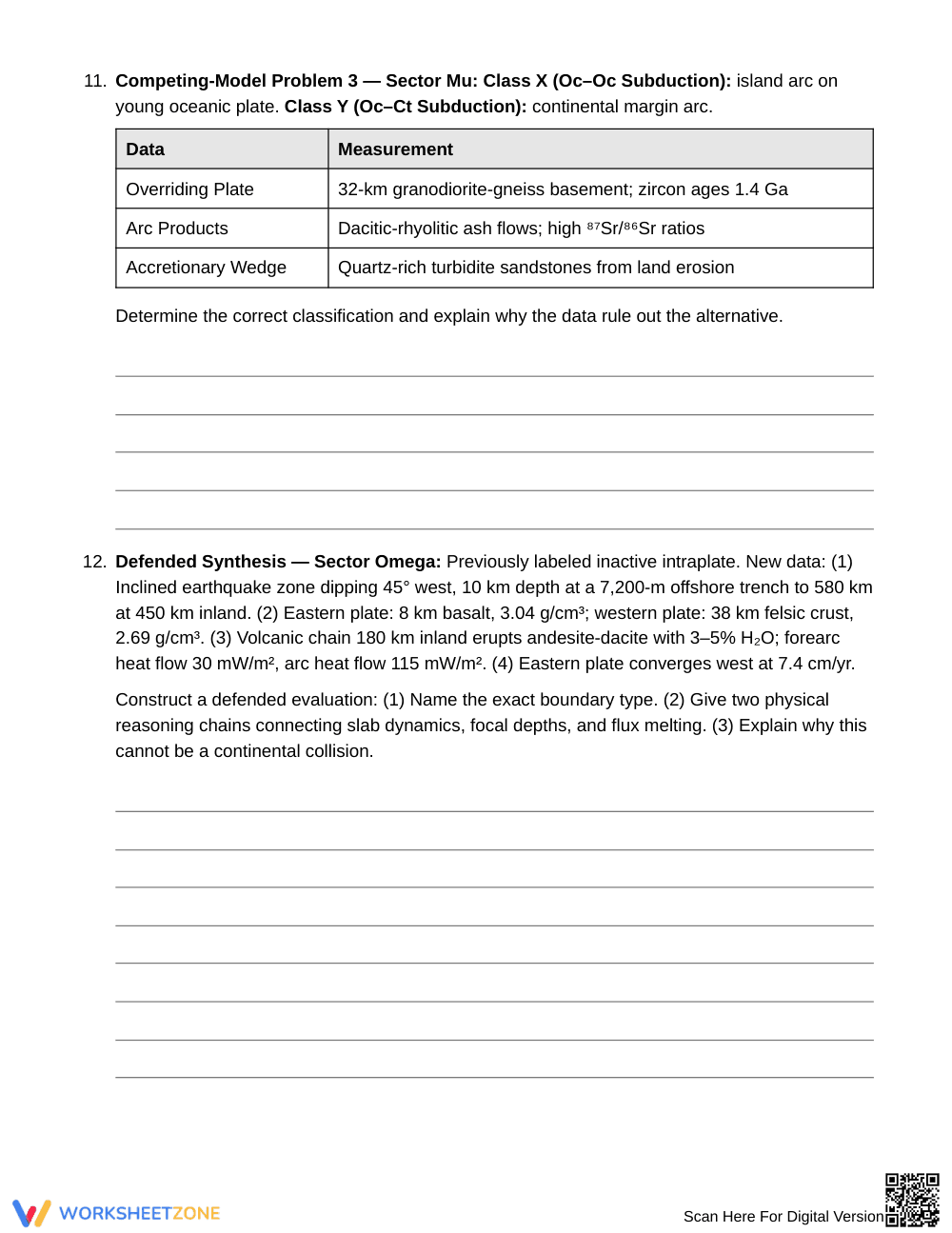
The 5-page student activity features a quick-reference key principles table outlining crust densities, seismic depths, and diagnostic landforms. It presents 12 in-depth analytical scenarios split into two rigorous sections: multi-clue boundary diagnosis and multi-step model evaluation. A 4-page detailed answer key provides full mathematical solutions, geological explanations, and mechanistic justifications.
Skill Progression
- Guided Practice (Part A, Items 1–3): Students analyze straightforward sector profiles containing clear crustal densities, bathymetric elevations, and focal depths to identify basic subduction, collision, and rift settings with explicit scaffolding.
- Supported Practice (Part A, Items 4–6): Scaffolds decrease as students calculate full spreading rates from paleomagnetic crust ages, evaluate strike-slip shear depths, and explain ocean-ocean subduction dynamics using density differentials.
- Independent Practice (Part B, Items 7–12): Students tackle competing geologic hypotheses, calculate micro-continent trench arrival timelines, and defend complete tectonic syntheses using petrological and thermal data.
This structured progression follows the gradual release of responsibility framework, moving learners smoothly from structured data interpretation to independent scientific argumentation.
Standards Alignment
This resource directly targets middle school Earth and space science standards requiring students to analyze geoscience data to construct evidence-based explanations for tectonic plate motions and surface features. Both standard targets and analytical skills can be copied directly into lesson plans, IEP goals, or district curriculum mapping tools.
How to Use It
Deploy this worksheet after direct instruction on plate boundary types and mantle convection. For formative assessment, observe whether students connect earthquake focal depth profiles to descending slabs during Part A before they attempt the competing-model evaluations in Part B. The complete 12-task packet typically requires 45 to 60 minutes of focused partner or individual work.
Who It's For
This resource serves general education Grade 8 science classes, advanced middle school earth science courses, and introductory high school geology. Differentiate by providing the key principles chart as a permanent desk reference for struggling learners, while challenging advanced students to complete Part B extensions without reference tables. It pairs naturally with tectonic map sets, seismic cross-section diagrams, and physical rock sample labs.
According to research highlighted in Fisher & Frey (2014), student mastery of complex scientific reasoning accelerates when structured evidence interpretation precedes open-ended model evaluation. This Grade 8 science resource operationalizes that finding by organizing 12 multi-dimensional plate tectonics tasks into an explicit diagnostic progression. Students integrate crustal density calculations, Benioff zone focal depths, petrological compositions, and volcanic heat flow measurements to evaluate competing geologic hypotheses. By requiring two independent lines of physical evidence for each claim, the resource transitions students from simple identification to rigorous Earth systems argumentation. The complete 5-page worksheet and 4-page answer key provide a standards-aligned, classroom-tested solution for building robust spatial and causal reasoning in middle school Earth and space science curricula.


