

































Essential Phenotype vs. Genotype Worksheet | Grade 9 Biology

Paste this activity's link or code into your existing LMS (Google Classroom, Canvas, Teams, Schoology, Moodle, etc.).
Students can open and work on the activity right away, with no student login required.
You'll still be able to track student progress and results from your teacher account.
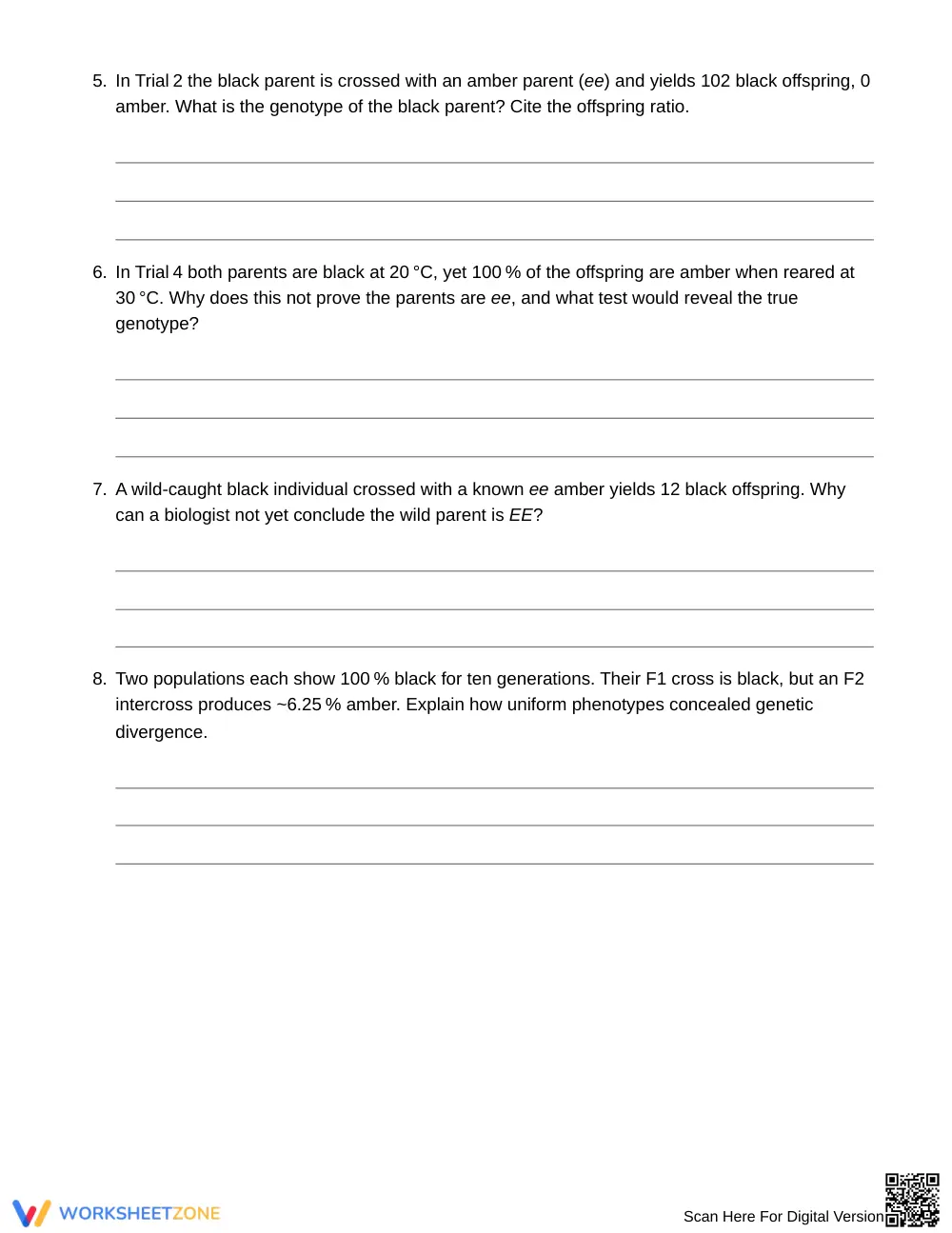
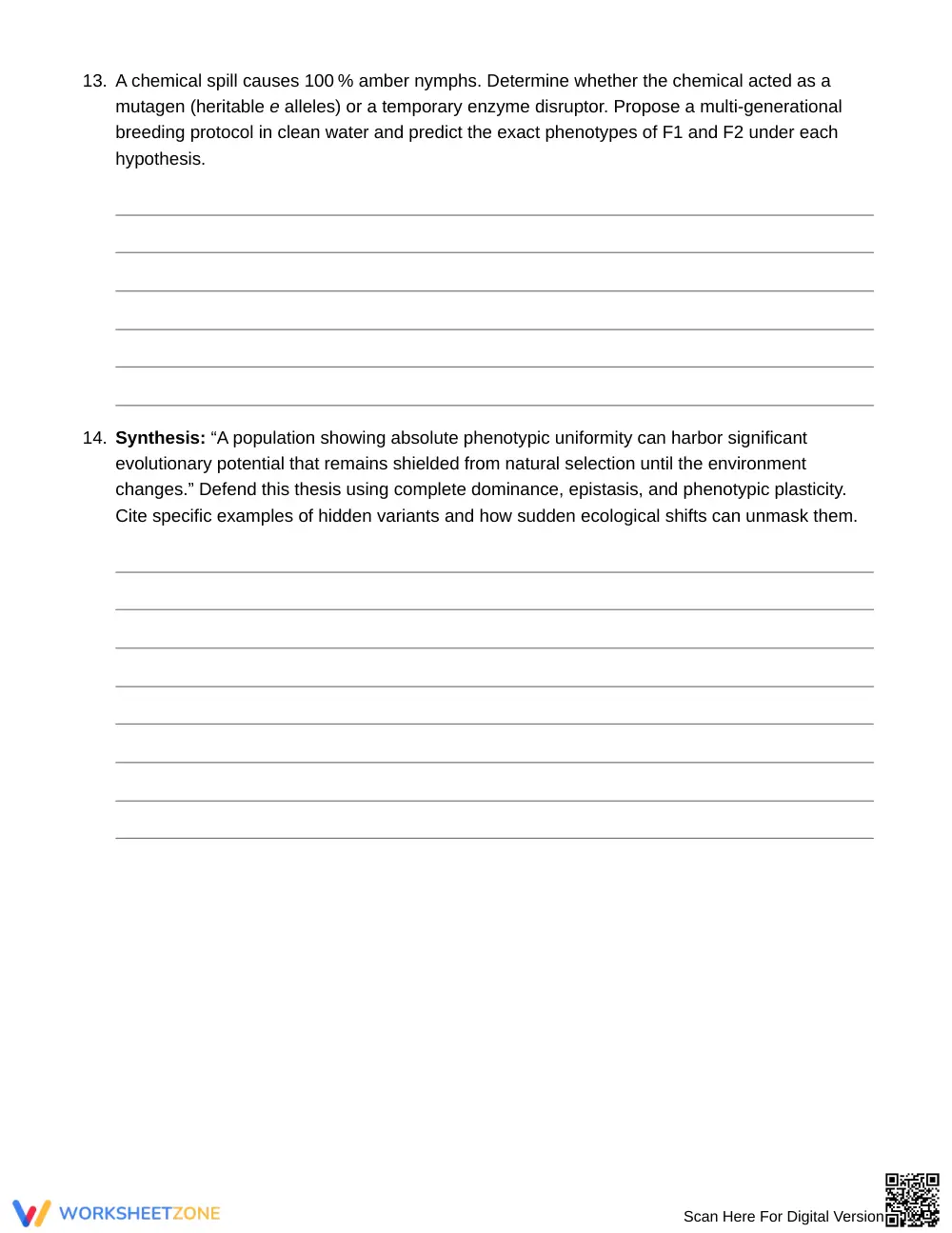
Students use this Grade 9 Biology worksheet to master why a visible phenotype does not always disclose the underlying genotype. By working through 14 data‑driven problems, they will articulate biochemical, epistatic, and environmental reasons for hidden genetic variation, preparing them for deeper genetics discussions.
At a Glance
- Grade: 9 · Subject: Biology
- Standard: — Students explain why phenotype alone may not reveal genotype (focus on dominance, epistasis, plasticity) or homework
- Skill Focus: Explain why phenotype alone may not reveal genotype
- Format: 5 pages · 14 problems · Answer key included · PDF
- Best For: Inquiry labs, genetics unit review, test prep
- Time: 30–45 minutes
The packet spans five double‑sided pages and contains fourteen mixed‑format tasks: short‑answer explanations, table‑based data interpretation, and multi‑step genotype calculations. A worked example opens Part A, followed by sentence‑frame prompts that guide students toward precise scientific language. A concise answer key occupies three pages, mirroring the worksheet layout for quick grading.
- Guided practice – 3 introductory problems paired with a worked example and sentence‑frame prompts.
- Supported practice – 5 intermediate items offering partial hints and a gene‑term word bank.
- Independent practice – 6 culminating challenges requiring full written explanations without scaffolds.
The sequence follows the classic I Do, We Do, You Do release.
This worksheet aligns with the Next Generation Science Standards for high‑school genetics (HS‑LS3‑1), which call for students to explain how genotype determines phenotype and why phenotypic expression can be masked by dominance, epistasis, or environmental factors. It also supports the Common Core State Standard for Science Practice of analyzing and interpreting data (CCSS‑ELA‑RST.9‑10.1). Both standard references can be copied directly into lesson plans, IEP goals, or district curriculum mapping tools.
Use the worksheet as a pre‑lab activity: students complete the first six questions before the hands‑on breeding simulation, allowing the teacher to gauge prior understanding and adjust instruction. Alternatively, employ it as a post‑assessment after a unit on Mendelian inheritance; collect responses, look for the formative cue of students correctly linking temperature‑induced phenocopies to enzyme denaturation, and record the results for a quick 30‑minute review.
Designed for ninth‑grade biology students who have completed basic Mendelian concepts, the worksheet challenges learners to integrate dominance, epistasis, and phenotypic plasticity. While the single version meets the needs of a mixed‑ability class, teachers can pair it with the classroom’s Amphipelta viridis simulation or an anchor chart of genetic pathways to reinforce visual learning.
Research shows that explicit instruction combined with scaffolded practice dramatically improves students’ ability to articulate complex genetic concepts (Fisher & Frey, 2014). This worksheet embodies that approach by first modeling genotype‑phenotype reasoning, then gradually releasing responsibility through guided, supported, and independent tasks. By confronting learners with real‑world scenarios—temperature‑dependent phenocopies, epistatic suppression, and hidden recessive alleles—students experience the depth of analysis required by NGSS HS‑LS3‑1. The built‑in answer key enables rapid feedback, reinforcing the formative loop highlighted in the study. Fisher & Frey (2014) reported that students receiving scaffolding achieved a 22 % higher gain on genetics assessments than peers using unstructured worksheets. The inclusion of a worked example and sentence frames mirrors the study’s recommended “I Do, We Do, You Do” sequence, ensuring that learners build conceptual vocabulary before tackling independent analysis. This alignment with evidence‑based practice makes the worksheet a tool for accelerating genotype‑phenotype reasoning.


