































Essential Phase Change Word Search | Grades 6–7 Science

Paste this activity's link or code into your existing LMS (Google Classroom, Canvas, Teams, Schoology, Moodle, etc.).
Students can open and work on the activity right away, with no student login required.
You'll still be able to track student progress and results from your teacher account.
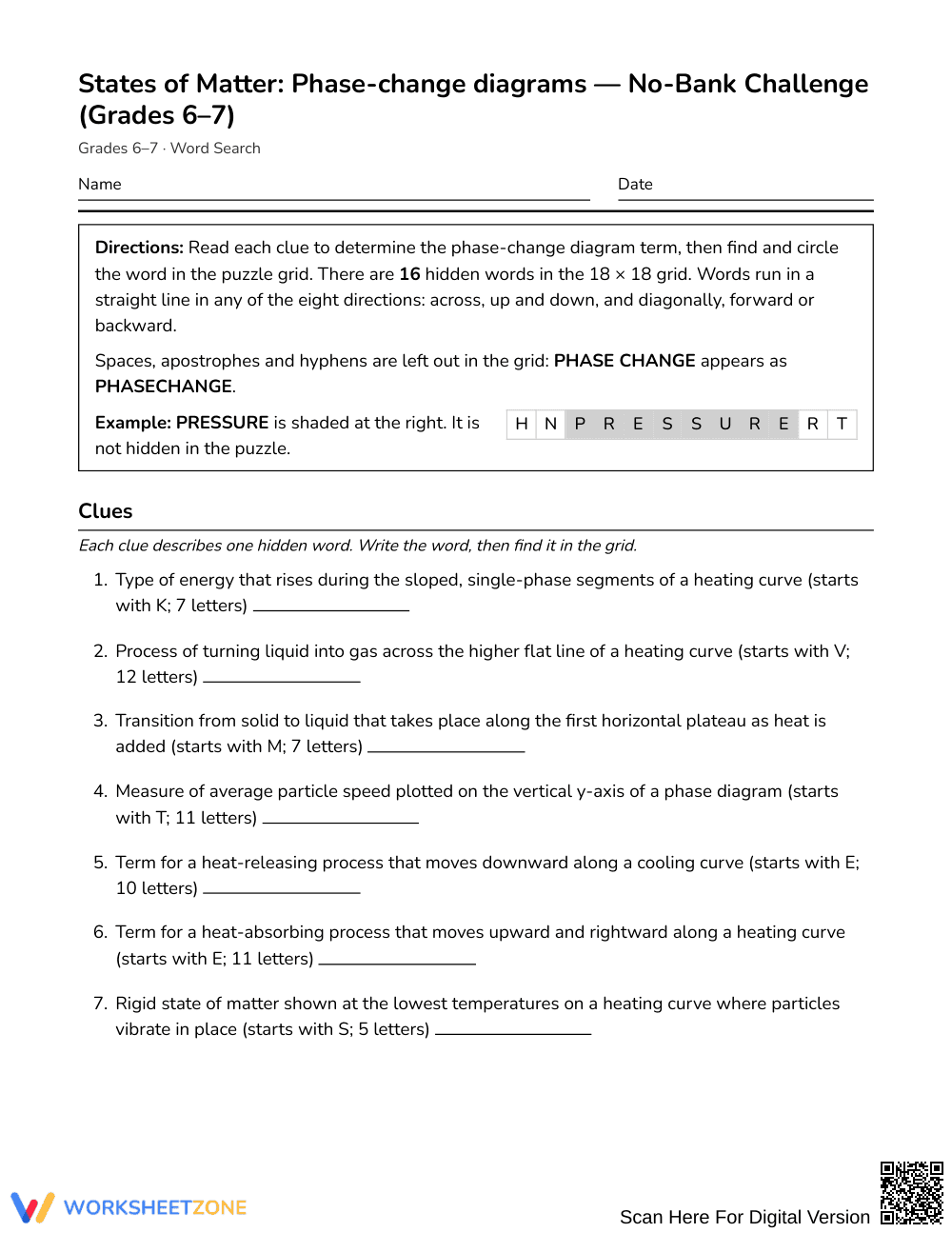
This physical science word search challenges students to reinforce critical phase-change diagram vocabulary through active clue retrieval. Designed for middle school learners in Grades 6–7, the activity requires students to interpret descriptive science prompts about states of matter, plateaus, and thermal energy transitions to identify 16 targeted terms hidden within a puzzle grid.
At a Glance
- Grade: Grades 6–7 · Subject: Physical Science
- Standard: Not standards-assessed — vocabulary enrichment for middle school physical science
- Skill Focus: Interpreting phase-change diagrams and thermal energy vocabulary
- Format: 3 pages · 16 words · Complete answer key included · PDF
- Best For: Vocabulary review, sub plans, and early finisher science practice
- Time: 25–35 minutes
What's Inside
The 3-page printable resource includes a student puzzle sheet, comprehensive clue list, and full answer keys. Rather than supplying a traditional word list, the activity tasks learners with determining each target word from scientific descriptions of heating and cooling curves before locating it in the puzzle. A detailed answer key highlights every term across the grid for rapid verification.
Puzzle Mechanics and Structure
This word search uses an 18 × 18 grid containing 16 phase-change terms placed in all eight possible directions: North, Northeast, East, Southeast, South, Southwest, West, and Northwest. Because there is no word bank provided, students must read and solve content-based clues—such as defining horizontal plateaus, kinetic energy changes, or specific phase transitions like sublimation and deposition—before searching the grid.
Standards Alignment
This activity serves strictly as vocabulary enrichment and is not aligned to a specific standard. It reinforces essential conceptual language related to heating curves, kinetic and potential energy, and phase transitions, providing targeted terminology practice that supports broader physical science units on matter and thermal energy.
How to Use It
Deploy this puzzle immediately following direct instruction on heating and cooling curves, or assign it as an independent review station during unit test preparation. While students work, observe whether they can identify phase terms from the clues alone or if they need to reference their science notebooks, offering an informal check of vocabulary retention. Students typically finish within 25 to 35 minutes.
Who It's For
This resource is tailored for Grades 6–7 science students exploring matter and energy. The no-bank clue structure provides purposeful cognitive engagement for learners ready to demonstrate conceptual recall without visual prompts. For optimal results, pair this puzzle with a labeled heating curve anchor chart or an introductory lesson on phase change diagrams.
Vocabulary acquisition in secondary science requires deliberate opportunities for students to retrieve domain-specific terminology from memory rather than passively copying definitions. According to Fisher & Frey (2014), intentional word exposure embedded within problem-solving contexts strengthens cognitive retention and accelerates academic literacy across technical subjects. Although this puzzle is not assessed under a single standard code, mastering phase-change diagram concepts demands precise understanding of thermodynamic terms such as sublimation, vaporization, and plateau. Solving clue-based puzzles without a pre-printed word bank forces students to generate correct scientific terms directly from descriptive prompts, transforming a traditional word search into an active retrieval task. When middle school students actively connect definitions of kinetic and potential energy shifts to graphical transitions, they establish a robust conceptual framework that directly supports advanced physical science comprehension in subsequent grade levels.


