


























Views
Downloads


Essential Paragraph Functions Worksheet | Grade 8 ELA
Paste this activity's link or code into your existing LMS (Google Classroom, Canvas, Teams, Schoology, Moodle, etc.).
Students can open and work on the activity right away, with no student login required.
You'll still be able to track student progress and results from your teacher account.
This targeted Grade 8 ELA worksheet guides students to analyze how individual paragraphs contribute to an author's central claim in argumentative texts. Students move from core structural terminology to text-based multiple-choice evaluation and multi-sentence written analysis, building mastery of complex informational text organization.
At a Glance
- Grade: 8 · Subject: ELA
- Standard:
RI.8.5— Analyze the role of specific paragraphs in developing and refining a key concept- Skill Focus: Paragraph Functions Within an Argument
- Format: 5 pages · 10 problems · Answer key included · PDF
- Best For: Informational text unit core practice
- Time: 40–50 minutes
What's Inside
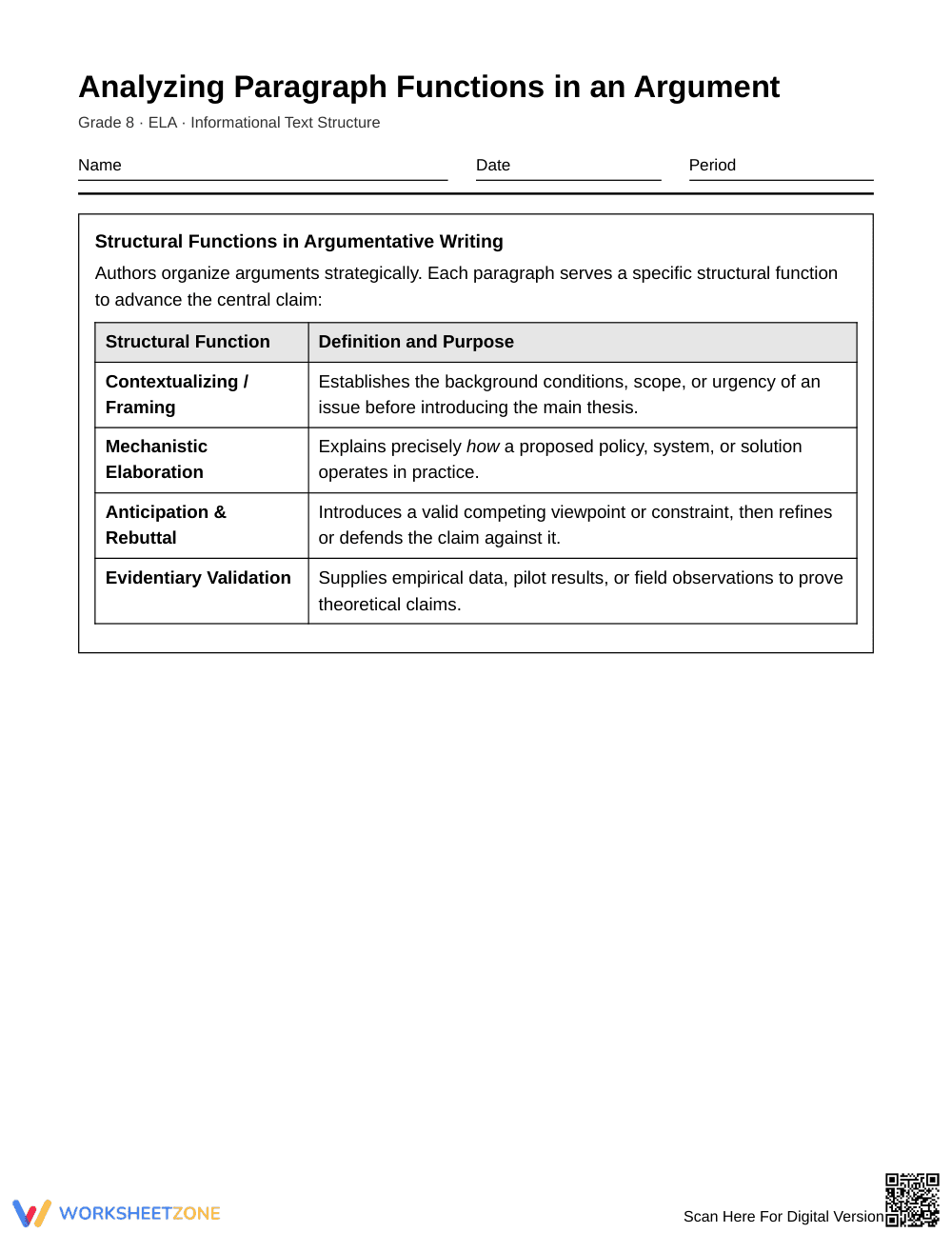
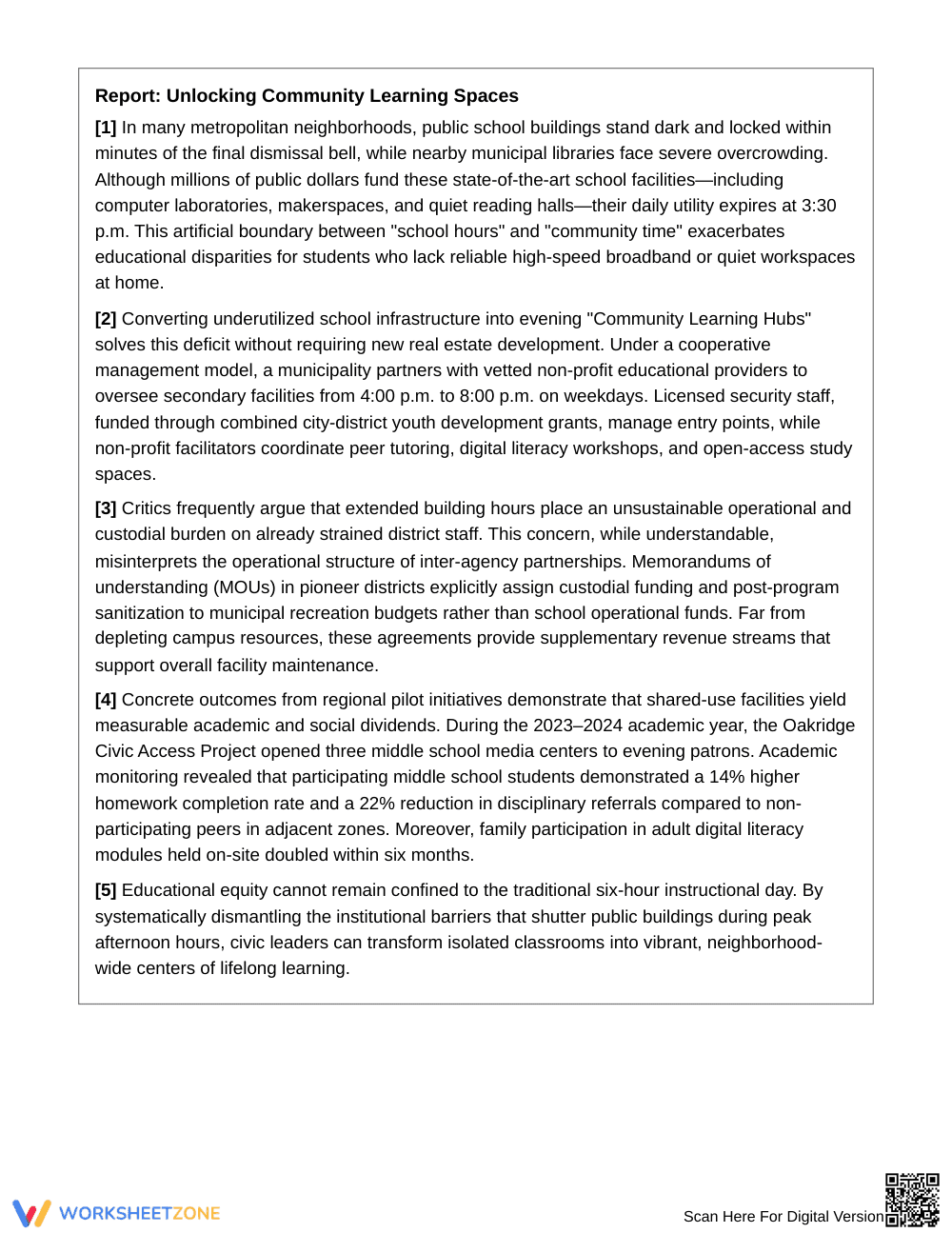
The 5-page student resource includes an informational reference table defining structural roles (contextual framing, mechanistic elaboration, anticipation and rebuttal, and evidentiary validation), an authentic five-paragraph argumentative report on community learning spaces, 10 rigorous analytical tasks across three distinct parts, and a comprehensive 2-page answer key with model written explanations.
Skill Progression
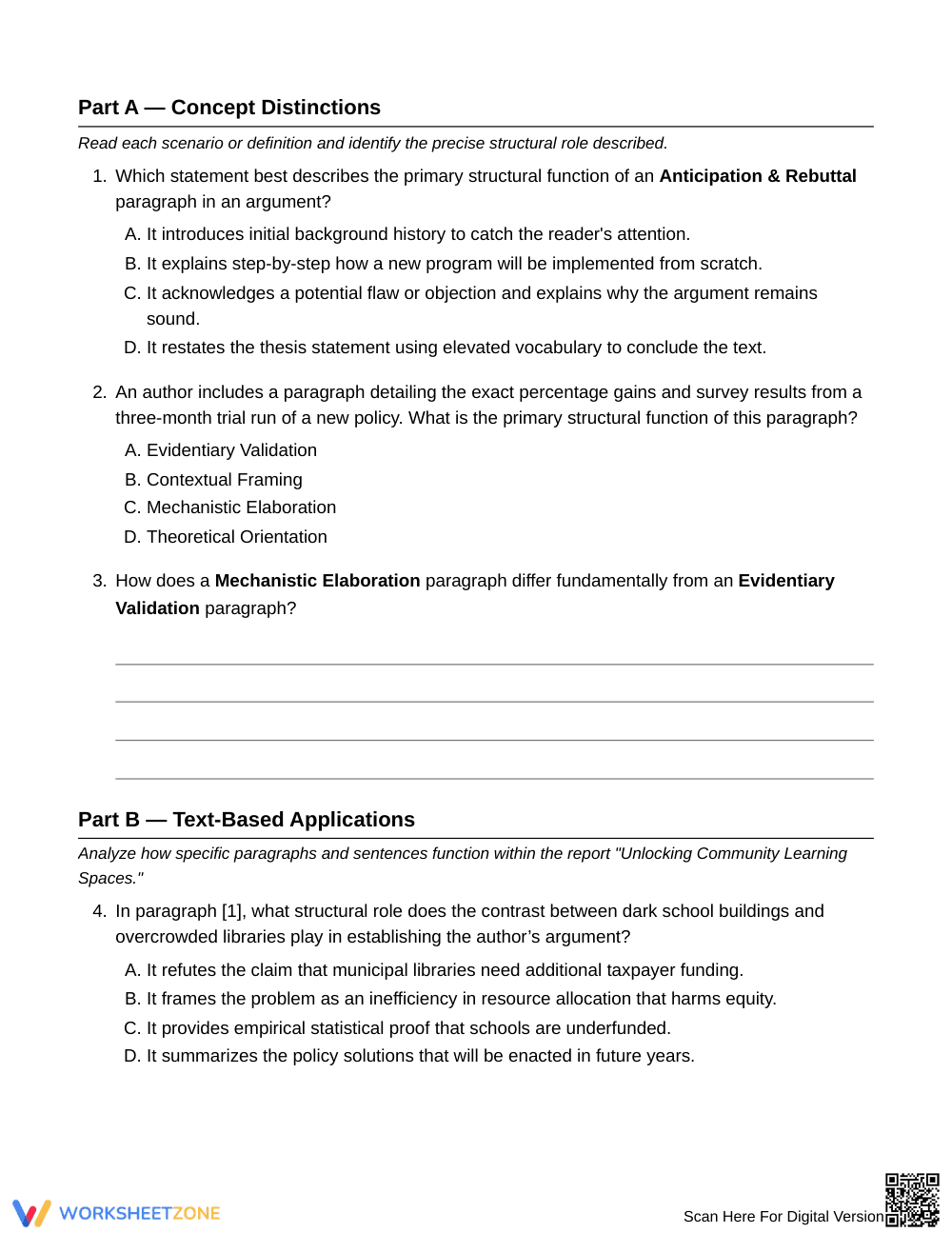
- Guided Practice (Part A, 3 items): Students review structural definitions and distinguish conceptual roles, identifying the precise function of rebuttal and empirical evidence without passage interference.
- Supported Practice (Part B, 5 items): Students apply functional analysis directly to the included argumentative report, evaluating paragraph roles, transition sentences, and structural connections between theoretical models and field data.
- Independent Practice (Part C, 2 items): Students write extended, evidence-based justifications evaluating counterarguments and tracing the logical problem-to-proof progression across multiple paragraphs.
This structured progression follows a gradual-release model, providing the scaffolding necessary for students to transition from conceptual understanding to complex written textual analysis.
Standards Alignment
This worksheet directly aligns with `RI.8.5`: Analyze in detail the structure of a specific paragraph in a text, including the role of particular sentences in developing and refining a key concept. It also reinforces `RI.8.8` by assessing how authors delineate arguments and address counterclaims. Both standard codes can be copied directly into lesson plans, IEP goals, or district curriculum mapping tools.
How to Use It
Implement this resource directly after introducing argument structure in whole-group instruction. For formative assessment, examine student responses to Part B item 6 (evaluating how transition sentences pivot into counterarguments) to determine whether learners understand functional progression before assigning the extended written responses in Part C. The complete lesson activity takes approximately 40 to 50 minutes of instructional time.
Who It's For
Designed for Grade 8 general education English language arts classrooms, this resource also supports Grade 9 intervention groups and advanced Grade 7 readers. Pair this printable with a mentor-text argument chart or an explicit mini-lesson on counterclaims and structural transitions.
According to research by Fisher & Frey (2014) on close reading and text-dependent questioning, explicit instruction in paragraph-level organizational architecture substantially improves adolescent reading comprehension across complex informational texts. Standard RI.8.5 asks eighth-grade students to isolate the precise function of text sections, moving beyond simple topical summaries to analyze structural design, including how authors introduce contextual urgency, construct mechanistic explanations, acknowledge counterarguments, and provide empirical validation. This structured 10-item worksheet provides the scaffolded analysis and evidence-based writing practice required for students to achieve measurable mastery in evaluating sophisticated argumentative rhetoric.


